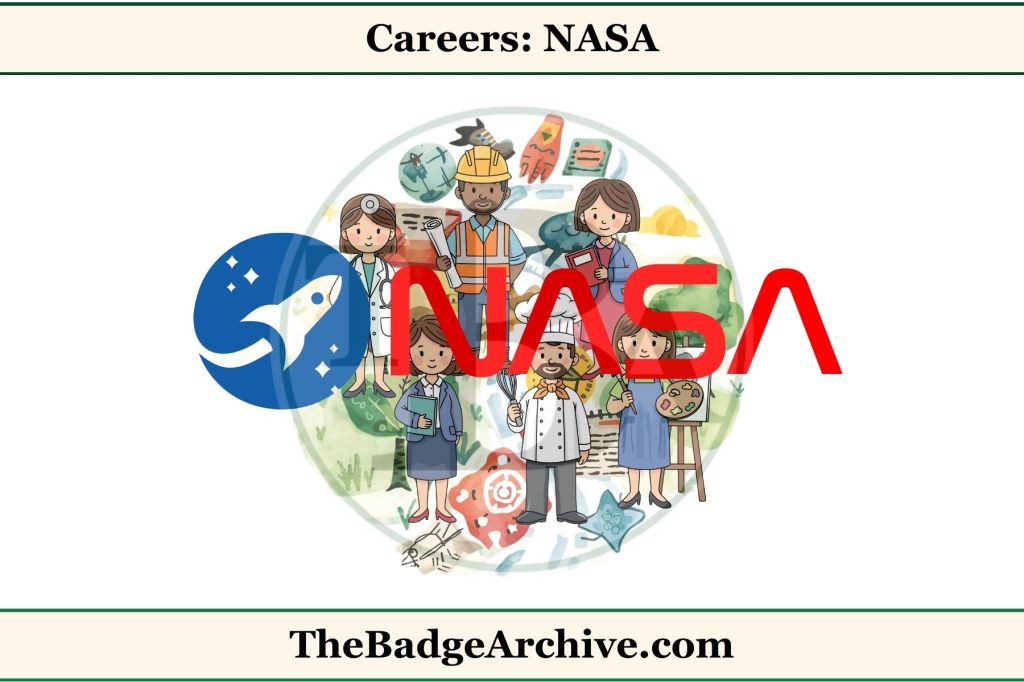
When we look at a rocket launch, we often see a singular moment of triumph. But behind that countdown is a “team of teams”. There are thousands of experts across medicine, law, engineering, and the arts, all working in perfect synchronization.
“Be Prepared” isn’t just a motto for space exploration. It is a fundamental requirement. NASA hires experts who have mastered a specific discipline on Earth (be it coding, geology, or structural design) and then challenges them to apply that mastery to the stars. The following lists represent the high-level professional paths that make the impossible, possible.
For Elementary Scouts (Grades K-5)
- Astronaut (Mission Specialist): These are elite scientists, engineers, or medical doctors who are selected to conduct complex research in microgravity. They must master the systems of the spacecraft while simultaneously performing high-stakes experiments that can’t be done on Earth.
- Training: 10+ years (Advanced STEM degree + years of professional mastery + 2 years of basic astronaut candidate training).
- Aerospace Engineer: The architects of flight who develop the structural design and propulsion systems for spacecraft. They use advanced math to ensure a vehicle can survive the massive pressure of launch and the vacuum of space.
- Training: 4–6 years (Bachelor’s in Engineering; often a Master’s for specialized design roles).
- Planetary Geologist: These scientists analyze the “makeup” of other worlds. They study rocks and soil samples to piece together the history of the solar system and identify where water (and potentially life) once existed.
- Training: 8–10 years (Requires a PhD to lead planetary research missions).
- Robotics Engineer: They design the complex “limbs” and “eyes” of rovers and space station arms. This involves mechanical building, electrical wiring, and programming the AI that allows a robot to think for itself.
- Training: 4–6 years (Bachelor’s in Robotics or Mechatronics).
- Flight Surgeon: Highly specialized medical doctors responsible for the total health of the crew. They monitor bone density loss, radiation exposure, and psychological well-being from the ground and during missions.
- Training: 12+ years (Medical Doctorate + Residency + Aerospace Medicine Fellowship).
- Propulsion Lead: The experts who focus entirely on the engines. They manage the volatile chemicals and physics required to generate enough thrust to break Earth’s gravity.
- Training: 6–8 years (Advanced degree in Mechanical or Chemical Engineering).
- Space Suit (EMU) Engineer: They build “Extravehicular Mobility Units.” This is a multi-layered pressure vessel that provides oxygen, temperature control, and micrometeoroid protection.
- Training: 4–6 years (Degree in Materials Science or Mechanical Engineering).
- Meteorologist (Space Weather): They monitor solar flares and radiation storms coming from the sun. Their predictions are vital to ensure astronauts aren’t outside the station during dangerous “space weather” events.
- Training: 4–6 years (Degree in Atmospheric Science or Physics).
- Software Developer: They write the mission-critical code that runs a spacecraft’s navigation and life-support systems. If their code has a “bug,” it can put the entire mission at risk.
- Training: 4 years (Bachelor’s in Computer Science).
- Microbiology Researcher: They study how tiny organisms like bacteria or fungi grow in space. This is crucial for keeping the space station clean and understanding how human health changes in orbit.
- Training: 8–10 years (PhD in Microbiology or related field).
- Habitation Architect: These designers create the pressurized modules where people live. They have to maximize tiny spaces for living, working, and exercising while keeping the air breathable and safe.
- Training: 5–7 years (Architecture degree + focus on industrial design).
- Avionics Technician: They are the experts in the electronic “nervous system” of a rocket, installing and testing the thousands of wires and sensors that tell the computer what the engines are doing.
- Training: 2–4 years (Technical certification or Associate’s degree in Electronics).
For Teen Scouts (Grades 6-12)
- Data Scientist (AI & Machine Learning): They build algorithms to sift through terabytes of data from deep-space probes. They teach computers how to recognize a new galaxy or a distant exoplanet without a human looking at every photo.
- Training: 4–7 years (Bachelor’s + Master’s in Data Science or Statistics).
- Aerospace Physiologist: A specialist who researches the physiological “cost” of spaceflight. They develop the exercise equipment and nutritional plans needed to prevent a human body from wasting away in zero-g.
- Training: 6–9 years (Master’s or PhD in Kinesiology or Physiology).
- Astrobiologist: This is a cross-disciplinary field involving biology, chemistry, and physics. They study “extremophiles” on Earth to predict what kind of life might exist on moons like Europa or Enceladus.
- Training: 8–10 years (PhD is essential for research and university-level work).
- Cybersecurity Lead: They protect NASA’s command-and-control links. A hack on a satellite or rover could result in the loss of a multi-billion dollar asset, so they build the “walls” that keep missions secure.
- Training: 4–6 years (Degree in Cybersecurity or Network Engineering).
- Strategic Communications Manager: More than just “social media,” they manage the global narrative of NASA, handling international press, government relations, and high-level educational outreach.
- Training: 4–6 years (Degree in Communications or Public Policy).
- Patent Attorney: NASA creates thousands of new technologies. These lawyers ensure that “Space Tech” is protected and can be licensed to private companies to help the economy.
- Training: 7 years (4 years undergraduate + 3 years Law School).
- Program Analyst (Budget & Strategy): They handle the complex financial modeling for projects that take decades to complete. They must account for inflation, risk, and shifting government priorities.
- Training: 4–6 years (Degree in Finance, Economics, or MBA).
- Systems Integration Engineer: They are responsible for making sure the thousands of components built by different companies (like Boeing, SpaceX, and Lockheed) actually work together when bolted on a rocket.
- Training: 6–8 years (Bachelor’s in Engineering + significant project management experience).
- Optical Engineer: They design the lenses and mirrors for telescopes like James Webb. These parts must be polished to the width of a human hair and survive the freezing cold of deep space.
- Training: 4–8 years (Degree in Physics or Optical Engineering).
- Human Factors Engineer: They study how humans interact with machines. They design the cockpit displays and controls to ensure that an exhausted astronaut can still make the right decision in an emergency.
- Training: 4–7 years (Degree in Psychology or Industrial Engineering).
- Orbital Mechanics Specialist: They use complex calculus to plot the “trajectories” of spacecraft. They calculate exactly when and where a rocket needs to fire its engines to “slingshot” around a planet.
- Training: 6–8 years (Master’s or PhD in Mathematics or Physics).
- Environmental Control & Life Support (ECLSS) Specialist: They manage the systems that recycle sweat into drinking water and CO2 into oxygen. On a long-duration mission to Mars, their work is the only thing keeping the crew alive.
- Training: 4–6 years (Degree in Chemical or Environmental Engineering).
What Scouts Can Do Now:
Target “Core” Merit Badges
Scouting America provides a direct bridge to these careers through the Merit Badge program. If a Scout is interested in the roles listed above, they should prioritize:
- Space Exploration: Covers the history, technology, and future of NASA missions.
- Robotics & Programming: Essential for anyone looking at Engineering or Data Science roles.
- Sustainability & Environmental Science: Perfect for Earth-monitoring or Habitation roles.
- Communications & Public Speaking: Vital for Mission Control and Public Affairs roles.
Earn the Space Science Badge
GSUSA has a Space Science Badge for every level.
- Daisy – Space Science Explorer – Sun, Moon, and Constellations
- Brownie – Space Science Adventurer – Planets, Sun, Moon, and Constellations
- Junior – Space Science Investigator – Planets and Constellations
- Cadette – Space Science Researcher – Invisible Vs. Visible Light
- Senior – Space Science Expert – Explore distance between stars
- Ambassador – Space Science Master – Explore NASA and Space Careers
Participate in Citizen Science
The SciStarter projects (Like Moon SciStarter Projects) allow Scouts to contribute to actual NASA research right now. This is real data analysis that helps NASA scientists map the moon and identify landing sites.
Take a Virtual Facility Tour
NASA offers high-definition virtual tours of their “offices.” Seeing the inside of the Neutral Buoyancy Lab (the giant pool where astronauts train) or the Mission Control Center at Johnson Space Center helps bridge the gap between a job title and daily reality. Visit NASA Virtual Tours.
Interview a “Pro”
As part of the Eagle Scout journey or high-level Scouting America awards, scouts often need to interview professionals. Encourage them to reach out to a local engineer, doctor, or programmer to ask: “How does your work on Earth translate to what NASA needs for a Mars mission?”
Career Exploration
Every GSUSA level has a STEM Career Exploration which is perfect for scouts to look into the possibility of a NASA Career.
- Daisy – Daisy STEM Career Exploration
- Brownie – Brownie STEM Career Exploration
- Junior – Junior STEM Career Exploration
- Cadette – Cadette STEM Career Exploration
- Senior – Senior STEM Career Exploration
- Ambassador – Ambassador STEM Career Exploration
Apply for NASA Pathways & Internships (For Teens)
NASA isn’t just for adults. The NASA Pathways Program provides paid internships to students from high school through graduate school. It is one of the most reliable ways to get hired by NASA permanently. Visit NASA Internships & Pathways.
–
For More Fun Ideas and Plans

Join the Girl Scout Daisy, Brownie, and Junior Leader Help Facebook Group
(Not an official GSUSA Group)

Join the Girl Scout Cadette, Senior, and Ambassador Leader Help Facebook Group
(Not an official GSUSA Group)

See other Recommended Facebook Groups for some Scouting Organizations
(No official Groups)
–
Click Here -> To see information References:
Disclaimer: The information published on The Badge Archive is built from the references listed below. These sources demonstrate that our content is grounded in facts and research, not opinion or speculation. Readers may consult them directly when looking for additional material.
- Blodgett, Rachael. “Careers at NASA: Explore the Extraordinary, Every Day.” NASA, 27 July 2017, http://www.nasa.gov/careers/. Accessed 28 Jan. 2026.
- “Careers at NASA’s Jet Propulsion Laboratory (JPL).” JPL (Jet Propulsion Laboratory), http://www.jpl.jobs/. Accessed 28 Jan. 2026.
- National Aeronautics and Space Administration. “About OCFO – NASA.” Nasa.gov, 10 Apr. 2023, http://www.nasa.gov/ocfo/about-ocfo/. Accessed 28 Jan. 2026.
- National Aeronautics and Space Administration. “Astronaut Selection and Training.” Nasa.gov, 2011, http://www.nasa.gov/wp-content/uploads/2017/05/606877main_fs-2011-11-057-jsc-astro_trng.pdf. Accessed 28 Jan. 2026.
- National Aeronautics and Space Administration. “For Students Grades 9-12.” Nasa.gov. http://www.nasa.gov/learning-resources/for-students-grades-9-12/. Accessed 28 Jan. 2026.
–
- Find out how you can support The Badge Archive!
Short Link: https://tinyurl.com/42pcp5fd





 The Badge Archive