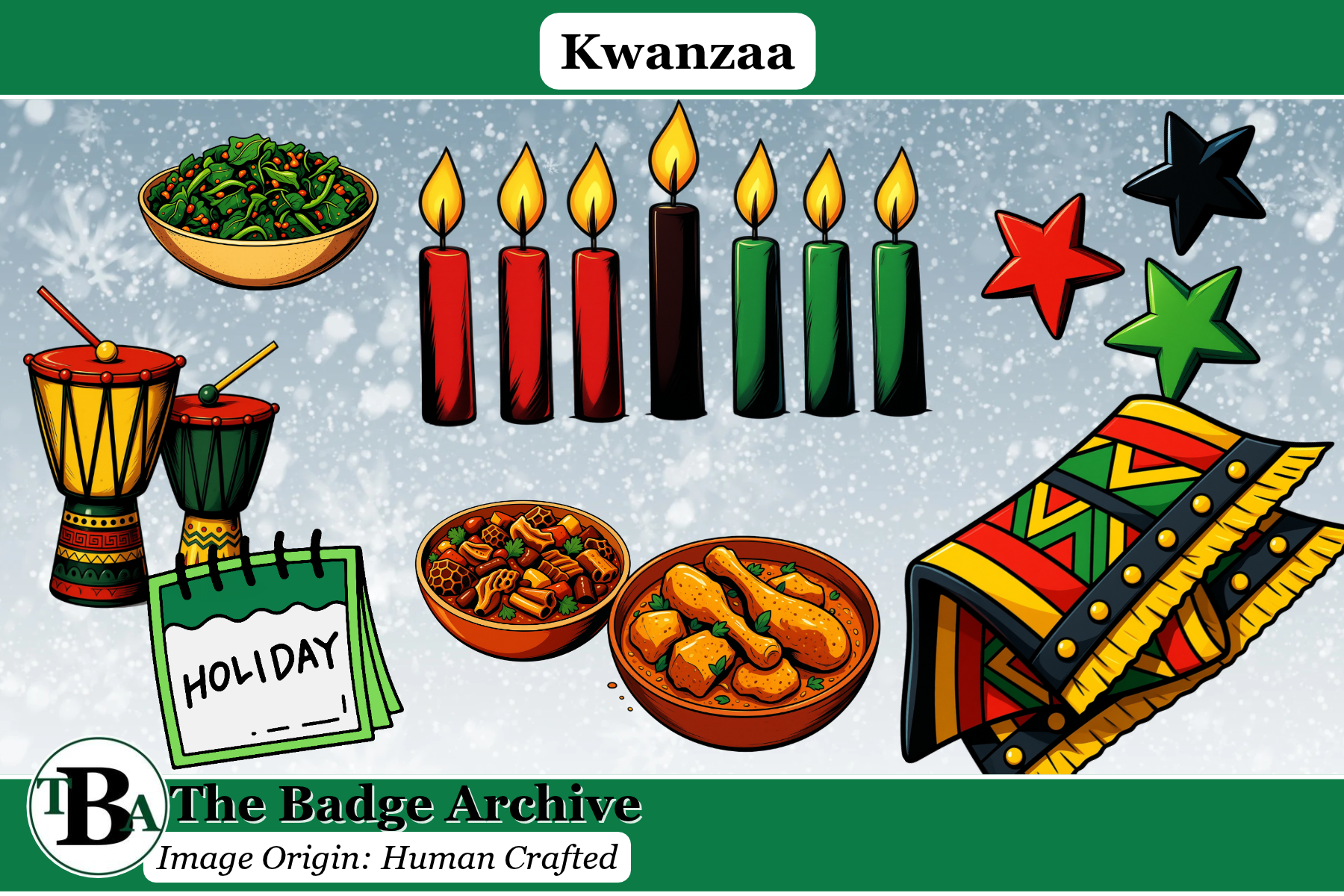
Between December 26th and January 1st, Kwanzaa is an annual celebration of African American and Pan-African culture. Communities and families get together to honor their heritage, reflect on community values, tell stories, and share music. Giving meaningful gifts and having a feast called Karamu is usually done on the sixth day.
Quick Links: History, Celebrate, Activities, Meetings, Fun Patch Ideas
History of Kwanzaa
Kwanzaa was created in 1966, by a professor of Africana studies, Dr. Maulana Karenga. The Watts riots in Los Angeles had just occurred and he wanted to bring the African American community together and help them reconnect with their roots. The name Kwanzaa comes from the Swahili phrase “matunda ya kwanza,” which translates to “first fruits” of the harvest. An extra ‘a’ was added so the name would have seven letters to match the seven children that participated in the first Kwanzaa celebration.
The Seven Principles
The holiday is organized around the Nguzo Saba (Seven Principles), one for each of the seven days of Kwanzaa: Umoja (Unity), Kujichagulia (Self-Determination), Ujima (Collective Work and Responsibility), Ujamaa (Cooperative Economics), Nia (Purpose), Kuumba (Creativity), and Imani (Faith).
The Kinara (Candelabrum), holds seven candles called the Mishumma Saba. There is one black candle in the center with three red candles on the left and three green candles on the right. One candle is lit each night, starting with the center candle. Families set out a woven mat (Mkeka) with crops (Mazao) and drink form a unity cup (Kikombe cha Umoja). Reflections and discussions are held during the lighting of the candles each evening. Most families blow out the candles at the end of the night, and use high-quality, slow-burning, tall candles before lighting them the next evening in the appropriate number. Other families prefer to leave the candles lit and burn all the way down to replace them as needed.
Countries That Celebrate

Note: We do our best to ensure accuracy. Traditions vary worldwide. This list may miss some countries.
Individual Country pages are still under construction.
Kwanzaa is most notably celebrated in:
African Continent – Some Pan-African cultures (particularly diaspora expats or university groups) celebrate the American made holiday as a way to honor the cultural bridge between the African continent and global Black communities.
Brazil – Afro-Brazilians reconnect with their African roots and build community solidarity with grassroot celebrations. They incorporate Afro-Brazilian music, dance, and discussions on racial equality and social justice.
Canada – Celebrating Kwanzaa started officially in 1993. Many Canadian celebrations are hosted by local churches and community centers, with large communal Karamu feasts. The events often blend traditional Kwanzaa ceremonies with African-Canadian and Caribbean cultural expressions.
Caribbean (Jamaica & Barbados) – Local culture is deeply integrated into Kwanzaa celebrations. Families often prepare jerk chicken, fried sweet plantains and rice and peas instead of African American soul food for their Karamu feast. In Barbados, there are advocates to have Kwanzaa recognized as an official national holiday.
United Kingdom – Community organizations, student groups, arts centers, and some cities (like London and Manchester) host large public Kwanzaa events. Many focus primarily on the principles of Kuumba (Creativity) and Ujamaa (Cooperative Economics) with educational workshops, youth leadership showcases, poetry readings, and marketplaces to highlight and support Black-owned businesses.
United States – As the birthplace of the holiday, celebrations are the most widespread in the United States. Kwanzaa is typically held at home, with nightly gatherings to light the Kinara and discuss the daily principle. Some cities (like New York, Chicago, and Los Angeles) host large public events with African drumming, dance performances, and Ujamaa (cooperative Economics) marketplaces to support Black-owned businesses. The Karamu feast often features African American soul food (collard greens, black-eyed peas, and sweet potatoes) with traditional African and Caribbean dishes.
Activity Choices

Each individual country that celebrates will have a list of activities on their page that match their history and way to celebrate. Look at the St. Nicholas Day activities to see all activities available. (Activities currently under construction.)
–
Available Meeting Plans
- None Currently Available
–
Fun Patch Ideas
- Kwanzaa by Advantage Emblem
- Karamu and food images
- Kwanzaa by Advantage Emblem
- Seven candles of varied colors image
- Kwanzaa by Snappy Logos
- Karamu, corn, and present images
Note – Please see our Affiliations page to know if any of the links on The Badge Archive benefit the website in anyway.
Other Resources
- None Currently Available.
–
For More Fun Ideas and Plans

Join the Girl Scout Daisy, Brownie, and Junior Leader Help Facebook Group
(Not an official GSUSA Group)

Join the Girl Scout Cadette, Senior, and Ambassador Leader Help Facebook Group
(Not an official GSUSA Group)

See other Recommended Facebook Groups for some Scouting Organizations
(No official Groups)
–
Click Here -> To see information References:
Disclaimer: Content on The Badge Archive is based on the research and reference materials listed below. We encourage readers to review these sources directly for additional information.
- “Heri Za Kwanzaa.” BLAM UK CIC, 26 Dec. 2022, https://blamuk.org/2022/12/26/heri-za-kwanzaa/. Accessed 14 Nov. 2026.
- “Kwanzaa Celebrated in Haynesville Amid Call for Youth to Be Told ‘The Truth.’” Barbados Today, 29 Dec. 2023, https://barbadostoday.bb/2023/12/29/kwanzaa-celebrated-in-haynesville-amid-call-for-youth-to-be-told-the-truth/. Accessed 14 Nov. 2026.
- “Kwanzaa — Celebrating Pan-African Culture, Community and History.” CBC Kids, 16 Dec. 2022, https://www.cbc.ca/kids/articles/kwanzaa-celebrating-pan-african-culture-community-and-history. Accessed 14 Nov. 2026.
- “Kwanzaa Celebrations Around the World – Travel Noire.” Travel Noire, 2023, https://travelnoire.com/kwanzaa-celebrations-worldwide. Accessed 14 Nov. 2026.
- “Official Kwanzaa Website.” Official Kwanzaa Website, https://www.officialkwanzaawebsite.org/. Accessed 14 Nov. 2026.
- Vassell, Nicole. “What About Kwanzaa? Your Guide to the Afrocentric Festive Celebration.” Pridemagazine.Com, 15 Dec. 2022, https://www.pridemagazine.com/what-about-kwanzaa-your-guide-to-the-afrocentric-festive-celebration/. Accessed 14 Nov. 2026.
- “What Kwanzaa Means for Black Americans.” PBS, 30 Dec. 2021, https://www.pbs.org/newshour/nation/what-kwanzaa-means-for-black-americans. Accessed 14 Nov. 2026.
–
- Find out how you can support The Badge Archive!
Short Link: https://thebadgearchive.com/hol-kwan/

Leave a Reply