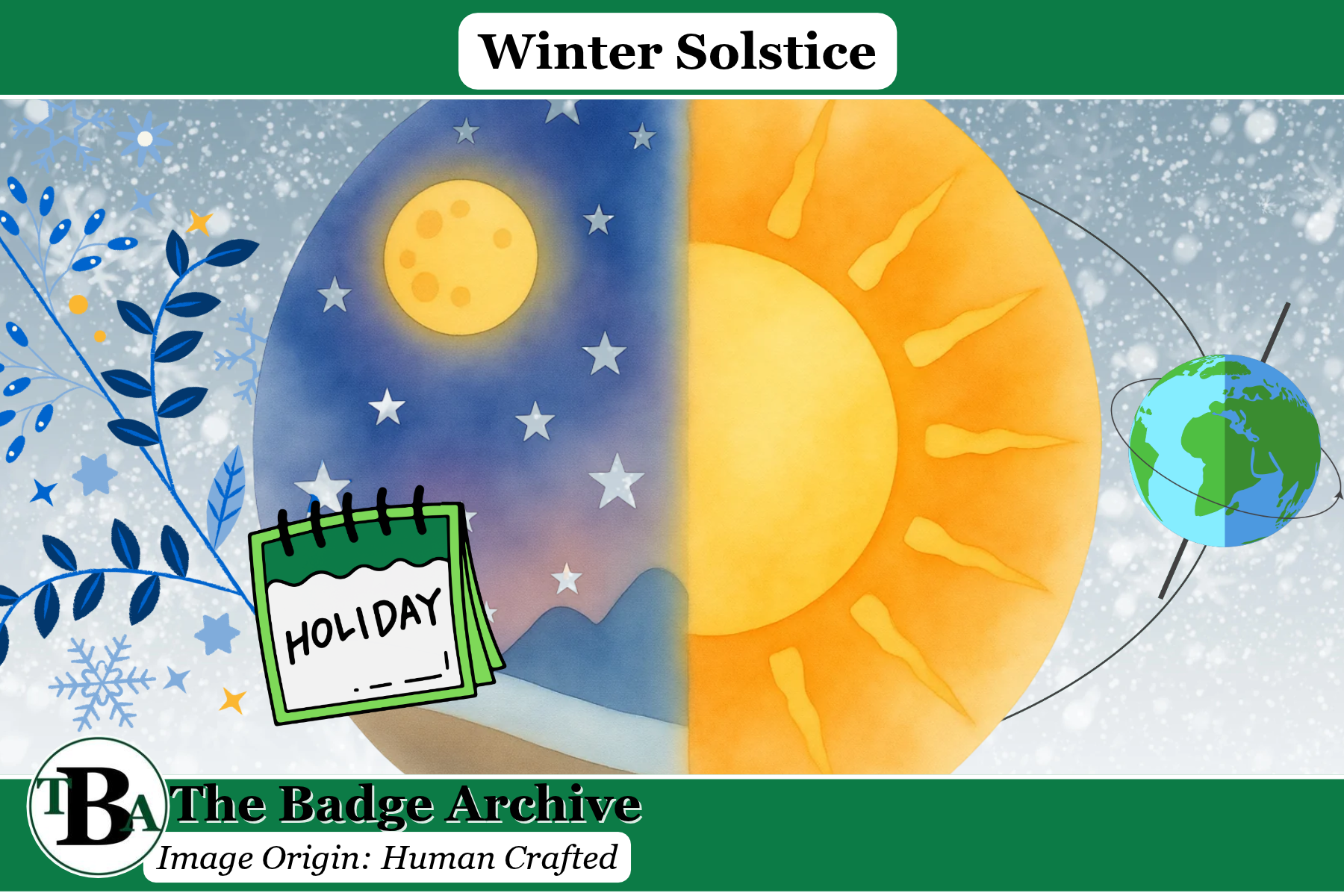
Winter solstice is the longest night of the year. For thousands of years, people get together and have fires, lights, food, stories, and hope the sun will return on that night. Yule is one of the oldest names for the midwinter season.
Quick Links: History, Celebrate, Activities, Meetings, Fun Patch Ideas
History of Winter Solstice
When the Northern Hemisphere reaches the greatest tilt away from the sun, that is the Winter Solstice. Earth’s axis is about a 23.5-degree tilt. For half the year, the north leans towards the sun and then leans away the other half. The Winter Solstice is when the sun’s rays reach the southernmost point: Tropic of Capricorn at 23.5 degrees south latitude. The North Pole sits in darkness, and the South Pole has light for 24 hours. The earliest sunset in most mid-latitude places is about two weeks before the solstice and the latest sunrise happens weeks after due to the tilt and Earth’s oval-shaped orbit around the sun.
Monuments that catch the solstice sun were built long before written calendars. Newgrange, Ireland has a 5,000-year-old passage tomb. The sunlight on the shortest day passes through a roof box and lights the inner chamber. Stonehenge’s Stone Circle and Avenue lie on the axis of the midsummer sunrise and midwinter sunset. Egypt’s long corridor of the Great Hypostyle Hall at Karnak lines up with the solstice sunrise. This was built around 2000 BC. Petra in modern Jordan has the Ed-Deir monastery where sunlight reaches a sacred podium at sunset. Cambodia visitors can watch the solstice sunset over Angkor Wat from the temple of Pre Rup.
December 25th was the day marked for winter solstice in the Roman Calendar. The true solstice was occurring around two and a half days before December 25th by the late third century. However, December 25th was firmly fixed as the winter solstice date by many people in Europe. Christian officials chose December 25th for the date for the Nativity feast in the middle of the fourth century. As most were used to celebrating the Winter Solstice at that time, scholars believe it helped draw people away from pagan midwinter holidays for the Christian ones.
Egypt placed the solstice on January 6th. Christians started to celebrate Epiphany on that day. The twelve days between the two feasts held the Roman new-year festival of Kalends. The Roman festival of Saturnalia ended just as the twelve days began. In 567 CE, the Council of Tours formally declared the entire period between Christmas (Dec 25) and Epiphany (Jan 6) a unified, sacred festive season. The famous 12 days of Christmas refers to these 12 days.
Midwinter festival was called Yule or Jol.
The origin of the word Yule is unknown. Scholars have tried to link it to the Anglo-Saxon word for “feast,” and others to an old Germanic word for “wheel,” suggesting a celebration of the turning year as the days begin to lengthen. The monk Bede (c. 672–735) wrote the English called December and January “Giuli”, named for the turning of the sun toward longer days. He claimed their year began on the night of December 24th to 25th, called Modranicht, “night of the mothers.” English writers used Yule as another name for Christmas from the eleventh century on.
The Yule feast has disagreeing accounts. Germanic people held great autumn feasts in November, when animals were slaughtered for winter. This later blended in with Roman midwinter customs of greenery, gifts, and processions to create Yule. People in the far north have short days and celebrated the sun’s return near the solstice. Pagan Scandinavians left no writings of their own, so Christian missionaries (between around 900-1300) wrote about their religion. Yule seemed to have begun on the longest night and lasted several days with feasting, bonfires, offerings to the gods, and remembrance of the dead. The boar (a symbol of the god Frey) was an important part of the feast. In the tenth century, Norways’ King Haakon the Good ordered that Yule be held around the time of Christmas instead of the Winter Solstice.
Traditions Continue
Northern Europeans decorated their homes with evergreens like holly and ivy during Yule. Romans did the same in Saturnalia. Using evergreens for decorations during December continues in the modern day.
Yule bonfires may have led to the Yule log tradition. The first record of a Yule log for the fireplace is from medieval Germany. The English custom only appears in the 1600s. Large fireplaces slowly disappeared in the 1800s, and the tradition faded, but France kept a reminder by the log-shaped bûche de Noël cake.
Thor, the Norse god of Thunder, had a chariot pulled by goats. Some believe the Scandinavian Yule goat came from this legend while others believe it a medieval invention.
Many stories of folklore tell of the veil between life and death thinning or how spirits of the dead return to the world of the living for a short time during the longest night. The Norse Wild Hunt, bands of spirits riding the stormy sky, is a common association with the Winter Solstice.
Countries That Celebrate

Note: We do our best to ensure accuracy. Traditions vary worldwide. This list may miss some countries.
Individual Country pages are still under construction.
Antarctica – Antarctica does not have its own country, but many researchers live there and work at stations in the Southern Hemisphere. Winter solstice comes in June. Midwinter Day comes with a specially prepared feast, decorations, and entertainment to celebrate the halfway makr of the long winter. No planes can land between February and October. The sun sets late in March and only rises in late September. In 1898, the Belgian ship Begica was trapped in pack ice. Their crew is credited with the first Midwinter’s Day celebration.
Austria and Germany – Rauhnächte is the German word for the 12 days between Christmas (December 25th and Epiphany (January 6th). A common tale was how spirits were highly active during those days. To drive out harm and evil, families burned incense in homes and churches. These nights are often called “Smoke Nights.” Berchta (or Perchta) and Holde are winter figures who rewarded hard workers for tidy homes. Holde caused snow fall when she shook out her feather bed in the sky. Berchta had follower spirits called Perchten. The Twelfth Night is called Perchtennacht. The weather of Perchtennacht is said to foretell the weather of the whole coming year. This is also the season for Schwibbögen (candle arches) to glow in windows in Saxony’s Ore Mountains. These candles recalled miners who worked long shifts during short winter days and never saw the sun.
Chile – Winter solstice falls in June, but it’s a national holiday each year: National Indigenous Peoples Day (Día Nacional de los Pueblos Indígenas). The Mapuche people have We Tripantu, often translated as “the new sunrise.” Families gather, share food, tell stories, play traditional games, and participate in a dawn river bath to welcome the returning sun.
China and Taiwan – At Winter solstice, many in China and Taiwan eat Tanguyan, sweet rice balls that stand for family togetherness and long life. Northern China often eats dumplings.
Denmark, Finland, Norway, and Sweden – Danish, Norwegian, and Swedish word for Christmas is jul, a trace of the old Yule festival. Many midwinter customers may have roots in the Yule traditions such as the Yule goat, Christmas ale, and spirits visiting the living realm. In the 1800s, a legend of Christmas gifts coming from the Jultomten (Sweden), Joulupukki (Finland), Julenisse (Norway), or Julnissen (Denmark) started. This was a gnome with a white beard and red cap. Before that time the Yule goat brought presents and straw goats are still a common decoration. Sweden also celebrates St. Lucy’s Day on December 13th.
Estonia – Jõulud (Estonian for Christmas) comes from the Scandinavian word jul. Folklorists believe people celebrated a midwinter festival at winter solstices before Christianity arrived. Early Christmas celebrations still occur and last 17 days, from St. Thomas’s Day on December 21st to Epiphany on January 6th. Families decorate with straw spread on the floor to make a playground for children. They twist straw into hanging “crowns”, a custom that almost died off in the 1900s but was revived in the 1970s. The Declaration of Christmas Peace (Jõulurahu) is a tradition dating back to the 17th century for the afternoon of December 24th. Many go to the sauna, attend a church service, and share a large meal on Christmas Eve.
Iceland – The first settlers of Iceland came from Scandinavia and the Celtic lands in the 9th century. They may have brought the midwinter Yule festival with them. Iceland adopted Christianity in the year 1000, but tales of elves, trolls, and magic continued to be linked to the season. Iceland only gets around four hours of daylight near Christmas, so candles are popular. 13 Yule Lads come down the mountain the nights before Christmas. From December 12th onward, children place a favorite shoe in the windowsill to find a small gift, or a potato if they misbehaved. On December 25th, the 13 Yule Lads leave one by one, with the last going home on January 6th. December 23rd is St. Thorlak’s Day, a day for last minute preparations for the winter. Christmas begins at 6pm on Christmas Eve, with a festive meal and desert of rice pudding that hides one almond. Whoever finds the almond wins an extra gift. New Year’s Eve is celebrated with fireworks, bonfires, and “elf dances.” Folklore states that elves move to new homes that night.
Iran – The longest night of the year is Yalda, or Shab-e-Yalda, traditionally seen as light’s victory over darkness. Families share a meal that includes pomegranates, read poems, and tell stories together by candlelight. The birthday of ancient Persian sun god Mithra is linked to Winter Solstice.
Ireland – Newgrange, Ireland has a 5,000-year-old passage tomb from the Stone Age. The sunlight on the shortest day passes through a roof box and lights the inner chamber for around 17 minutes. It’s part of the Brú na Bóinne World Heritage Site on the River Boyne. The Office of Public Works holds a lottery and the winners can be inside Newgrange for the solstice sunrise as they livestream the event.
Japan – Around December 21st or 22nd is Tōji. People traditionally take a bath with yuzu citrus fruit and eat pumpkin dishes. Rice steamed with pumpkin and red beans is a common dish. During the Edo period (1603–1868) pumpkins were important during winter in a time before refrigerators.
Peru – Inti Raymi is the Festival of the Sun, honoring Inti, the Sun God of the Inca. During the rule of Pachacutec in Cusco, the Inca capital in the 1400s, they held the first Inti Raymi at winter solstice to ask for good harvests. It was banned by Spanish authorities in 1572, but continued in secret in some places. A modern version was staged on June 24, 1944 at Sacsayhuamán. Cusco now celebrates with 750-800 actors every June 24th in a rotation of three sites: the Qorikancha temple, Cusco’s main square, and Sacsayhuamán, where the ceremony is performed entirely in Quechua. Peru declared Inti Raymi part of the nation’s cultural heritage in 2001.
South Korea – Around December 22nd is Dongji, long called “little Lunar New Year.” There is a myth the red beans keep evil spirits away. A red bean porridge called patjuk is the special dish of the holiday. Families will place bowls of patjuk around the house, near the front door, and at ancestral shrines. Small rice balls called saealsim is served with the patjuk. The number of rice balls was once supposed to match the eater’s age.
United Kingdom – Stonehenge’s Stone Circle and Avenue lie on the axis of the midsummer sunrise and midwinter sunset. These were built between 3700 and 1600 BC. The monk Bede (c. 672–735) wrote the English called December and January “Giuli”, named for the turning of the sun toward longer days. He claimed their year began on the night of December 24th to 25th, called Modranicht, “night of the mothers.” English writers used “Yule” as another name for Christmas from the eleventh century on. The poet Rober Herrick described lighting the new log with a piece saved from last year’s as the Yule log in the 1600s. A birch trunk was the favorite Yule Log in Scotland.
Activity Choices

Each individual country that celebrates will have a list of activities on their page that match their history and way to celebrate. Look at the ASDF activities to see all activities available. (Activities currently under construction.)
–
Available Meeting Plans
- None Currently Available
–
Fun Patch Ideas
- Happy Holidays by Advantage Emblem
- Mittens image
- Happy Holidays by Advantage Emblem
- Snowman image
- Holiday Event by Advantage Emblem
- Snowflake image
- Science of Snow by Girls Love Scouting
- Snowflakes image
- Winter by Girls Love Scouting
- Snowman image
- Winter Bonfire by Advantage Emblem
- Blue campfire image
- Winter Carnival by Advantage Emblem
- Festive lettering image
- Winter GO Challenge by Girls Love Scouting
- Snowman, hot cocoa, sled, lights, ice pond, pine trees, snowflakes, and hat images
- Winter Fun by Advantage Emblem
- Snow hills and snowflakes images
- Winter Fun by Advantage Emblem
- Snowflake image
- Winter Fun by Advantage Emblem
- Snowmen building snowman image
- Winter Fun by Snappy Logos
- Moose with coat hat image
- Winter Fun by Snappy Logos
- Owl with hat and scarf image
- Winter Fun by Snappy Logos
- Penguin and snowman image
- Winter Fun by Snappy Logos
- Penguins on sled image
- Winter Fun by Snappy Logos
- Polar bear with hat image
- Winter Fun by Snappy Logos
- Snowflake smiling image
- Winter Fun by Snappy Logos
- Snowman image
- Winter Party by Making Friends
- Snowflakes image
- Winter Solstice by Girls Love Scouting
- States “The Shortest Day of the Year” with earth and sun images
- Winter Solstice by Snappy Logos
- Bear, rabbit, deer silhouette with pine trees and sun images
- Winter Wonderland on Girl Scout Shop
- States “Winter Wonderland Girl Scouts” with snowflakes image
- Winter Wonders by Advantage Emblem
- Ice covered trees image
- Winter Wonders by Advantage Emblem
- Snowy owl image
- Wonderful Winter on Create with DI
- Snowflake image, retired Artistry Badge, non-official
- Yule Log by Snappy Logos
- Log with candles image
- Yule Log by Snappy Logos
- Log with swirls image
Note – Please see our Affiliations page to know if any of the links on The Badge Archive benefit the website in anyway.
Other Resources
- None Currently Available.
–
For More Fun Ideas and Plans

Join the Girl Scout Daisy, Brownie, and Junior Leader Help Facebook Group
(Not an official GSUSA Group)

Join the Girl Scout Cadette, Senior, and Ambassador Leader Help Facebook Group
(Not an official GSUSA Group)

See other Recommended Facebook Groups for some Scouting Organizations
(No official Groups)
–
Click Here -> To see information References:
Disclaimer: Content on The Badge Archive is based on the research and reference materials listed below. We encourage readers to review these sources directly for additional information.
- “The 2017 Winter Solstice Arrives.” National Environmental Satellite, Data, and Information Service, National Oceanic and Atmospheric Administration, 17 Dec. 2017, https://www.nesdis.noaa.gov/node/907. Accessed 12 Nov. 2026.
- “Brú na Bóinne – Archaeological Ensemble of the Bend of the Boyne.” UNESCO World Heritage Centre, https://whc.unesco.org/en/list/659. Accessed 12 Nov. 2026.
- Consulate-General of Japan in Calgary. “Eating Seasonally with Chef Owada: Touji ‘Winter Solstice’ (Dec 22).” Consulate-General of Japan in Calgary, 21 Dec. 2023, https://www.calgary.ca.emb-japan.go.jp/itpr_en/11_000001_00829.html. Accessed 12 Nov. 2026.
- Embassy of Japan in Germany. “Dezember.” Nachrichten aus Japan, Dec. 2007, https://www.de.emb-japan.go.jp/NaJ/NaJ0712/filesD/Ddezember.pdf. Accessed 12 Nov. 2026.
- Embassy of Japan in Iceland. “The Icelandic Christmas and Its 13 Santa Clauses.” From Ambassador, 5 Dec. 2019, https://www.is.emb-japan.go.jp/itpr_en/taishi23.html. Accessed 12 Nov. 2026.
- Gulevich, Tanya. Encyclopedia of Christmas and New Year’s Celebrations. 2nd ed., Omnigraphics, 2003.
- “Indigenous New Year.” Marca Chile, Fundación Imagen de Chile, 21 June 2018, https://www.marcachile.cl/en/el-ano-nuevo-indigena/. Accessed 12 Nov. 2026.
- “Indigenous New Year.” Marca Chile, Fundación Imagen de Chile, 21 June 2018, https://www.marcachile.cl/en/el-ano-nuevo-indigena/. Accessed 12 Nov. 2026.
- “Inti Raymi: ¿En qué consiste?, ¿Cuál es su historia y en qué lugares de Cusco ocurre?” Andina, Editora Perú, https://andina.pe/agencia/noticia-en-consiste-inti-raymi-cual-es-su-historia-y-que-lugares-cusco-ocurre-989247.aspx. Accessed 12 Nov. 2026.
- “Lucia Celebrations: A Unique Tradition with Ancient Roots.” Linköping University, https://liu.se/en/article/lucia-celebrations-a-unique-tradition-with-ancient-roots. Accessed 12 Nov. 2026.
- McKarthy, Katie. “Winter Solstice Celebrations in Library of Congress Collections.” Minerva’s Kaleidoscope: Resources for Families, Library of Congress, 18 Dec. 2024, https://blogs.loc.gov/families/2024/12/winter-solstice-at-the-library-of-congress/. Accessed 12 Nov. 2026.
- Media. “Midwinter in Antarctica.” Antarctic Logistics & Expeditions, 18 June 2014, https://antarctic-logistics.com/midwinter-in-antarctica/. Accessed 13 Nov. 2026.
- Ministry of Culture, Sports and Tourism. “Koreans Celebrate Winter Solstice with Special Annual Dish.” Korea Here & Now, Republic of Korea, 29 Nov. 2021, https://www.mcst.go.kr/english/policy/kocis/newsView.jsp?pSeq=60. Used under the Korea Open Government License Type 1 (source indication). Accessed 12 Nov. 2026.
- Nacional, Biblioteca del Congreso. “Biblioteca Del Congreso Nacional | Ley Chile.” Www.Bcn.Cl/Leychile, 2026, https://www.bcn.cl/leychile/navegar?idNorma=1161743. Accessed 13 Nov. 2026.
- Office of Public Works. “Newgrange’s Ancient Secrets Revealed: Join Us for Live Streaming of the Winter Solstice.” gov.ie, Government of Ireland, 1 Dec. 2023, updated 12 Apr. 2025, https://www.gov.ie/en/office-of-public-works/press-releases/newgranges-ancient-secrets-revealed-join-us-for-live-streaming-of-the-winter-solstice/. Accessed 12 Nov. 2026.
- “Peru’s Inti Raymi: How This Festival Shapes Cusco’s Identity and Inspires Pride.” Andina, Editora Perú, 24 June 2026, https://andina.pe/Ingles/noticia-perus-inti-raymi-how-this-festival-shapes-cuscos-identity-and-inspires-pride-1080933.aspx. Accessed 12 Nov. 2026.
- “Stonehenge, Avebury and Associated Sites.” UNESCO World Heritage Centre, https://whc.unesco.org/en/list/373. Accessed 12 Nov. 2026.
- Swanner, Rebecca. “The 12 Days of Yule: Traditions, Rituals, and How to Celebrate.” The Pagan Grimoire, 21 Nov. 2025, https://www.pagangrimoire.com/12-days-of-yule/. Accessed 13 Nov. 2026.
- “Twelve Days of Christmas.” Christian History Institute, Christian History, 2025, https://christianhistoryinstitute.org/magazine/article/ff-twelve-days-of-christmas. Accessed 13 Nov. 2026.
- Weber, Anna. “Ungewöhnliche Weihnachtstraditionen aus Bayern und Sachsen.” Goethe-Institut Tschechien, Dec. 2021, https://www.goethe.de/ins/cz/de/kul/mag/22659175.html. Accessed 12 Nov. 2026.
–
- Find out how you can support The Badge Archive!
Short Link: https://thebadgearchive.com/hol-wintsol/

Leave a Reply