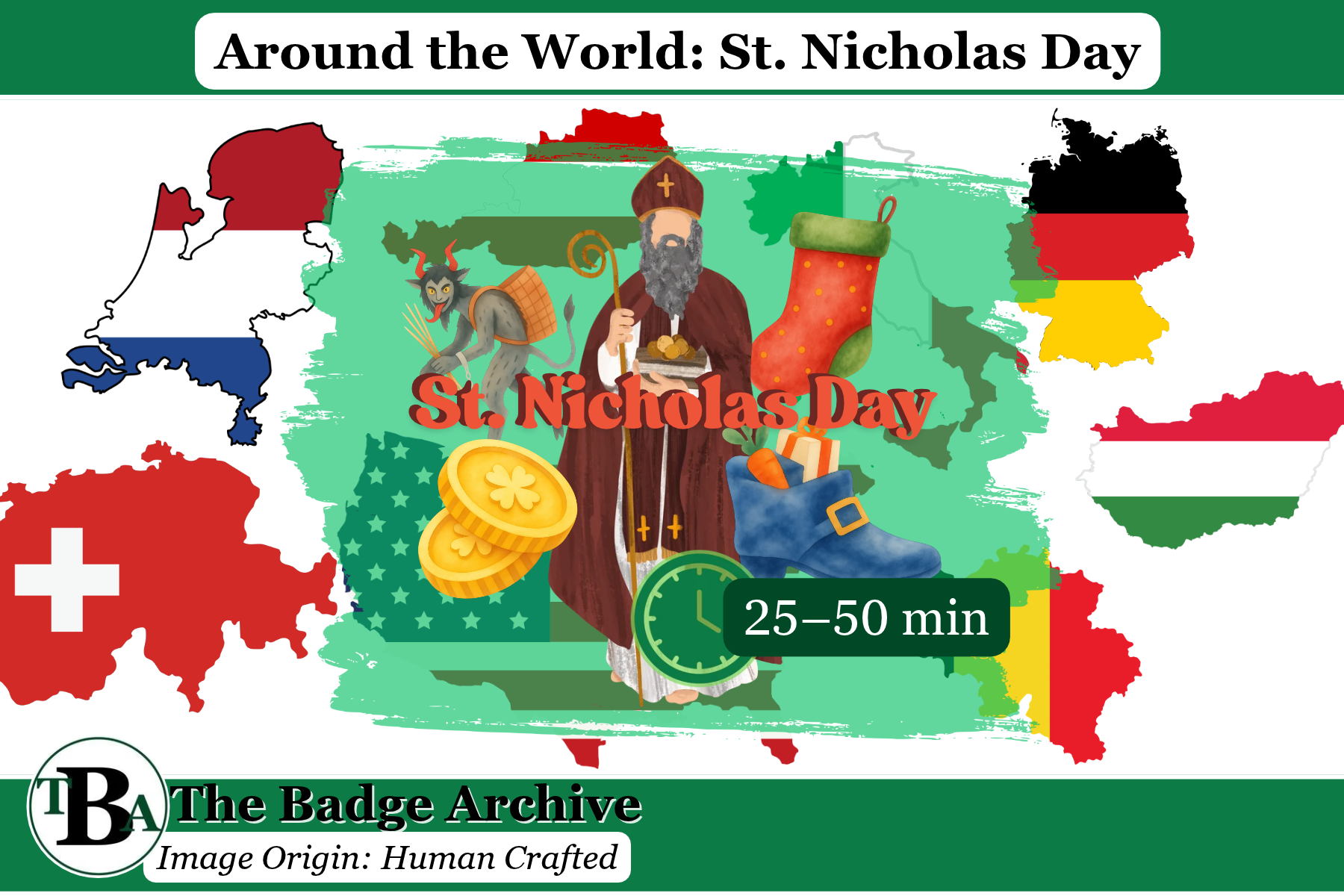
Activity Description: Visit eight country stations to learn how St. Nicholas Day is celebrated around the world.
Items Needed:
- One set of St. Nicholas Station Cards
- Station supplies:
- Austria: 1 jingle bell
- Belgium: 3 bean bags or rolled socks + 1 sturdy large bowl
- Germany: Photo copies of a blank shoe + crayons
- Hungary: 1 bundle of 3–4 sticks or pencils
- Italy: 1 small tub/tray of shallow water + 1 pre-made aluminum foil boat
- The Netherlands: 3 bean bag “carrots” + 1 shoe
- Switzerland: 1 small puzzle or cut-up map of Central Europe (4–6 pieces)
- United States: 1 pair of oven mitts or oversized mittens + 1 Christmas stocking + 3 small wrapped candies or tokens
- (Optional) A St. Nicholas Passport for each youth
- (Optional) Stamps, stickers, or markers for each station
Before the Meeting Starts:
- Create the station cards and passports. (10–15 min)
- Prepare the eight country cards using the card-making guide below and fold one piece of paper per youth into a small passport booklet.
- Set up the eight country stations. (5–10 min)
- Place one station card, a stamp or sticker sheet, and any matching props at eight different tables or corners around the meeting room.
- For a shorter meeting, set up only four stations.
Instructions (Estimated Total Time: 25–50 min):
- Introduce St. Nicholas Day and hand out passports. (2–5 min)
- Give each youth a St. Nicholas Passport and briefly explain that over 1,700 years ago, a generous bishop named Nicholas lived in Myra (modern-day Turkey) and secretly gave gold and food to help poor families. Over time, different countries developed their own unique ways to celebrate his feast day on December 6.
- Split youth into small groups and assign each group a starting country.
- Rotate through the country stations. (20–40 min)
- Have groups visit each station (spending about 2–5 minutes per country).
- At each station, youth read the country card (or a leader reads aloud for younger youth), complete the quick mini-challenge on the card, and stamp or sticker their passport before moving to the next country.
- Come back together and reflect. (3–5 min)
- Gather the group and compare what they discovered: Which country’s tradition would you most like to try? What stayed the same across almost every country, and what changed?
How to Make the Station Cards
Create eight uniform cards (using cardstock or half-sheets of paper) so each station is easy to read and self-guided. On each card, include:
- Austria
- On the eve of St. Nicholas Day, children leave their shoes on the windowsill for St. Nicholas to fill with gifts. In regions like Styria and Salzburg, he is accompanied by Krampus, a shaggy, horned helper who will leave twigs instead of treats for misbehaviing kids.
- Challenge: Stand in a circle. Pass a jingle bell all the way around the group without letting it make a single sound, which might catch the attention of the Krampus.
- Belgium
- Chocolate coins are a classic St. Nicholas Day treat for children, recalling the legend of Nicholas secretly tossing three bags of gold through a window to help a poor family.
- Challenge: Stand behind the tape line and take turns tossing the three gold bean bags into the target bowl until your group lands all three inside.
- Germany
- For Nikolaustag, children and adults place polished shoes or boots outside their front door for treats. St. Nicholas travels with Knecht Ruprecht (“Servant Ruprecht”), a helper dressed in furs or rags carrying a bell and sack (called Krampus in Bavaria).
- Challenge: Use a crayon to color in a blank shoe to ‘polish’ it.
- Hungary
- Mikulás (St. Nicholas) leaves sweets and chocolates in shoes or boots placed in the window. Naughty children are visited by Krampusz instead and may receive a virgács (a bundle of gold-colored birch twigs).
- Challenge: Balance a bundle of twigs across the back of your hand (or two fingers) and walk from one side of the station to the other without dropping them. Each group member must complete one trip.
- Italy
- San Nicola is the patron saint of sailors. In Bari, Italy, the main celebration takes place in May with a procession carrying his statue to the harbor, where it rides on a flower-covered boat followed by small boats on the water.
- Challenge: Place an aluminum foil boat at one end of a shallow water tray and work in pairs by blowing air (no hands!) to sail the boat all the way across.
- The Netherlands
- Sinterklaas arrives in Amsterdam by boat weeks before December 6 with his helpers (Pieten) and rides a white horse. Children set shoes by the fireplace with carrots, hay, or sugar for his horse, and families celebrate Pakjesavond (“Parcel Evening”) on December 5 with cleverly wrapped gifts and funny rhyming poems.
- Challenge: The group must come up with a two-line rhyming couplet about St. Nicholas or treats. Then toss the three “carrot” bean bags into a shoe before stamping their passport.
- Switzerland
- Swiss celebrations closely follow Austrian and German customs, with children leaving shoes out for treats while helpers known as Klaubauf or Krampus accompany St. Nicholas.
- Challenge: Find 6-pieces of a map of Central Europe as a team, assemble it and then point out Switzerland, Austria, and Germany, and hide the pieces for the next group.
- United States
- In the 1700s, Pennsylvania Dutch settlers brought Pelz Nicholas (“Fur Nicholas”), whose name became Belsnickel. Over time, Dutch Sinterklaas blended into Santa Claus, moving gift-giving to Christmas Day and swapping shoes by the hearth for hanging Christmas stockings.
- Challenge: Put on oven mitts or oversized mittens and transfer three small treats from the table into the Christmas stocking using only your mittened hands. Return the treats to let the next person try.
–
For More Fun Ideas and Plans

Join the Girl Scout Daisy, Brownie, and Junior Leader Help Facebook Group
(Not an official GSUSA Group)

Join the Girl Scout Cadette, Senior, and Ambassador Leader Help Facebook Group
(Not an official GSUSA Group)

See other Recommended Facebook Groups for some Scouting Organizations
(No official Groups)
–
Click Here -> To see information References:
Disclaimer: Content on The Badge Archive is based on the research and reference materials listed below. We encourage readers to review these sources directly for additional information.
- Amsterdam & Partners. “Sinterklaas.” I amsterdam, https://www.iamsterdam.com/uit/feestdagen-en-events/sinterklaas. Accessed 12 Nov. 2026.
- German National Tourist Board. “Romantic Advent: Christmas Cookies, Advent Calendars, Saint Nicholas and Christmas Markets.” Germany Travel, https://www.germany.travel/en/cities-culture/romantic-advent.html. Accessed 12 Nov. 2026.
- Gulevich, Tanya. Encyclopedia of Christmas and New Year’s Celebrations. 2nd ed., Omnigraphics, 2003.
- Kohlrusz, Gabor. “Mikulás, the Hungarian Santa Claus.” Faculty of Business and Economics, University of Pannonia, 6 Dec. 2011, https://www.gtk.uni-pannon.hu/en/mikulas-the-hungarian-santa-claus/. Accessed 12 Nov. 2026.
- Luzern Tourismus AG. “Küssnachter Klausjagen.” Luzern.com, https://www.luzern.com/de/event/kuessnachter-klausjagen. Accessed 12 Nov. 2026.
- Martin, Brian. “Holiday Coins.” United States Mint, 22 Dec. 2017, https://www.usmint.gov/news/inside-the-mint/holiday-coins. Accessed 12 Nov. 2026.
- “Mikulás Day.” USC Digital Folklore Archives, University of Southern California, https://folklore.usc.edu/mikulas-day/. Accessed 12 Nov. 2026.
- “Shoes for St. Nick.” USC Digital Folklore Archives, University of Southern California, 20 Apr. 2015, https://folklore.usc.edu/shoes-for-st-nick/. Accessed 12 Nov. 2026.
- Simmel, Natalie. “Christmas Traditions in Germany.” U.S. Army, 30 Nov. 2022, https://www.army.mil/article/262379/christmas_traditions_in_germany. Accessed 12 Nov. 2026.
- Union fribourgeoise du Tourisme. “Saint-Nicolas à Fribourg.” Région de Fribourg, https://fribourg.ch/fr/inspiration/saint-nicolas-fribourg/. Accessed 12 Nov. 2026.
- Winick, Stephen. “Krampus: Origins and Development of a Winter Devil.” Folklife Today, Library of Congress, 3 Dec. 2025, https://blogs.loc.gov/folklife/2025/12/krampus-origins-and-development-of-a-winter-devil/. Accessed 12 Nov. 2026.
- Winick, Stephen. “Nicholas and Krampus: A Heartwarming Tale of Love and Monsters.” Folklife Today, Library of Congress, 22 Dec. 2025, https://blogs.loc.gov/folklife/2025/12/nicholas-and-krampus-a-heartwarming-tale-of-love-and-monsters/. Accessed 12 Nov. 2026.
- “(W)international Hints: Santa Claus.” University of Pécs, 5 Dec. 2014, https://adminisztracio.pte.hu/english/node/1269. Accessed 12 Nov. 2026.
–
- Find out how you can support The Badge Archive!
- Pick a different Design Challenge Activity.
- Return to the St. Nicholas Day page.




Leave a Reply