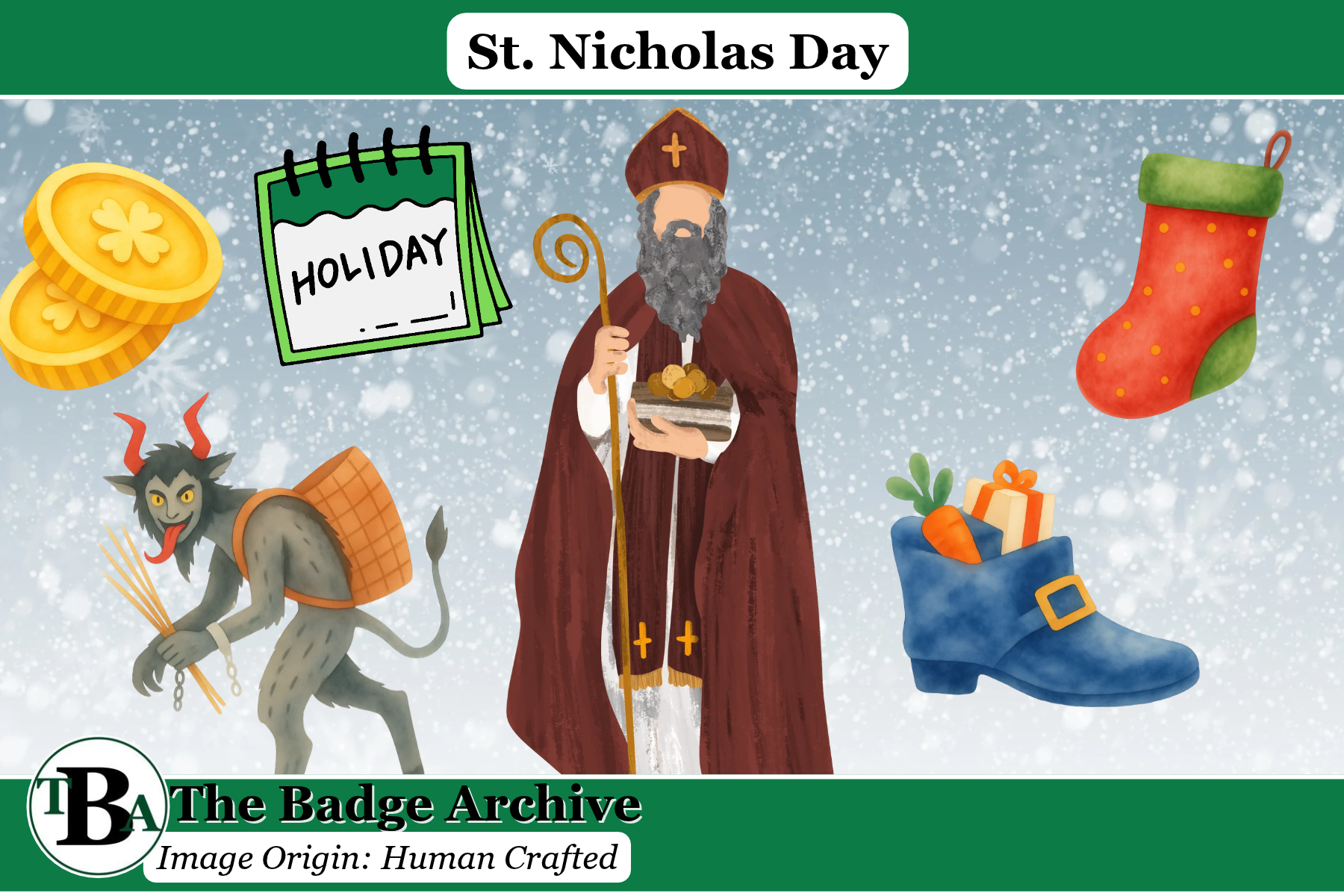
December 6th is St. Nicholas Day, a holiday to honor Nicholas, a bishop who lived 1,700 years ago in a town called Myra. He was known to be generous to the poor, so children set out shoes on the night of December 5th. In the morning, good children find small treats like nuts, fruit, and candy. This is mostly celebrated in Europe.
Quick Links: History, Celebrate, Activities, Meetings, Fun Patch Ideas
History of St. Nicholas Day
Most of what is known about the real Nicholas is myth and legend. Scholars believe he was born in what is currently known as Turkey, around 280 A.D. He died around 343 A.D. He was a bishop for a town called Myra, which is now called Demre, Turkey.
The most well known tales are of his generosity, love of the poor, and the acts of charity he performed. There was a Council of Nicaea in 325 A.D. that many believe he attended, but his names does not appear on any list of attendees that is still preserved.
St. Nicholas is often symbolized with three bags of gold, or three gold balls.
The most famous legend of St. Nicholas is about a father who could not afford dowries for his three daughters. Nicholas came secretly at night and threw a small bag of gold through the window of the family’s home. Some versions of the legend say he threw it down the chimney. There was a bag for each daughter. Some versions of the story say the bags landed in stockings hung by the fire to dry, which could have inspired the customs of leaving shoes and stockings out the night before the holiday for gifts. The father of the daughters caught Nicholas later, but Nicholas asked him to keep the gift a secret.
Northern and Southern Europe view St. Nicholas differently.
In twelfth-century France, a legend was told of how Nicholas rescued three traveling students. A wicked innkeeper had killed them but Nicholas brought them back to life. In northern and central Europe, he became the patron saint of children. It is common to see him as a gift bringer for children.
Tales from southern and eastern Europe speak of how Nicholas saved sailors from storms at sea. In those areas he is the patron saint of sailors. He was not seen as a gift brining for children in these areas.
France and Germany have more than two thousand churches named after Nicholas. He was one of Europe’s most honored saints. Even as early as the 900s, his story was acted out in church dramas on his feast day. By 1100s, “St. Nicholas Plays” was sung by choirs. This is also the time when nuns in central France left nuts, oranges, and other foods on poor family doorsteps the eve of St. Nicholas Day. Researchers believe the custom of giving gifts on St. Nicholas Day was spread across northern Europe from these original doorstep gifts.
Other Helpers
The kind St. Nicholas had a frightening helper who went by different names depending on the country. Germany had Knecht Ruprecht. Austria and Bavaria had Krampus. Czech lands had a demon called a čert. Piet (Peter) was the helper in Netherlands.
While the saint rewarded good children, the helper was a threat for naughty children. Birch twigs, ashes, or a stick were given instead of the small treats. Some folklorists relate this helper to pagan spirits. Medieval art and drama often showed the helper as a type of devil.
The Protestant Reformation had a strong movement of ending the practice of honoring the saints. There is record of a German Protestant minister in the early 1600s, complaining about how St. Nicholas brings gifts. Much of Germany started to have the Christ Child (Christkindel) take over as the gift bringer at Christmas time.
December 6th is still celebrated in several European countries. And when Europeans moved to America, they brought St. Nicholas along. He and the Dutch Sinterklass (a contraction of Sint Nikolaas, meaning Saint Nicholas) were eventually transformed into the American Santa Claus.
Countries That Celebrate

Note: We do our best to ensure accuracy. Traditions vary worldwide. This list may miss some countries.
Individual Country pages are still under construction.
Austria – St. Nicholas leaves gifts in children’s shoes, left on their windowsill on the eve of St. Nicholas Day. The Krampus is a shaggy, horned helper who is popular in the regions of Styria and Salzburg.
Belgium – Chocolate coins are a classic treat for children on St. Nicholas Day.
Germany – Nikolaustag (St. Nicholas Day), is a well loved holiday. Children and adults place polished shoes or boots outside the front door for small treats the next day. Knecht Ruprecht (“Servant Ruprecht”), is a figure in rags, straw, or furs with a whip, stick, bell, or sack. In Bavaria they call the helper Krampus.
Hungary – Mikulás (St. Nicholas) brings sweets or chocolate for children who set shoes or boots in the window. Naughty children are visited by Krampusz (the helper) instead and may receive a virgács, a bundle of gold-colored birch twigs.
Italy – San Nicola (St. Nicholas) is the patron saint of sailors. Their main celebration is in May, the arrival of St. Nicholas remains to Bari, Italy. Celebrations center around visiting the tomb and following a procession of his statue carried down to the harbor to ride on a flower-covered boat and then sailing out in small boats to follow it.
Netherlands – The largest modern celebrations of St. Nicholas Day happen in Netherlands. Weeks before December 6th, Sinterklass (St. Nicholas) arrives in a boat in Amsterdam. He sails along the Amstel River with Pieten (the helper) and rides on horseback to Leidseplein square to greet the crowd. Children place their shoes by the fireplace, and leave carrots, hay, or sugar for his white horse. The evening of December 5 is called Sinterklaas-avond or Pakjesavond (“Parcel Evening”). They wrap gifts in clever ways and include funny rhyming poems in them to be read aloud.
Switzerland – Follows similar traditions as Austria and Germany, with Klaubauf or Krampus (the helper).
United States – In the 1700s, Pennsylvania Dutch settlers brought Pelz Nicholas (Fur Nicholas), whose name slowly became Belsnickel. Sinterklaas (St. Nicholas) became known as Santa Claus over time and brings gifts on Christmas Day instead of Dec. 6th with Christmas Stockings instead of shoes for small treats.
Activity Choices

Each individual country that celebrates will have a list of activities on their page that match their history and way to celebrate. Look at the St. Nicholas Day activities to see all activities available. (Activities currently under construction.)
–
Available Meeting Plans
- None Currently Available
–
Fun Patch Ideas
- Christmas Parade Santa by Advantage Emblem
- In honor of Netherlands grand procession.
- Christmas Stocking by Advantage Emblem
- Stockings were inspired by St. Nicholas.
- Fill a Stocking by Making Friends
- For St. Nicholas’s charity and how stockings were inspired by St. Nicholas.
- Filled With Love by The Patch Corner
- For St. Nicholas’s charity and how stockings were inspired by St. Nicholas.
- Gingerbread by Girls Love Scouting
- For the small holiday treats found in shoes.
- Secret Santa by Advantage Emblem
- A Santa that looks closer to St. Nicholas and in honor of his secret generosity.
- Tis the Season for Giving Patch Set by Patchwork Designs
- In honor of St. Nicholas charity
- ‘Tis the Season Scouts Give by Mad About Patches
- In honor of St. Nicholas charity
Note – Please see our Affiliations page to know if any of the links on The Badge Archive benefit the website in anyway.
Other Resources
- None Currently Available.
–
For More Fun Ideas and Plans

Join the Girl Scout Daisy, Brownie, and Junior Leader Help Facebook Group
(Not an official GSUSA Group)

Join the Girl Scout Cadette, Senior, and Ambassador Leader Help Facebook Group
(Not an official GSUSA Group)

See other Recommended Facebook Groups for some Scouting Organizations
(No official Groups)
–
Click Here -> To see information References:
Disclaimer: Content on The Badge Archive is based on the research and reference materials listed below. We encourage readers to review these sources directly for additional information.
- Amsterdam & Partners. “Sinterklaas.” I amsterdam, https://www.iamsterdam.com/uit/feestdagen-en-events/sinterklaas. Accessed 12 Nov. 2026.
- German National Tourist Board. “Romantic Advent: Christmas Cookies, Advent Calendars, Saint Nicholas and Christmas Markets.” Germany Travel, https://www.germany.travel/en/cities-culture/romantic-advent.html. Accessed 12 Nov. 2026.
- Gulevich, Tanya. Encyclopedia of Christmas and New Year’s Celebrations. 2nd ed., Omnigraphics, 2003.
- Kohlrusz, Gabor. “Mikulás, the Hungarian Santa Claus.” Faculty of Business and Economics, University of Pannonia, 6 Dec. 2011, https://www.gtk.uni-pannon.hu/en/mikulas-the-hungarian-santa-claus/. Accessed 12 Nov. 2026.
- Luzern Tourismus AG. “Küssnachter Klausjagen.” Luzern.com, https://www.luzern.com/de/event/kuessnachter-klausjagen. Accessed 12 Nov. 2026.
- Martin, Brian. “Holiday Coins.” United States Mint, 22 Dec. 2017, https://www.usmint.gov/news/inside-the-mint/holiday-coins. Accessed 12 Nov. 2026.
- “Mikulás Day.” USC Digital Folklore Archives, University of Southern California, https://folklore.usc.edu/mikulas-day/. Accessed 12 Nov. 2026.
- “Shoes for St. Nick.” USC Digital Folklore Archives, University of Southern California, 20 Apr. 2015, https://folklore.usc.edu/shoes-for-st-nick/. Accessed 12 Nov. 2026.
- Simmel, Natalie. “Christmas Traditions in Germany.” U.S. Army, 30 Nov. 2022, https://www.army.mil/article/262379/christmas_traditions_in_germany. Accessed 12 Nov. 2026.
- Union fribourgeoise du Tourisme. “Saint-Nicolas à Fribourg.” Région de Fribourg, https://fribourg.ch/fr/inspiration/saint-nicolas-fribourg/. Accessed 12 Nov. 2026.
- Winick, Stephen. “Krampus: Origins and Development of a Winter Devil.” Folklife Today, Library of Congress, 3 Dec. 2025, https://blogs.loc.gov/folklife/2025/12/krampus-origins-and-development-of-a-winter-devil/. Accessed 12 Nov. 2026.
- Winick, Stephen. “Nicholas and Krampus: A Heartwarming Tale of Love and Monsters.” Folklife Today, Library of Congress, 22 Dec. 2025, https://blogs.loc.gov/folklife/2025/12/nicholas-and-krampus-a-heartwarming-tale-of-love-and-monsters/. Accessed 12 Nov. 2026.
- “(W)international Hints: Santa Claus.” University of Pécs, 5 Dec. 2014, https://adminisztracio.pte.hu/english/node/1269. Accessed 12 Nov. 2026.
–
- Find out how you can support The Badge Archive!
Short Link: https://thebadgearchive.com/hol-stnic/


Leave a Reply