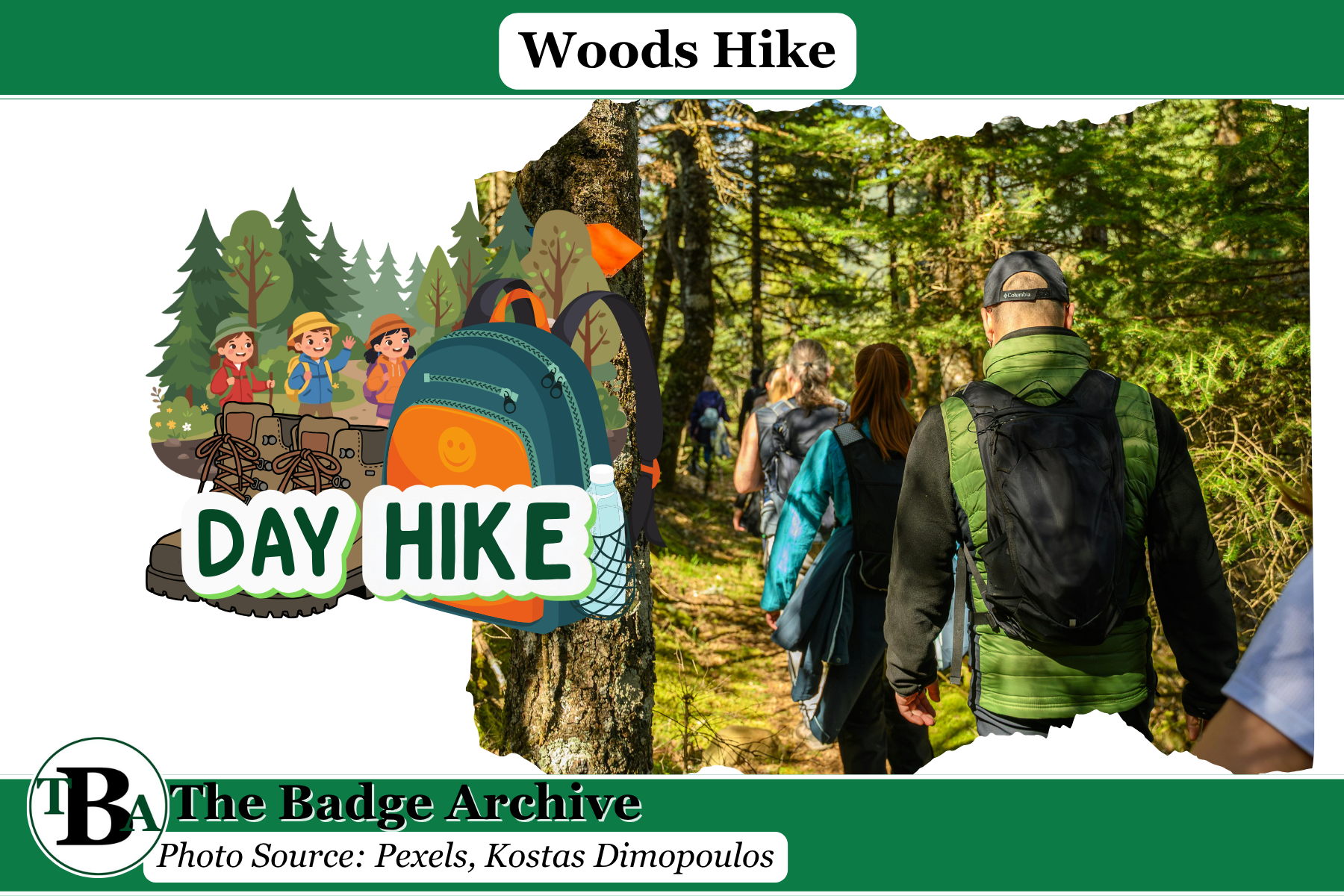
Activity Description: A day hike through a local forest or wooded area to help youth explore the woodland ecosystem, practice basic trail navigation, and enjoy being fully disconnected in nature.
Items Needed:
- Sturdy hiking boots or shoes with good traction (woodland trails are uneven and full of roots)
- Water bottles and high-energy snacks
- A physical trail map (do not rely entirely on cell service in the woods)
- Small youth backpacks equipped with a safety whistle
- Bug spray (essential for ticks and mosquitoes in wooded areas)
- (Optional) Compass for basic navigation practice
Before the Meeting Starts:
- Decide a route. (5–30 min)
- Pick a trail in a local state park or public forest. Choose a short hike with a clear destination, such as a creek, a large boulder, or a small waterfall, to keep youth engaged.
- Keep in mind that walking in the woods with rocks, roots, and uneven terrain is more physically challenging than flat surfaces, so gauge your trip by time rather than mileage.
- Consult and follow your specific youth organization’s official safety policies and activity checkpoints for hiking in wooded areas, ensuring proper adult-to-youth ratios.
Instructions (Estimated Total Time: 45 min):
- Introduce the activity and trail safety. (10 min)
- Give each youth their small backpack with a snack, water, and a safety whistle
- Explain the safety rule: if they become separated from the group, they must stop walking, stay exactly where they are (hug a tree), and blow the whistle in three sharp bursts to help adults find them.
- Review Leave No Trace principles and trail etiquette, emphasizing the importance of staying on the marked path to protect the delicate forest floor and avoid tick exposure.
- Go on a woods hike. (25 min)
- Walk the trail, allowing the youth to help set a comfortable pace.
- Pull out the physical map at trail intersections to verify your location and teach them how to read the landscape.
- Challenge them to spot the trail blazes (painted marks on trees) that keep hikers on the correct path.
- Encourage them to make observations about the environment using only things they find, like pointing out different leaf shapes, rocks, or sticks, ensuring they leave everything where they found it.
- Review their walk. (5 min)
- Discuss the differences between walking in a dense forest compared to a paved road or open field.
- Ask them to share their favorite part of the trail or the most interesting plant or animal sign they found.
- Remind them that part of the beauty of a woods hike is the chance to disconnect from technology, enjoy the quiet, and share an outdoor adventure.
Things to Look For:
- Trail Blazes and Markers: Painted rectangles on trees, metal diamonds, or stacked rock cairns that help hikers navigate the designated path.
- Forest Layers: The distinct zones of the woods, including the high canopy (tallest trees), the middle understory (smaller trees and shrubs), and the forest floor (covered in leaf litter and ferns).
- Nurse Logs: Fallen, decaying trees on the forest floor that are sprouting new life, serving as a nursery for moss, fungi, and tiny saplings.
- Signs of Wildlife: Woodpecker holes in dead standing trees (snags), scraped bark from deer rubs, or squirrel middens (piles of chewed pinecone scales left on stumps).
- Fungi and Lichen: Bracket fungi growing like shelves on tree trunks, bright mushrooms in damp soil, and crusty, pale-green lichen growing on rocks.
Common Animals:
- Squirrels and Chipmunks: Scurrying up tree trunks, darting across the trail, or leaving behind piles of chewed pinecones (middens) on stumps.
- White-Tailed Deer: Standing quietly in the brush or bounding away through the trees, flashing the white underside of their tails.
- Woodpeckers and Nuthatches: Clinging vertically to the sides of tree trunks. They are often heard drumming or tapping on bark before they are seen.
- Songbirds: Cardinals, Blue Jays, and Chickadees flitting through the middle understory and canopy, often traveling in small mixed flocks.
- Box Turtles and Toads: Perfectly camouflaged to look like fallen leaves or dirt, usually moving slowly through the leaf litter on the forest floor.
- Salamanders and Millipedes: Hiding in damp, dark environments. They can sometimes be found by carefully peeking under rotting logs or flat rocks (teach youth to always roll logs back exactly as they found them).
- Spiders and Insects: Orb weavers building webs across gaps in the trail, butterflies in sunny clearings, and ground beetles navigating the dirt and roots.
–
For More Fun Ideas and Plans

Join the Girl Scout Daisy, Brownie, and Junior Leader Help Facebook Group
(Not an official GSUSA Group)

Join the Girl Scout Cadette, Senior, and Ambassador Leader Help Facebook Group
(Not an official GSUSA Group)

See other Recommended Facebook Groups for some Scouting Organizations
(No official Groups)
–
Click Here -> To see information References:
Disclaimer: The information published on The Badge Archive is built from the references listed below. These sources demonstrate that our content is grounded in facts and research, not opinion or speculation. Readers may consult them directly when looking for additional material.
- Gantz, Dave. “Take A Hike: 5 Steps To Enjoy A Walk In The Woods.” Purple Lizard Maps, 23 Dec. 2019, https://www.purplelizard.com/blogs/news/take-a-hike-how-to-enjoy-walking-in-the-woods. Accessed 5 Oct. 2026.
- Ray, Tyler. “Hiking with Kids.” American Hiking Society, 10 Apr. 2013, https://americanhiking.org/hiking-with-kids/. Accessed 5 Oct. 2026.
- Find out how you can support The Badge Archive!
- Explore other Day Hike options.







Leave a Reply