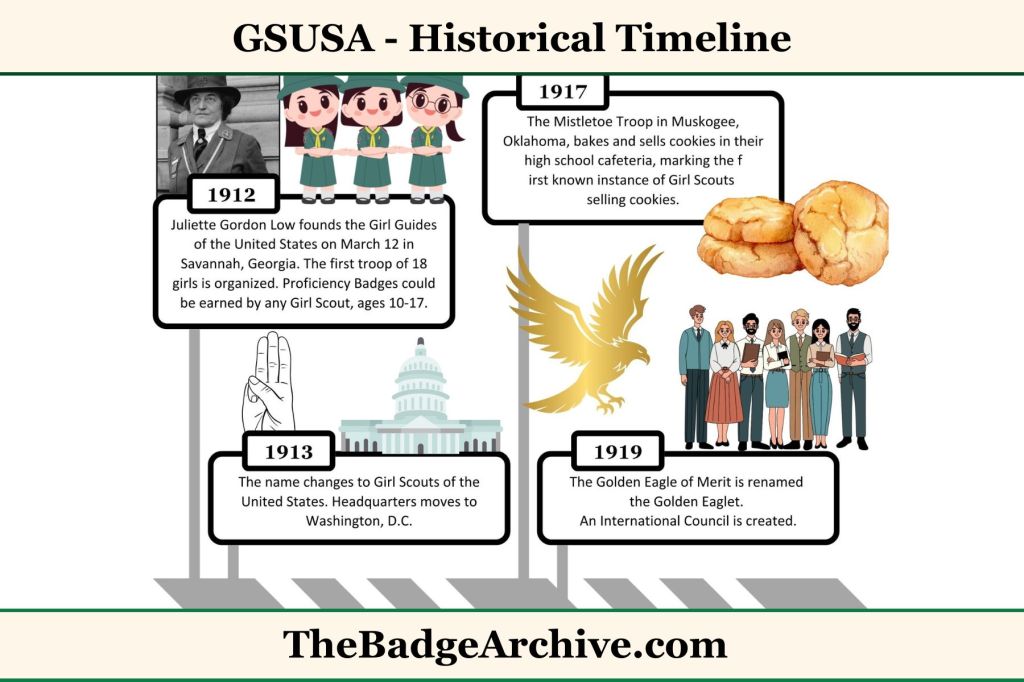
This timeline traces the major milestones in program development, including badge systems, age levels, awards, uniforms, and structural changes. It highlights how Girl Scouting has grown from a single troop in Savannah to a nationwide movement.
Explore the roots of retired badges, research how levels evolved, or simply learn curious information about how Girl Scouts earned their First Class in 1963.
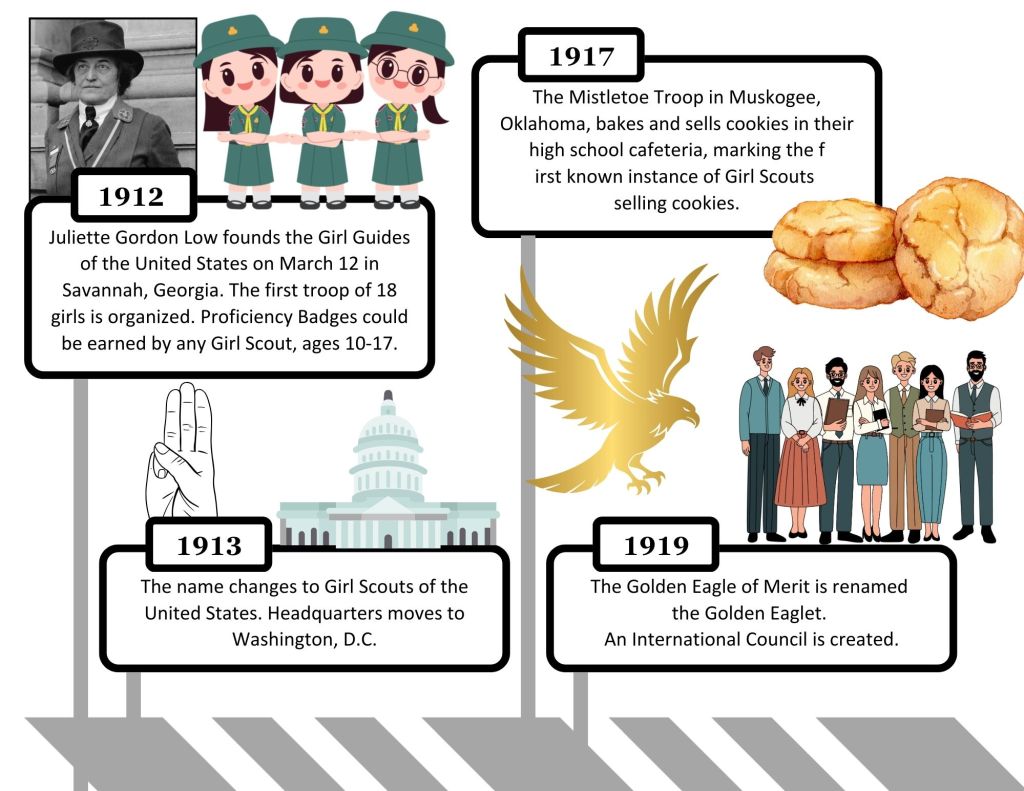
Short on time? Skip the manual formatting! Download the fully illustrated, 66-inch wall-sized version of this timeline (perfect for party decor) or the mini 3-page illustrated timeline (perfect for scout binders) for just $1 on Teachers Pay Teachers.
Looking for the basic list? You can download a clean, text-only PDF of these historical milestones for free.
- 1912 – Juliette Gordon Low founds the Girl Guides of the United States on March 12 in Savannah, Georgia. The first troop of 18 girls is organized. Proficiency Badges could be earned by any Girl Scout, ages 10-17.
- 1913 – The name changes to Girl Scouts of the United States. Headquarters moves to Washington, D.C.
- 1915 – The organization is incorporated, and headquarters moves to New York City. The first National Convention (National Council Session) is held in Washington, D.C.
- 1916 – The Golden Eagle of Merit, the first highest award for Girl Scouts, is introduced. Marblehead, Massachusetts organizes the first Brownie-age troop.
- 1917 – The Mistletoe Troop in Muskogee, Oklahoma, bakes and sells cookies in their high school cafeteria, marking the first known instance of Girl Scouts selling cookies.
- 1919 – The Golden Eagle of Merit is renamed the Golden Eaglet. An International Council is created.
- 1920 – The first International Conference of Girl Guides and Girl Scouts is held in England.
- 1922 – The Brownie level is officially recognized for girls in grades 2–3 (ages 7–9) and the first Brownie Book is published.
- 1923 – Girl Scouts are organized into patrols, troops, local councils, and a National Council. The term “Lone Girl Scout” (often shortened to “Lone Scout” in local records) is used to describe girls not attached to a troop.
- 1925 – Lone Troops on Foreign Soil (TOFS) starts in Shanghai, China.
- 1926 – Thinking Day is established at the 4th World Conference held at Camp Edith Macy in New York. February 22 is chosen to honor the birthdays of Lord and Lady Baden-Powell.
- 1927 – The khaki uniforms change to a new silver-gray fabric called “Girl Scout Green.”
- 1928 – The World Association of Girl Guides and Girl Scouts (WAGGGS) is founded at the 5th International Conference in Parád, Hungary. This formal association replaces the earlier International Council.
- 1932 – At the 7th World Conference in Poland, a Belgian delegate suggests that girls give a “birthday gift” to the movement on Thinking Day. Olave Baden-Powell asks girls to “spare a penny” for their thoughts, launching the World Thinking Day Fund.
- 1934 – The Girl Scout Council of Greater Philadelphia becomes the first to sell commercially baked cookies.
- 1936 – The national organization begins licensing commercial bakers to produce Girl Scout Cookies for councils nationwide.
- 1938 – The Golden Eaglet award is discontinued. The First Class award becomes the highest award for Intermediate Scouts.
- 1940 – The Curved Bar award is introduced as the highest honor for Intermediate Scouts who have already earned First Class. It is worn as an embroidered patch.
- 1947 – The organization is officially renamed Girl Scouts of the United States of America. Proficiency badges are restricted to Intermediate Girl Scouts (ages 10–14). Brownies and Senior Girl Scouts focus on group activities and leadership awards rather than badges. The Curved Bar award transitions from a patch to a metal pin.
- 1950 – On March 16, the United States Congress grants GSUSA a Congressional Charter.
- 1951 – TOFS – North Atlantic is organized.
- 1953 – TOFS – West Pacific is organized.
- 1955 – New Senior Interest Patches are introduced for the Senior level.
- 1963 – The Cadette level is created, establishing four age levels: Brownie (ages 7 and 8, or 2nd and 3rd grade), Junior (ages 9 through 11, or 4th through 6th grade), Cadette (ages 11 through 14, or 7th through 9th grade), and Senior (ages 14 through 18, or 10th through 12th grade).
The First Class award is reinstated as the highest honor (replacing the Curved Bar). Green Border Proficiency Badges are introduced for Juniors and Yellow Borders for Cadettes. Four Challenge pins are for Cadettes. Brownies still have no official badges. Seniors had expanded Senior Interest Patches alongside the new Eight Indispensables. - 1968 – International Friendship Recognition is introduced.
- 1971 – Pants are introduced as an official option for Senior level uniforms.
- 1972 – The number of Challenge pins available for Cadettes is expanded to eight.
- 1973 – Uniforms for Brownies, Juniors, and Cadettes are updated to a mix-and-match style, including pants as an option.
- 1976 – A pilot program for six-year-olds called “Pixies” is formed (the precursor to the Daisy level).
- 1977 – Badges are reorganized into “Worlds to Explore” and traditional Proficiency Badges are retired. Many images are retained but requirements and names are updated.
- 1978 – A second logo is adopted, giving scouts two official logo options for use.
- 1980 – The Girl Scout Gold Award and Silver Award are introduced as the highest awards, replacing the First Class award. TOFS is renamed USA Girl Scouts Overseas (USAGSO)
- 1984 – The Daisy Girl Scout level is officially introduced for kindergarten-aged girls.
- 1986 – Brownie Try-It badges are introduced.
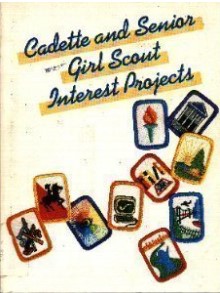
- 1987 – The standalone Cadette and Senior Girl Scout Interest Projects book is released, introducing 29 new badges and a dedicated Interest Project (IP) system.
- 1989 – Additional Brownie Try-Its are added to the program.
- 1999 – At the 30th World Conference in Dublin, Ireland, Thinking Day is officially renamed World Thinking Day. Brownie Try-Its and Junior badges begin transitioning from “Worlds to Explore” designs to single brown and green borders, respectively.
- 2000 – The Girl Scout Research Institute (GSRI) is established.
- 2001 – The Bronze Award is introduced. The Daisy Petals are introduced with no requirements to earn. Junior badges officially complete the transition to single green borders with updated requirements.
- 2002-2003 – The Studio 2B program is launched for Cadettes and Seniors. Silver and Gold Award requirements are altered to require Studio 2B activities.
- 2004 – The GSUSA National Board moves to consolidate 312 councils into 109 (although it eventually settled at 112). Cadette and Senior Interest Project badges transition to a single blue border. Cadette and Senior level Interest Project badges are changed from Worlds to Explore to a single blue border. The requirements to earn The Silver and Gold Award are redone.
- 2008 – The Ambassador level (grades 11–12) is introduced. All levels are renamed to begin with “Girl Scout” (e.g., Girl Scout Brownies). Sixth graders move from the Junior level to the Cadette level.
- 2010 – The 1978 logo is updated.
- 2011 – The Worlds to Explore program is retired and replaced by the 2011 program with Journeys and Take Action Projects (TAPs). Age divisions are finalized: Daisy (K–1), Brownie (2–3), Junior (4–5), Cadette (6–8), Senior (9–10), and Ambassador (11–12). The USAGSO Pin was redesigned.
- 2012 – The GSUSA National Board of Directors raises dues without the National Council involved. USAGSO Sunrise Ceremonies began in Guam
- 2015 – The term Individually Registered Member (IRM) is introduced to replace “Juliette.” However, the term “Juliette” still is in use today.
- 2016 – GSUSA started adding new badges to their 2011 program.
- 2017 – The Daisy level receives its first formal troop badges beyond Petals and Leaves. 4 New journeys were released.
- 2019 – Launch of new STEM badges in Cybersecurity and Space Science for all levels.
- 2020 – GSUSA launched the “Girl Scouts at Home” movement, encouraging virtual troop meetings and activities, in response to the COVID-19 pandemic.
- 2021 – GSUSA begins retiring select badges to replace them with updated versions.
- 2022 – Daisy petal requirements are completely refreshed and redone.
- 2025 – GSUSA announces the retirement of the Journey program for October 1, 2026. The new True North award and updated Global Action/Take Action awards are released to replace them. These three specific awards are now reserved for the Junior through Ambassador levels. Leadership pins (Junior Aide, Program Aide, Volunteer in Training, and Counselor in Training) are updated with new requirements.
–
For More Fun Ideas and Plans

Join the Girl Scout Daisy, Brownie, and Junior Leader Help Facebook Group
(Not an official GSUSA Group)

Join the Girl Scout Cadette, Senior, and Ambassador Leader Help Facebook Group
(Not an official GSUSA Group)

See other Recommended Facebook Groups for some Scouting Organizations
(No official Groups)
–
Click Here -> To see information References:
Disclaimer: The information published on The Badge Archive is built from the references listed below. These sources demonstrate that our content is grounded in facts and research, not opinion or speculation. Readers may consult them directly when looking for additional material.
- Degenhardt, Mary, and Judith Kirsch. Girl Scout Collector’s Guide. Lombard, IL, Wallace-Homestead Book Company, 1987, pp. 106–107, 120–136.
- Girl Scouts of California’s Central Coast. “A Century of Girl Scout Uniforms.” Girl Scout Blog, 15 Oct. 2019, girlscoutsccc.com/2019/10/15/a-century-of-girl-scout-uniforms/. Accessed 17 Jan. 2026.
- Girl Scouts of Central Maryland. “Girl Scouts’ Celebrate the 100th Anniversary of the Prestigious Gold Award 49 Local Girl Scouts Receive the “Gold” on April 17, 2016.” Gscm.org, https://www.gscm.org/content/dam/gscm-redesign/documents/gs-media/100thAnniversaryGSGoldAward.pdf. Accessed 22 Feb. 2026.
- Girl Scouts of Eastern Iowa and Western Illinois. “GSEIWI Historical Timeline.” Girlscoutstoday.org, 2015, http://www.girlscoutstoday.org/content/dam/girlscoutstoday-redesign/documents/GSEIWI%20Historical%20Timeline.pdf. Accessed 22 Feb. 2026.
- Girl Scouts of Eastern Washington and Northern Idaho. “100 Years of Gold the Highest Award in Girl Scouting.” Gsewni.org, https://www.gsewni.org/content/dam/gsewni-redesign/documents/Troop%20and%20Service%20Unit/GoldAwardHistoryProgram.pdf. Accessed 22 Feb. 2026.
- Girl Scouts of Manitou. “Fall 2022 Volunteer 411.” Gsmanitou.org, Aug. 2022, https://www.gsmanitou.org/content/dam/gsmanitou-redesign/documents/volunteer-411-august-2022.pdf. Accessed 22 Feb. 2026.
- Girl Scouts of NYPenn Pathways. “Discover Highest Awards.” Gsnypenn.org, https://www.gsnypenn.org/content/dam/gsnypenn-redesign/documents/honoring-our-heritage-patch-program/updated-files/HOH%20Discover%20Highest%20Awards-web.pdf. Accessed 22 Feb. 2026.
- Girl Scouts of the U.S.A. “2017 National Council Session/54th Convention.” Girlscoutgovernance.com, June 2018, http://www.girlscoutgovernance.com/wp-content/uploads/2018/06/NCS-Minutes-2017.pdf. Accessed 23 Feb. 2016.
- Girl Scouts of the U.S.A. “28 New Badges Embolden Girl Scouts to Navigate and Succeed in a Rapidly Changing World.” Girlscouts.org, 2021, https://www.girlscouts.org/en/footer/press-room/2021/new-badges-embolden-girls-rapidly-changing-world.html. Accessed 22 Feb. 2026.
- Girl Scouts of the U.S.A. “Blue Book of Basic Documents 2025.” GSUSA. Mar. 2025, 2024, https://www.girlscouts.org/content/dam/gsusa/forms-and-documents/footer/faqs/GSUSA_BlueBook.pdf. Accessed 22 Feb. 2026.
- Girl Scouts of the U.S.A. “Brownie Badges, Journeys and Awards.” Girlscouts.org, 2025, https://www.girlscouts.org/content/dam/gsusa/forms-and-documents/members/highest-awards/Brownie_GSUSA_BadgesAwardsAndPins.pdf. Accessed 22 Feb. 2026.
- Girl Scouts of the U.S.A. “Girl Scout Cookie History.” Girlscouts.org. https://www.girlscouts.org/en/cookies/cookie-history.html. Accessed 22 Feb. 2026.
- Girl Scouts of the U.S.A. “Girl Scout History.” Girlscouts.org. https://www.girlscouts.org/en/discover/about-us/history.html. Accessed 22 Feb. 2026.
- Girl Scouts of the U.S.A. “Girl Scouts New Brand Identity a Success on Year End Lists!” Blog.girlscouts.org, 07 Jan. 2011, https://blog.girlscouts.org/2011/01/girl-scouts-new-brand-identity-success.html. Accessed 22 Feb. 2026.
- Girl Scouts of the U.S.A. “Girl Scouts Selects Edelman to Lead Public Relations Efforts during 100th Anniversary Celebration.” Prnewswire.com, Cision PR Newswire, 22 Aug. 2011, https://www.prnewswire.com/news-releases/girl-scouts-selects-edelman-to-lead-public-relations-efforts-during-100th-anniversary-celebration-128173913.html. Accessed 22 Feb. 2026.
- Girl Scouts of the U.S.A. “Girl Scouts of the USA Reveals the Second Annual “Girls’ Choice” Badges at Macy’s 2016 Flower Show.” Prnewswire.com, Cision PR Newswire, 21 Mar. 2016, https://www.prnewswire.com/news-releases/girl-scouts-of-the-usa-reveals-the-second-annual-girls-choice-badges-at-macys-2016-flower-show-300238743.html. Accessed 22 Feb. 2026.
- Girl Scouts of San Gorgonio. “History of GSSGC From 1912 To Present.” Gssgc.org, https://www.gssgc.org/content/dam/gssgc-redesign/documents/HISTORY-OF-GSSGC-FROM-1912-TO-PRESENT.pdf. Accessed 22 Feb. 2026.
- Houston Family. “23 New STEM and Outdoor Badges Enrich Girl Scout Programming, Which Data Shows Helps Girls Excel in Life.” Houston Family Magazine, 25 July 2017, https://houstonfamilymagazine.com/news-you-can-use/23-new-stem-outdoor-badges-enrich-girl-scout-programming-data-shows-helps-girls-excel-life/. Accessed 22 Feb. 2026.
- McCarthy, Kelly. “Girl Scouts Launches 42 New Badges to Mobilize Girls to Change the World.” ABC News, 16 July 2019, https://abcnews.com/GMA/Living/girl-scouts-reveal-42-badges-girls-control/story?id=64294186. Accessed 23 Feb. 2026.
- Prihar, Asha. “Thin Mints or Caramel DeLites? Girl Scout Cookie Season Got Its Start in Philadelphia.” Billy Penn at WHYY, 21 Jan. 2022, https://billypenn.com/2022/01/21/girl-scout-cookies-philadelphia-origin-story/. Accessed 22 Feb. 2026.
- Robertson, Ann. “Badges, and Try-Its, and IPs, Oh My.” Girl Scout History Project, 14 Apr. 2015, https://gshistory.com/2015/04/14/badges-and-try-its-and-ips-oh-my/. Accessed 22 Feb. 2026.
- Robertson, Ann. “Brownie Badges: We Tried It, Girls Loved It!” Girl Scout History Project, 07 Oct. 2016, https://gshistory.com/2016/10/07/brownie-badges-we-tried-it-girls-loved-it/. Accessed 22 Feb. 2026.
- Robertson, Ann. “Girl Scout National Convention Highlights.” Girl Scout History Project, 16 July 2023, https://gshistory.com/2023/07/16/girl-scout-national-convention-highlights/. Accessed 22 Feb. 2026.
- Robertson, Ann. “Pants! We Want Pants!” Girl Scout History Project, 28 Aug. 2020, https://gshistory.com/2020/08/28/pants-we-want-pants/. Accessed 22 Feb. 2026.
- Robertson, Ann. “Pixies? Girl Scout Pixies?” Girl Scout History Project, 4 Oct. 2024, https://gshistory.com/2024/10/04/girl-scouts-pixies/. Accessed 22 Feb. 2026.
- USA Girl Scouts Overseas. “History of USAGSO.” Girl Scouts of the USA, 2024, https://www.usagso.org/en/discover/our-council/history-faqs.html. Accessed 22 Feb. 2026.
- World Association of Girl Guides and Girl Scouts. “Symbols of the Movement.” WAGGGS, https://www.wagggs.org/en/about-us/who-we-are/symbols-movement/. Accessed 22 Feb. 2026.
- World Association of Girl Guides and Girl Scouts. “World Thinking Day 2026.” WAGGGS, https://www.wagggs.org/en/what-we-do/world-thinking-day/. Accessed 22 Feb. 2026.
- Wrinkle, Tim, et al. “A Scout by Any Other Name.” National Museum of American History, 11 Mar. 2019, americanhistory.si.edu/explore/stories/scout-any-other-name. Accessed 22 Feb. 2026.
–
- Find out how you can support The Badge Archive!
Short Link: https://tinyurl.com/4c2z87xm


 The Badge Archive