Welcome to the adventure of leading a Girl Scout troop. It is completely normal to feel a bit overwhelmed right now. The good news is that Girl Scouts is flexible. There is no single “right” way to run a troop meeting. Your troop’s flow will evolve as your girls grow and decide on their own interests (this is the “Girl-Led” part!).
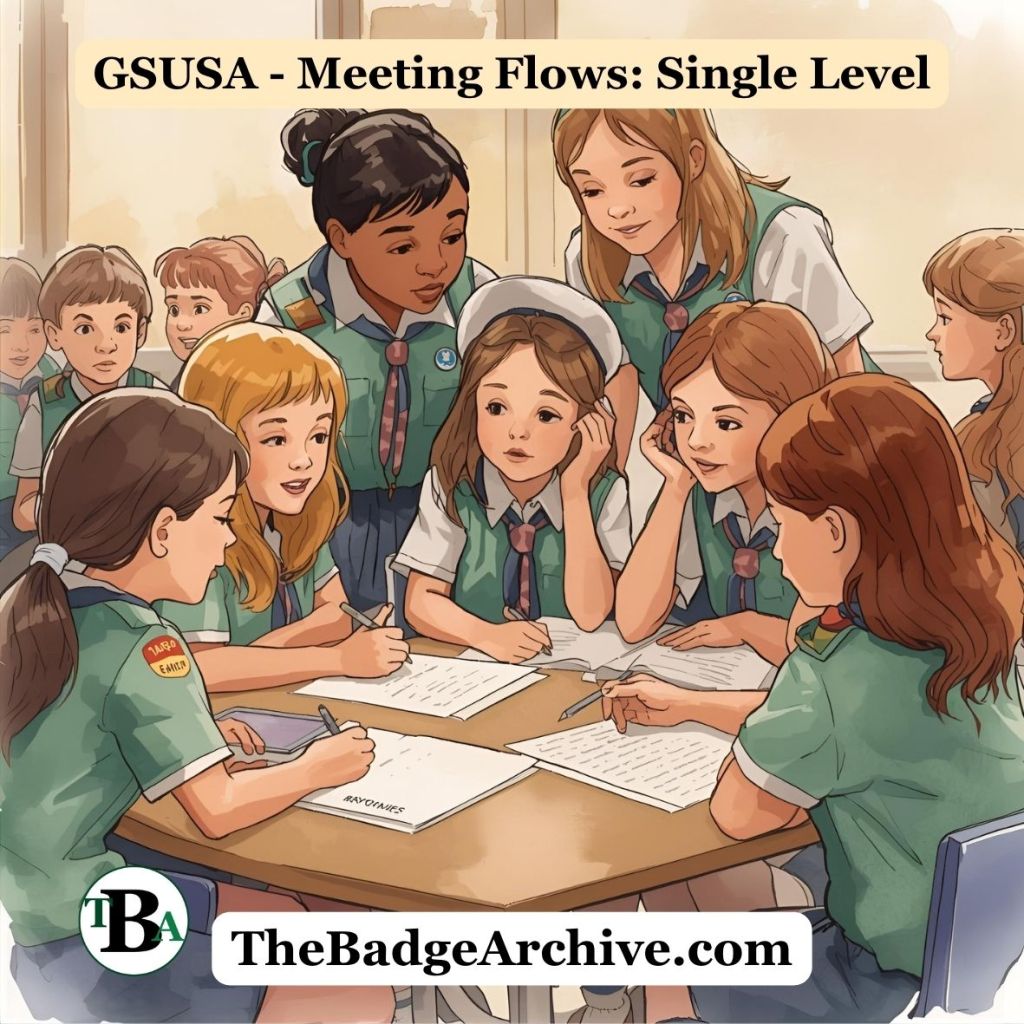
To help you get started, here is a look at three common meeting flows that single-level troops often adopt. You can mix and match elements to find what works best for your girls, your co-leader, and your meeting frequency.
The Traditional Flow: The Time-Tested Standard
This is the most common and versatile structure, providing a great balance of routine, badge work, and camaraderie. This structure is often used by troops that meet every two to three weeks for about 60 to 90 minutes. It gives the troop enough time to deep-dive into a main activity.
The Traditional Agenda (60–90 Minutes):
- Gathering Activity (5–15 Minutes): This is a low-key activity for early arrivals, like a coloring page, quiet craft, or simple game that keeps girls occupied until the official start time. (See Gathering Activity page for more ideas.)
- Opening Routine (5–10 Minutes): This is the formal start that sets the mood and establishes Girl Scout identity. It usually involves a Pledge of Allegiance, the Girl Scout Promise and Law, and sometimes a troop song. (For more on this, check out Opening Routine)
- Troop Business (5–10 Minutes): Quick check-in for attendance, collecting dues, sharing important announcements about upcoming events, or quick planning discussions (for older girls). (Although this is often considered part of the Opening Routine)
- Main Activity (30–60 Minutes): This is the core of the meeting, dedicated to one of the following:
- Working through a full step of a badge or Journey.
- A guest speaker or skill-building workshop.
- Planning or prepping for a service project.
- A significant craft project.
- Clean Up (5 Minutes): A designated time for the girls to put away supplies and tidy the space. Many troops use a “Kaper Chart” to assign clean-up duties.
- Closing Routine (5 Minutes): A moment for reflection, a final song, and the Friendship Circle/Squeeze. (Find more ideas here: Closing Routine)
The Structured Flow: Planning for Consistency
This structure is more detailed and works well for troops that meet weekly and want to ensure steady, predictable progress on their goals. It takes a larger badge and breaks it down into small, manageable pieces over many weeks. The consistent rhythm makes it feel safe and familiar for younger girls (like Daisies and Brownies).
The Structured/Routine Agenda (60 Minutes):
- Gathering Activity (5–10 Minutes): As girls arrive, they jump into a pre-set, easy activity. This helps manage the transition from school/home. (See Gathering Activity page for more ideas.)
- Opening Routine (5–10 Minutes): This includes a quick Promise/Law recitation and perhaps a structured moment for each girl to share something (e.g., her “high” of the week, or an answer to a simple prompt). (For more on this, check out Opening Routine)
- Badge Block (15–20 Minutes): Focus on a single, simple badge step. For example, if a badge has five requirements, you focus only on requirement one this week, requirement two next week, and so on.
- Routine/Service Element (10–15 Minutes): This is a consistent, non-badge activity that anchors the week. This could be writing one thank-you note to a community helper, practicing a skill like first aid, or learning a new song.
- Game/Social Time (10–15 Minutes): Supervised playtime or a fun, high-energy game to break up the learning and build troop friendships.
- Clean Up & Closing Routine (5 Minutes): A quick tidy followed by the formal closing. (Find more ideas here: Closing Routine)
The Flexible Flow: Prioritizing Connection
This is common for troops whose primary goal is building social connections and having fun, and less focused on strict badge completion, or for older girls who just need a social outlet.
The Connection-Focused Agenda (45–90 Minutes):
- Soft Arrival (5–10 Minutes): Girls arrive and simply start interacting socially—chatting, working on a low-stress craft, or engaging in a simple icebreaker game set up by the leader. There is no rigid structure for this period.
- Quick Opening Routine (Optional, 2 Minutes): A lightning-fast moment of the Promise/Law, or simply a group “shout-out” or cheer, or sometimes no formal opening at all. (For more on this, check out Opening Routine)
- Main Activity (35–65 Minutes): The primary goal is FUN and bonding:
- Playing high-energy group games or team builders.
- A low-stress, fun-themed craft or activity (e.g., a simple tie-dye session, a themed party, making a personalized item).
- Just simple social time for older girls to check in with each other.
- Wrap-up (5–15 Minutes): Supplies are collected, and a friendly, informal farewell is given. There is typically no formal closing routine.
For More Help
Remember, the best meeting flow is the one that your Girl Scouts enjoy and feel ownership over. You and your co-leader should start with a structure that feels manageable for you, and then let the girls take the lead in adapting it. Don’t be afraid to try one style for a month, then switch to another!
You might also want to check out the First Four Meetings Guide for Volunteers from Girl Scouts of Greater New York as a helpful tool when starting out. If nothing else, it gives a good view of what a traditional meeting structure would be like.
For more help as a New Leader – check out our New Leader Checklist, the New Leaders Need… article with advice from multiple experienced Leaders, and our Girl Scout Leader 101 section.
Multi-Level Leaders will want to check out our Multi-Level Themes Section and the pages regarding Multi-Levels such as: Multi-Level: Structure, Multi-Level: Activities, Multi-Level: Finances, and Multi-Level: Encouraging Leadership.



 The Badge Archive