Items Needed
- Large sheet of paper or poster board
- Markers or pens
- (Optional) Sample Code of Conduct (see list below activity)
Instructions
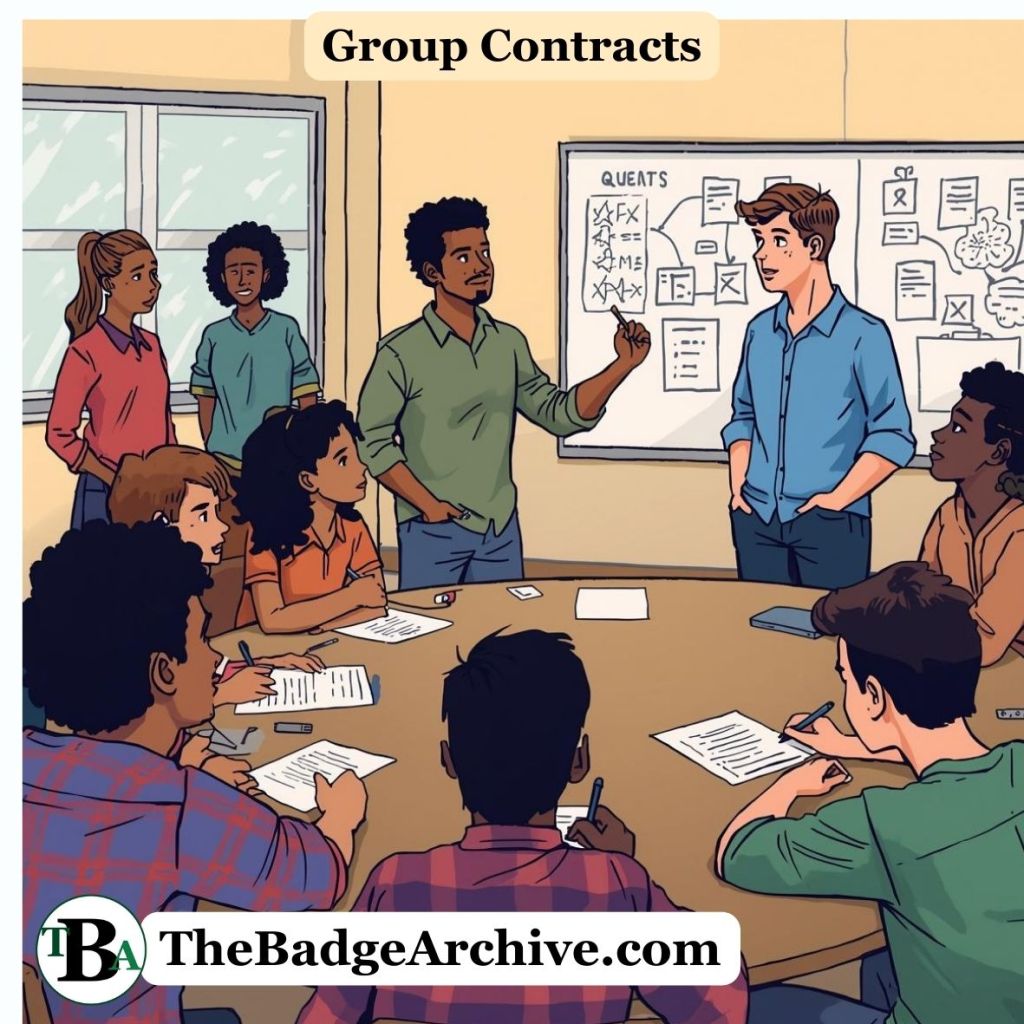
- Explain to scouts that they will work together to create a set of group agreements about how everyone should behave to keep activities fun and respectful. Ask scouts to suggest behaviors they think should be included (e.g., listening to others, sharing, helping teammates).
- Write these ideas visibly for everyone to see. Discuss and agree on the final list of behaviors as a group.
- Write the agreed-upon behaviors on the large sheet of paper or poster board and display it where everyone can see.
- Have each scout sign the contract to show their commitment to the group agreements. Refer back to the contract as needed to reinforce positive behavior and accountability.
Sample Group Agreements
These are several samples other scout leaders have offered as possible starts to form your own group agreement.
Signature lines are usually as follows:
Scout’s Signature________________________________________ Date________________________
Parent’s Signature___________________________________________ Date________________________
Friends and Troopmates
In our troop, we have two options for how we treat each other:
We can be FRIENDS. This means:
- We hang out together.
- We help each other.
- We joke and laugh with each other.
- We stick up for each other.
- We like and trust each other.
- We don’t gossip about each other.
OR, we can be TROOPMATES. This means:
- We respect each other.
- We are polite to each other.
- We don’t ignore each other.
- We don’t talk negatively about each other.
- We aren’t mean to each other.
- We don’t make faces or gestures meant to hurt each other.
- We don’t stop each other from making or having friends.
- We don’t try to hurt each other (physically, verbally, or online).
This is NOT an option: Being Enemies. If you act like this, there will be consequences. Being an enemy means:
- You try to hurt others (physically, verbally, or online).
- You make fun of others to be mean.
- You stop others from making or having friends.
- You try to get someone in trouble for something they didn’t do.
- You push, shove, or act aggressively.
- You intentionally ignore others to upset them.
- You make unwarranted negative or hurtful comments.
- You intimidate others using body language or gestures (eye rolling, glaring, etc.).
We agree to be troopmates or friends.
<Add Signature Line>
Scout Law
I agree to follow the principles of the Scout Promise and Law. I understand that these values help us create a space that is safe, inclusive, and fun for everyone.
- Safety & Success: I will follow the rules designed to protect myself and others. I understand these rules are there to ensure our activities are successful and enjoyable for the whole group.
- Respect for All: I will treat myself, my peers, our leaders, and our equipment with respect. This includes being considerate of others’ feelings and belongings.
- Constructive Communication: I will be respectful of my Scout Leaders. If I disagree or feel disappointed, I will ask questions calmly and express my opinions in a respectful manner without resorting to insults or arguing.
- Inclusion of Ideas: I recognize that others have thoughts and perspectives different from mine. I will listen without making fun of others and will share my own ideas in a way that is mindful of the group.
- Physical & Emotional Boundaries: I will not bully or use physical force (such as hitting or unwanted touching). I understand that maintaining a safe environment is our top priority.
We are all human, and sometimes we forget the rules. When I struggle to follow this agreement, my leaders will use these steps to help me get back on track.
- Step 1: The Gentle Reminder: A leader will talk with me about the Scout Law. We will discuss what happened, and I will offer an apology or find a way to “make it right” if my actions hurt someone. Since leaders often talk to scouts about correcting behavior as a normal part of being part of a troop, a leader will formally tell you if your behavior has reached “Step 1.” Otherwise it does not count as a “Step”.
- Step 2: The Family Reminder: If I forget the rules again, my leader will talk to my parents or guardians. This helps my family understand how to support me so I can have a great time at scouts.
- Step 3: The Team Meeting: If I am still having a hard time, my leader, my parents, and I will meet to make a plan. We might decide that a parent needs to stay with me at meetings for a few weeks to help me stay focused.
- Step 4: Finding the Best Fit: If these steps haven’t helped and my behavior is making it hard for the group to be safe or have fun, we will have a final meeting. We will discuss if there is a different way for me to participate in scouting that works better for my needs.
These steps are designed to help you during a specific meeting or event. The steps reset at the end of every meeting. If you have a hard time one meeting and reach Step 1, you start with a clean slate at the next meeting. We believe every day is a new chance to do your best!
<Add Signature Line>
Note to Leaders: Step 4 is reserved for major, persistent issues that impact the safety or mission of the group. Talk to the family about potentially finding a new group that fits their need better is an option at that point. But there is no need to alarm new scouts. Simple misbehaviors are a natural part of learning and should be handled with the “gentle reminders” and earlier steps.
Links to Sample Contracts
- Cub Scout Pack 2143 Behavior Contract
- Cub Scout Pack Behavior Contract
- Cub Scout Simon Kenton Council Den Code of Conduct
- Cub Scout Tewksbury Pack 49 Code of Conduct
- Cub Scout 2019 Den and Pack Behavior and Discipline – Activity Instructions
- Girls Scouts of Arizona Cactus Pine – Includes leader “Guide to Managing Girl Behavior”
- Girl Scouts of Central Texas
- Girls Scouts of Colorado
- Girl Scouts of Greater Atlanta
- Girl Scouts of Maine
- Girl Scouts of Northeast Ohio
- Girl Scouts of Orange County – Includes Troop Agreement Activity Instructions
- Scouting America Troop 336 Behavior Contract
- Scouting America Troop 356 Behavior Contract
- Scouting America BSA Scouting Official Code of Conduct
–
For More Fun Ideas and Plans

Join the Girl Scout Daisy, Brownie, and Junior Leader Help Facebook Group
(Not an official GSUSA Group)

Join the Girl Scout Cadette, Senior, and Ambassador Leader Help Facebook Group
(Not an official GSUSA Group)

See other Recommended Facebook Groups for some Scouting Organizations
(No official Groups)
–
Click Here -> To see information References:
Disclaimer: The information published on The Badge Archive is built from the references listed below. These sources demonstrate that our content is grounded in facts and research, not opinion or speculation. Readers may consult them directly when looking for additional material.
- Girl Scouts Arizona Catctus-Pine. “Guide to Managing Girl Behavior.” Girlscouts.org, 2018, my.girlscouts.org/content/dam/girlscoutsaz/documents/volunteer-resources/guide-to-managing-girl-behavior-2018.pdf. Accessed 28 Jan. 2026.
- Girl Scouts of Orange County. “Creating a Troop Agreement – Troops and Parents.” Girlscoutsoc.org, Girl Scouts of Orange County, http://www.girlscoutsoc.org/content/dam/girlscoutsoc-redesign/documents/VolunteerResources/Creating_Troop_and_Parent_Agreements_S_and_S.pdf. Accessed 28 Jan. 2026.
- Scouting America. “Interest Topic: Den and Pack Behavior and Discipline.” Scouting.org, 2019, http://www.scouting.org/wp-content/uploads/2019/03/Den-and-Pack-Behavior-and-Discipline-2019.pdf. Accessed 28 Jan. 2026.
- Scouting America. “Scouting America Scouter Code of Conduct.” Scouting.org, 4 Mar. 2025, http://www.scouting.org/health-and-safety/gss/bsa-scouter-code-of-conduct/. Accessed 28 Jan. 2026.
–
- Find out how you can support The Badge Archive!



 The Badge Archive