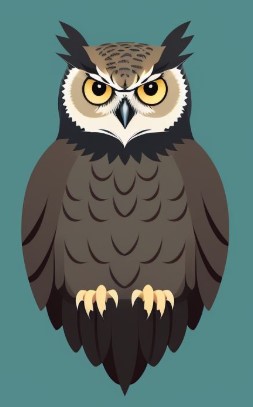
Basic Facts
- Common Name: Great Horned Owl
- Scientific Name: Bubo virginianus
- Diet: Carnivore
- Average Life Span In The Wild: 5 to 15 years
- Average Life Span In Captivity: Close to 40 years
- Size: Body: 18 to 25 inches
- wingspan: 3.3 to 5 feet
- Weight: 2 to 5.5 pounds
Appearance
- Tufts of feathers that look like horns gives it the Great Horned Owl name.
- Part of the Raptor family, with strong wings to soar and dive after prey.
- Their feathers are soft to help muffle the sound of them flying.
- Sharp eyesight to see small animals while high in the sky.
- Four talons on each foot to catch and kill prey. Two face forward, one back, and the fourth faces forward when perching, but backwards when grabbing prey.
- Hooked beaks to help them tear their prey into smaller pieces.
- Black, gray, red-brown, or white mix of colors with lighter colors on their stomachs.
- White patch on their throats and striped bands on their stomachs.
- Their feathers are patterned to look like the bark of a tree to blend in.
- Large, round, yellow eyes with a black ring around them with night vision.
Diet
- Very small animals (crows, mice, squirrels)
- Small animals (cats, dogs, ducks, geese, rabbits, raccoons, skunks, voles)
- Live or dead animals
- Swallows very small animals whole and tears larger prey into smaller pieces.
Habitat
- In all three Americas (North, Central, and South).
- Both cold and warm environments, but prefer few people around.
- Dense forests with lots of prey.
- Rocky areas with canyons and tall cliffs they can perch and wait for prey.
- City parks or near farmland where there are small animals to prey on.
Life Cycle
- They often mate for life.
- Female owls usually have lay 1-4 eggs in late winter.
- They use empty nests built by other big birds.
- The male owl brings food, the female stays to warm the eggs.
- The eggs take 30-37 days to hatch.
- Baby owls are called owlets
- The parents place food on nearby branches when owlets are 5-6 weeks old to get them out of the nest.
- The parents care for the young for a few months and then stop feeding them to force them to hunt by themselves.
- By autumn of the following year, the young are ready to be on their own.
Fun Facts
- Great Horned Owls are sometimes called Cat Owls because the tufts also look like cat ears.
- Great Horned Owls move their ear tufts to communicate with other Great Horned Owls, or puff up to look more threatening.
- Most live in the same place all year, but a few in the far north will migrate south in the winter.
- Their feet and toes have feathers.
- Females are larger than the males.
- They can hunt in complete darkness using their strong hearing. They can even hear prey under leaves or snow.
- They cannot turn move their eyes like humans can, which is why they can turn their heads almost all the way around.
- When hunting, they prefer doing so from a perch and not when soaring in the sky.
- Foxes, coyotes, and hawks will eat eggs and owlets.
- After swallowing, and digesting most of the prey, the undigested parts of the small animals (feathers, fur, bones) are thrown up in pellets that look like poop, but isn’t poop.
Reference:
- Animal: Great Horned Owl (no date) National Geographic. Available at: https://www.nationalgeographic.com/animals/birds/facts/great-horned-owl (Accessed: 18 December 2024).
- Frick, Ivi. Hunting with Great Horned Owls. Gareth Stevens Pub, 2013.
- Leaf, C. (2016) Great horned owls. Minneapolis, MN: Bellwether Media.





 The Badge Archive