Grace Hopper was an amazing woman who loved solving problems and working with computers. She was born on December 9, 1906, in New York City. As a child, she was very curious and even took apart seven alarm clocks to see how they worked!
Grace became a mathematician and a computer scientist. She helped create one of the first computers and invented a way to make computer programming easier by using English words instead of just numbers. This invention led to the creation of a programming language called COBOL, which is still used today.
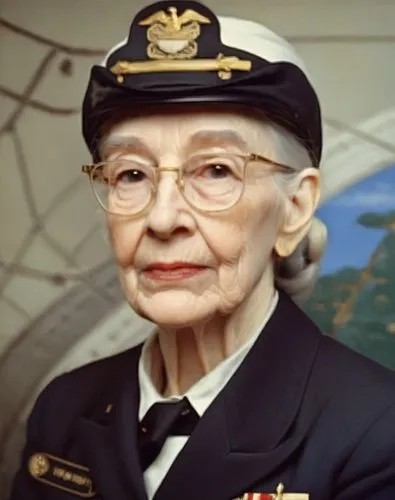
Grace also served in the U.S. Navy and became a high-ranking officer. She worked on important computer projects and was known for her dedication and hard work. Grace Hopper passed away on January 1, 1992, but her contributions to computer science and her inspiring story continue to be remembered and celebrated
Videos
- Women’s Stories (2:23)
- Biography (2:26)
- HERstory in STEM (3:33)
- Fascinating Stories (2:17)
- Bedtime History (10:45)
GSUSA Law Line
“Grace Hopper made the world a better place. Without her pioneering computer technology, we would not have computers in our homes today. With computers we are able to do fun projects with Girl Scouts, school is easier, and I love playing video games. Grace Hopper made my world a better place.” – Scout K., GSSJC – Girl Scouts of San Jacinto Council, Juliette
Timeline
- 1906 – Grace Hopper was born on December 9, in New York City, New York. The oldest of three children from Walter Fletcher Murray and Mary Campbell Van Horne.
- 1913 – At the age of 7, Grace Hopper’s curiosity led her to take apart seven alarm clocks to see how they worked. Her mother, recognizing her inquisitive nature, took away six of the disassembled clocks but left one for her to continue exploring.
- 1922 – At the age of 16, Grace Hopper applied to Vassar College but was initially rejected due to her low grades in Latin. She didn’t give up. She was accepted to Vassar the following year. She went on to study mathematics.
- 1928 – Grace Hopper graduated from Vassar College with a Bachelor’s degree in Mathematics and Physics.
- 1930 – Grace Hopper continued her education and earned a Master’s degree in Mathematics from Yale University. Grace’s dedication to learning and her pursuit of higher education were key factors in her many achievements and contributions to technology.
- 1934 – Grace Hopper graduated with her Doctorate (PhD) in Mathematics from Yale University.
- 1943 – Grace Hopper joined the United States Navy Reserve to serve her country during World War II. The following year, she was made a Lieutenant.
- 1944 – Grace Hopper and her team built the first computer in America, known as the Mark I computer. It was enormous, about the size of a bedroom!
- 1947 – The Mark II computer broke down. Upon investigating, Grace Hopper’s team discovered a moth inside the machine. They carefully removed the moth and referred to the process as “debugging,” a term that is still used in computer science today to find and fix problems.
- 1949 – Grace Hopper and her team created the first electronic digital computer for commercial use, known as the UNIVAC (Universal Automatic Computer).
- 1959 – Grace Hopper played a key role in inventing the programming language COBOL (Common Business-Oriented Language). It is still used today in various applications
- 1966 – After retiring, Grace Hopper was called back to Naval duty twice! During her time in service, she was promoted to the rank of Captain. Grace’s dedication and expertise made her an invaluable asset to the Navy and the field of computer science.
- 1986 – Grace Hopper was awarded the Defense Distinguished Service Medal, the highest non-combat honor given by the Department of Defense. She retired for good later that year.
- 1991 – Grace Hopper was awarded the National Medal of Technology by President George H. W. Bush. She was the first woman to receive this prestigious honor
- 1992 – Grace Hopper passed away at the age of 85. In her honor, the Grace Hopper Celebration of Women in Computing conference was created to encourage and support women in the field of computer science.
- 2016 – Grace Hopper’ was posthumously awarded the Presidential Medal of Freedom by President Barack Obama in 2016. This prestigious honor recognized her groundbreaking work in computer programming and her significant contributions to the field of computer science.
–
References
Ehlinger, Samantha. “Grace Hopper, Margaret Hamilton Receive Presidential Medals of Freedom.” FedScoop, 22 Nov. 2016, fedscoop.com/grace-hopper-margaret-hamilton-awarded-presidential-medals-of-freedom/. Accessed 1 Mar. 2025.
“Grace Hopper.” Britannica Kids, kids.britannica.com/kids/article/Grace-Hopper/629259. Accessed 1 Mar. 2025.
“Grace Hopper.” Britannica Kids, kids.britannica.com/students/article/Grace-Hopper/326636. Accessed 1 Mar. 2025.
“Grace Hopper.” National Science and Technology Medals Foundation, nationalmedals.org/laureate/grace-hopper/. Accessed 1 Mar. 2025.
“Grace Hopper Facts for Kids.” Kids.kiddle.co, kids.kiddle.co/Grace_Hopper. Accessed 1 Mar. 2025.
“Hopper, Grace.” National Women’s Hall of Fame, http://www.womenofthehall.org/inductee/grace-hopper/. Accessed 1 Mar. 2025.
The Maritime Executive. “Grace Hopper Awarded Presidential Medal of Freedom.” The Maritime Executive, 23 Nov. 2016, maritime-executive.com/article/grace-hopper-awarded-presidential-medal-of-freedom. Accessed 1 Mar. 2025.
VTK Grace Hopper from GSUSA
Wikipedia Contributors. “Grace Hopper.” Wikipedia, Wikimedia Foundation, 22 Mar. 2019, en.wikipedia.org/wiki/Grace_Hopper. Accessed 1 Mar. 2025.
–
For More Fun Ideas and Plans
for Daisy, Brownie, and Junior Scouts
Join the Girl Scout Daisy, Brownie, and Junior Leader Help Facebook Group
(Not an official GSUSA Group)

This is a supportive Facebook community for Daisy, Brownie, and Junior Girl Scout leaders. Whether you’re seeking advice, fresh ideas, or meeting plans, you’re in the right place! Let’s inspire each other, share our experiences, and make every troop meeting a memorable adventure.
for Cadette, Senior, and Ambassador Scouts
Join the Girl Scout Cadette, Senior, and Ambassador Leader Help Facebook Group
(Not an official GSUSA Group)

This is a supportive community for Cadette, Senior, and Ambassador Girl Scout leaders. This group offers solutions to keep older scouts engaged in scouting amidst their busy lives. Share strategies, tackle challenges, and exchange ideas for fun, meaningful activities that resonate with teens and build lasting connections.
Find out how you can support The Badge Archive!
–
For more Historical and Notable Figures:
- 50 Famous Girl Scouts
- Beauty Icon Bios
- Famous Women by Law Line
- U.S. Current Notable Figures by State
- U.S. Historical Figures by State
- U.S. State Military Personnel
- U.S. State Philanthropists
- Bonus: Spotlight – Current Women Helpers
–





 The Badge Archive