Ada Lovelace from GSUSA
Ada Lovelace lived a long time ago, born on December 10, 1815. She really liked math and science and was very good at them.
When she was 17, she became friends with a professor named Charles Babbage, who made a Different Engine No. 1 that could do calculations. Later, he worked on a bigger machine called the Analytic Engine.
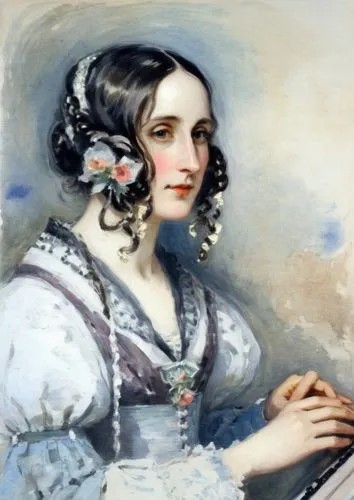
In 1843, Professor Babbage asked Ada to translate a paper about his Analytic Engine. He thought Ada was really good at understanding it. While translating, Ada added lots of notes and ideas on how the machine could be used in the future. She even wrote special instructions – the first computer programs – for the machine to do math.
Unfortunately, Ada and Charles both passed away before the Analytic Engine was built.
In 1991, scientists at the London Science Museum made one of Professor Babbage’s machines, and Ada Lovelace was recognized as the first computer programmer ever.
Videos
- History’s Who’s Who (1:46)
- Seeker (4:25)
- SciShow (3:30)
GSUSA Law Line
“Ada Lovelace shows how being considerate and caring can help make the world a better place. She did not get paid to help Professor Babbage. She did it because of her love of math and caring about a friend who needed her. Her work helped lay the foundation of computer programs that we use hundreds of years later.” – Ms. Tia, GSSJC – Girl Scouts of San Jacinto Council, Troop Leader
Timeline
- 1815 – Ada was born in London, England, on December 10. She really liked math and science and was very good at them.
- 1816 – Ada’s father Lord Bryon left England permanently.
- 1823 – Charles Babbage brought Joseph Clement a prototype difference engine design.
- 1824 – Ada’s father died in Greece. Ada never knew her father.
- 1832 – Joseph Clement completed Different Engine No. 1, with about 2,000 parts.
- 1833 – Ada was introduced to Professor Charles Babbage by their mutual friend, author Mary Somerville.
- 1835 – On July 8 she married Baron William King.
- 1837 – Charles Babbage wrote the first program for his Analytical Engine.
- 1838 – William King became and Earl and Ada became Countess of Lovelace.
- 1842 – Luigi Federico Menabrea, an Italian mathematician and engineer wrote “Notions sur la machine analytique de Charles Babbage”. That translates to “Elements of Charles Babbage’s Analytical Machine”.
- 1843 – Professor Babbage asked Ada to translate Menabrea’s paper about his machine.
- 1852 – Ada died in London, England, on November 27.
- 1971 – Charles Babbage died in London, England on October 18. A large model of the Analytical Engine was under construction at the time, but a full-scale version was never built.
- 1991 – Charles Babbage’s Difference Engine No. 2 was built.
- 2000 – Charles Babbage’s printer for the Difference Engine No. 2 was built.
- 2009 – Technologist Suw Charman-Anderson established Ada Lovelace Day on the second Tuesday in October. It is meant to highlight the pioneering contributions of Ada and celebrate women in STEM.
–

NOTE – A Printable Meeting for Daisy Coding Basics badge, with 7 illustrated picture sheets of the story of Ada Lovelace, 4 seed to flower algorithm cards, 8 Ada Lovelace timeline cards, and an easy to use Sorting Algorithm printable is available on Teachers Pay Teachers.
–
References
“ADA Lovelace Day – October 13.” National Today, 13 Oct. 2021, nationaltoday.com/ada-lovelace-day/. Accessed 2 Mar. 2025.
Biography.com Editors. “Ada Lovelace – Quotes, Children & Facts.” Biography, 6 May 2021, http://www.biography.com/scholars-educators/ada-lovelace. Accessed 2 Mar. 2025.
“Charles Babbage’s Difference Engines and the Science Museum | Science Museum.” Www.sciencemuseum.org.uk, 18 July 2023, http://www.sciencemuseum.org.uk/objects-and-stories/charles-babbages-difference-engines-and-science-museum. Accessed 2 Mar. 2025.
The Editors of Encyclopedia Britannica. “Ada Lovelace | Biography & Facts.” Encyclopædia Britannica, 23 Nov. 2018, http://www.britannica.com/biography/Ada-Lovelace. Accessed 2 Mar. 2025.
The Editors of Encyclopedia Britannica. “Charles Babbage | Biography & Facts.” Encyclopædia Britannica, 2019, http://www.britannica.com/biography/Charles-Babbage. Accessed 2 Mar. 2025.
Jack, Copeland B. “The Modern History of Computing (Stanford Encyclopedia of Philosophy).” Stanford.edu, 18 Dec. 2000, plato.stanford.edu/entries/computing-history/. Accessed 2 Mar. 2025.
Wikipedia Contributors. “Charles Babbage.” Wikipedia, Wikimedia Foundation, 7 Sept. 2019, en.wikipedia.org/wiki/Charles_Babbage. Accessed 2 Mar. 2025.
–
For More Fun Ideas and Plans
for Daisy, Brownie, and Junior Scouts
Join the Girl Scout Daisy, Brownie, and Junior Leader Help Facebook Group
(Not an official GSUSA Group)

This is a supportive Facebook community for Daisy, Brownie, and Junior Girl Scout leaders. Whether you’re seeking advice, fresh ideas, or meeting plans, you’re in the right place! Let’s inspire each other, share our experiences, and make every troop meeting a memorable adventure.
for Cadette, Senior, and Ambassador Scouts
Join the Girl Scout Cadette, Senior, and Ambassador Leader Help Facebook Group
(Not an official GSUSA Group)

This is a supportive community for Cadette, Senior, and Ambassador Girl Scout leaders. This group offers solutions to keep older scouts engaged in scouting amidst their busy lives. Share strategies, tackle challenges, and exchange ideas for fun, meaningful activities that resonate with teens and build lasting connections.
Find out how you can support The Badge Archive!
–
For more Historical and Notable Figures:
- 50 Famous Girl Scouts
- Beauty Icon Bios
- Famous Women by Law Line
- U.S. Current Notable Figures by State
- U.S. Historical Figures by State
- U.S. State Military Personnel
- U.S. State Philanthropists
- Bonus: Spotlight – Current Women Helpers
–



 The Badge Archive