- Common Name: Green Cardamom Essential Oil
- Botanical Name: Elettaria cardamomum
- Family: Zingiberaceae (Ginger family)
- Synonyms: True Cardamom, Malabar Cardamom
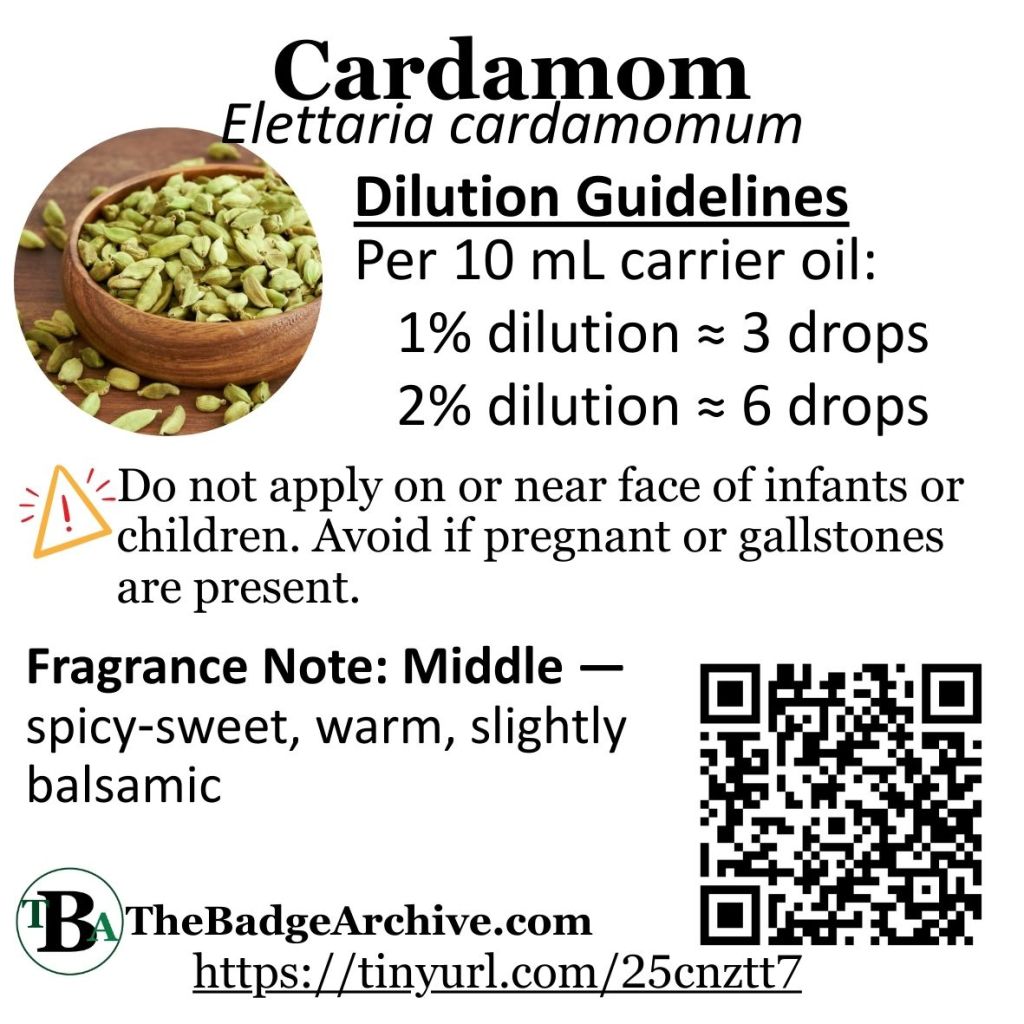
- Fragrance Note: Middle — spicy‑sweet, warm, slightly balsamic
Green cardamom is native to southern India and Sri Lanka and is widely cultivated across tropical Asia. The essential oil is steam‑distilled from the seeds of Elettaria cardamomum, producing a sweet, spicy aroma valued in both traditional medicine and modern aromatherapy. Unlike black cardamom (Amomum subulatum), which has a smoky character from fire‑drying, green cardamom oil is lighter and more balsamic, making it especially prized for digestive support and perfumery.
Key Constituents
These are some of the major compounds in green cardamom oil. See Essential Oil Safety (2nd ed.) for a full constituent list with percentages.
- 1,8‑Cineole – respiratory support, antimicrobial
- α‑Terpinyl acetate – digestive aid, calming
- Linalyl acetate – floral, relaxing
- Limonene – antioxidant, digestive support
- Linalool – antimicrobial, mood support
Safety & Hazard Information
- General Safety: Must be diluted before topical use. Avoid undiluted application (AromaWeb; Essential Oil Safety).
- Hazards: May cause skin irritation or sensitization (Essential Oil Safety).
- Flammability: All essential oils are a flammable liquid.
Dilution Guidelines
See Dilution Guidelines for more in-depth explanation on dilution amounts. Children require lower dilution rates than adults.
- Essential Oil Safety notes that cineole‑rich oils (like green Cardamom) should be kept at low dermal concentrations (~1–2%) to avoid irritation.
- On the Tisserand Institute dilution chart:
- 1% dilution ≈ 3 drops per 10 mL carrier oil
- 2% dilution ≈ 6 drops per 10 mL carrier oil
Contraindications
- Children: Avoid use on or near the face of infants/young children due to cineole content (Essential Oil Safety).
- Pregnancy: Avoid medicinal amounts; may increase miscarriage risk (WebMD; RxList).
- Gallstones: Cardamom may trigger gallstone colic; avoid if gallstones are present (WebMD).
General Advisory: Do not apply on or near face of infants or children. Avoid if pregnant or gallstones are present.
Simplified Side Effects
- Skin irritation or sensitization (especially if undiluted) Source: Essential Oil Safety (Tisserand & Young, 2nd ed.) — cineole‑rich oils can irritate skin if not diluted.
- Gastrointestinal upset in high doses Source: WebMD – Cardamom Overview — cardamom may cause stomach upset or trigger gallstone colic.
- Possible respiratory irritation in sensitive individuals Source: Essential Oil Safety (Tisserand & Young, 2nd ed.) — cineole‑rich oils can irritate airways, especially in infants/young children.
Common Uses
- Digestive support – Traditionally used for indigestion, bloating, and nausea (HerbalGram; WebMD; RxList).
- Respiratory aid – Helps clear breathing and soothe coughs when diffused (AromaWeb; Essential Oil Safety).
- Mood uplift & stress relief – Documented as energizing and emotionally balancing (AromaWeb; Essential Oil Experts).
- Antimicrobial properties – Shown to have antibacterial and antifungal activity in laboratory studies (PubMed; ScienceDirect).
- Perfumery & aromatherapy – Adds a warm, spicy‑sweet note to blends (AromaWeb; Essential Oil Experts).
–
Click Here -> To see information References:
Disclaimer: The information published on The Badge Archive is built from the references listed below. These sources demonstrate that our content is grounded in facts and research, not opinion or speculation. Readers may consult them directly when looking for additional material.
- American Botanical Counil. “ABC Herbalgram Website.” Herbal Gram, http://www.herbalgram.org/about-us/. Accessed 3 Dec. 2025.
- “Best Essential Oils 2026.” Consumersadvocate.org, 24 May 2019, http://www.consumersadvocate.org/essential-oils. Accessed 3 Dec. 2025.
- Ehmig, Ashley. “4 Reliable Essential Oil Databases You Need to Know.” American College of Healthcare Sciences, 27 Sept. 2017, achs.edu/blog/credible-essential-oil-databases-for-research/. Accessed 3 Dec. 2025.
- “Essential Oils – Search Results – PMC.” Nih.gov, 2015, pmc.ncbi.nlm.nih.gov/search/?term=Essential+oils. Accessed 3 Dec. 2025.
- “Essential Oil – Search | ScienceDirect.com.” Sciencedirect.com, 2025, http://www.sciencedirect.com/search?qs=Essential%20Oil&offset=25&show=25&sortBy=relevance. Accessed 3 Dec. 2025.
- The North American Essential Oil and Aromatherapy Experts. “Our Research” Essential Oil Experts, 2025, essentialoilexperts.com/our-research/. Accessed 3 Dec. 2025.
- Robbins, Wendy. “150 Essential Oils: Essential Oil Uses and Benefits | AromaWeb.” Aromaweb.com, AromaWeb, 2025, http://www.aromaweb.com/essentialoils/index.php. Accessed 3 Dec. 2025.
- Robert, Tisserand, and Rodney Young. Essential Oil Safety. 2002. Second ed., China, Churchill Livingstone Elsevier, 2014.
All Essential Oil pages on The Badge Archive are also referred to the E.O.s: Trusted Sources article.
Short link: https://tinyurl.com/25cnztt7







 The Badge Archive