Activity Description: Scouts go on a hike to find and identify animal tracks, then guess which animals made them and explore how those animals live.
Fulfills Step 1 of GSUSA Daisy Animal Observer badge requirements.
Info Needed: Animal are all unique. They have different bodies and features that help them live where they are. There is thick fur for colder environments, or fins and gills for underwater creatures. They make unique sounds, and each leave a unique print where they move, called an animal track.
Items Needed:
- Print out a track guide for your specific hike area
- Find out what tracks are likely to be on your hike and print out a track guide for the troop to use, or multiple ones for small groups to use (Trios or Buddy system is great for this hike!).
- (An internet search for your area may have a pre-done track guide, like this one from Maine).
- (Optional) ruler to measure tracks when found
- (Optional) pen and paper to sketch the track and write observations
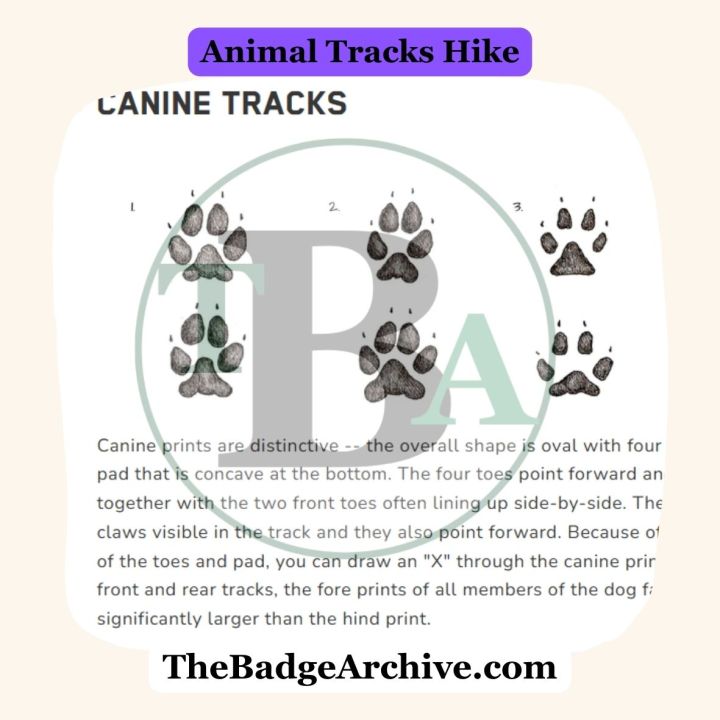
Before you go:
- Prepare for the hike (5–8 min)
- Leader chooses a location where tracks are likely to be found (mud, sand, snow, or soft ground). (A Leader should get familiar in what places are good to look for animal tracks and how to identify them.)
- Print one track guide for the group or multiple copies for small teams.
Instructions (Estimated Total Time: 20–40 min):
- Search for tracks (10–20 min)
- (Optional) Divide scouts into trios or buddy pairs for exploring. Print one track guide for the group or multiple copies for small teams.
- Scouts look for clear prints on easy surfaces like mud or sand.
- Tracks like bike tires or human footprints count too.
- Scouts guess which animal made each track.
- Leader can help look up answers during or after the hike.
- Observe and record (5–10 min)
- (Optional) scouts measure tracks and the space between them using a ruler.
- (Optional) scouts sketch the track and write down what they notice.
- Count and compare (3–5 min)
- Scouts count how many total tracks they found.
- They also count how many different types of animals or creatures left tracks.
Alternatives
- If hiking isn’t possible, scouts can draw animal tracks and guess each other’s drawings. Or you can use printed track images to identify animals and measure the tracks. See the Animal Track Worksheet activity.





 The Badge Archive