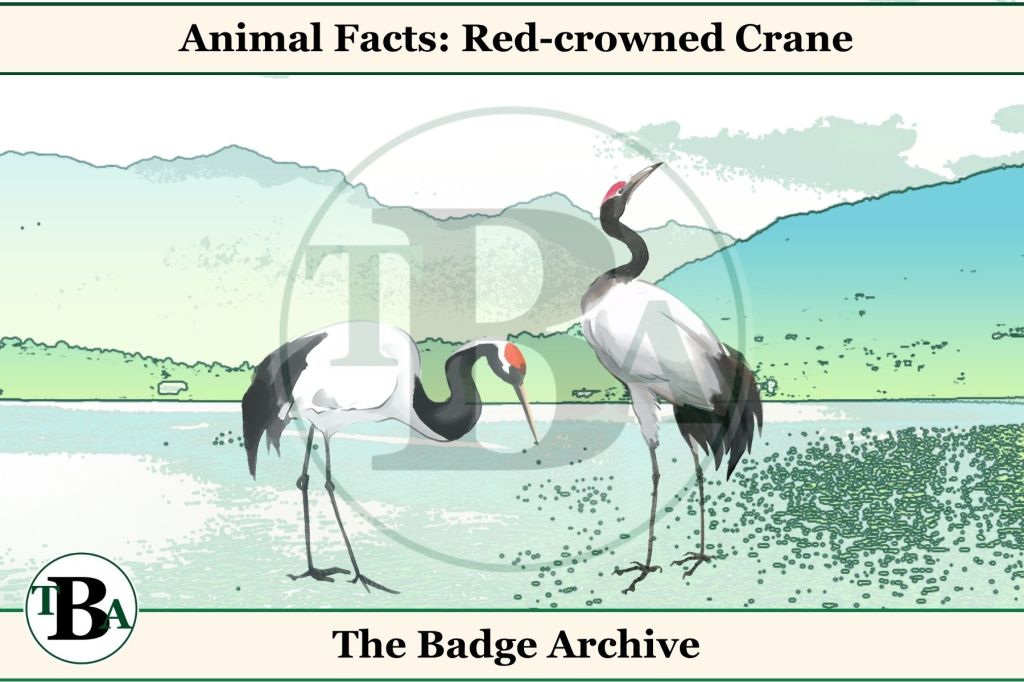
The Red-crowned Crane (Grus japonensis), also known as the Japanese Crane or Manchurian Crane, is a large bird belonging to the order of wetland birds. Its primary geographic distribution is centered in East Asia, with major populations found in southeastern Russia, northeastern China, the Japanese island of Hokkaido, and the Korean Peninsula.
This species possesses long legs and a slender neck adapted for foraging in deep wetland environments. Its hunting behavior is primarily omnivorous, involving the consumption of fish, amphibians, and aquatic plants. A unique identifying feature is a patch of bare red skin on the crown of the head, which becomes brighter when the bird is excited or aggressive.
Basic Facts
- Common Names: Red-crowned Crane, Japanese Crane
- Scientific Name: Grus japonensis
- Type of Animal: Bird
- Habitat Range: East Asia, including Russia, China, Japan, and Korea
- Lifespan (Wild): 30 to 40 years
- Wingspan: Approximately 2.5 meters
- Weight: 7 to 12 kilograms
Appearance
- Colors (Adult): Pure white body plumage with a black neck and black secondary wing feathers.
- Colors (Young): A mixture of white, buff, cinnamon, and grayish-brown feathers.
- Beak Shape: Long and pointed.
- Feathers: Primarily white with black secondaries; the black feathers appear as a black tail when the bird is folded.
- Specialized Feet/Talons: Long legs adapted for wading in marshes.
Diet
- Main Food Source: Small fish and frogs.
- Secondary Food Source: Insects, reeds, heath, and various plant roots.
Habitat
- Proximity to Water: Resides strictly in marshes and wetlands.
- Nesting Locations: Nests are built on flat ground in wet marshes or in shallow water.
- Environmental Preferences: Prefers areas with deep water and standing dead vegetation for nesting sites.
Life Cycle
- Mating Habits: Monogamous pairs engage in elaborate dancing displays and a coordinated unison call.
- Egg Details: Typically two eggs are laid.
- Incubation/Hatching Roles: Both the male and female share incubation duties for approximately 29 to 34 days.
- Milestones for Young: Chicks follow their parents to feeding grounds immediately after hatching and are capable of flight at 90 to 100 days.
Fun Facts
- In East Asia, the Red-crowned Crane is revered as a symbol of luck, longevity, and fidelity.
- Japanese folklore suggests that these cranes can live for 1,000 years.
- This species is the inspiration for the traditional Japanese art of “Senbazuru,” or folding 1,000 origami cranes to grant a wish.
- Cranes are famous for their complex dance which includes leaping into the air, bowing, and tossing pieces of grass.
- Because of their pure white feathers, they are often associated with winter and are highly visible against snowy landscapes.
- Mating pairs perform a unison call where they sing together in a specific rhythm to reinforce their bond.
–
For More Fun Ideas and Plans

Join the Girl Scout Daisy, Brownie, and Junior Leader Help Facebook Group
(Not an official GSUSA Group)

Join the Girl Scout Cadette, Senior, and Ambassador Leader Help Facebook Group
(Not an official GSUSA Group)

See other Recommended Facebook Groups for some Scouting Organizations
(No official Groups)
–
Click Here -> To see information References:
Disclaimer: The information published on The Badge Archive is built from the references listed below. These sources demonstrate that our content is grounded in facts and research, not opinion or speculation. Readers may consult them directly when looking for additional material.
- Britton, Dorothy, and Tsuneo Hayashida. The Japanese Crane: Bird of Happiness. Tokyo, New York, and San Francisco, Kodansha International, 1981.
- DuTemple, Lesley A. North American Cranes. Minneapolis, MN, Carolrhoda Books, Inc., 1999.
- Horn, Gabriel. The Crane. Mankato, MN, Crestwood House, 1988.
- Hughes, Janice M. Cranes A Natural History of a Bird in Crisis. Buffalo, New York. Firefly Books. 2008.
- Stahlecker, Dale, and Martin Frentzel. Seasons of the Crane. Heritage Assoc, 1986.
- McKenzie, Precious. Whooping Cranes. Rourke Publishing LLC, 2010.
- Takahama, Valerie, et al. How to Guide Girl Scout Daisies through 5 Flowers, 4 Stories, 3 Cheers for Animals. Girl Scouts of the U.S.A., 2010, p. 83.
- Voeller, Edward A. The Red-Crowned Crane. Minneapolis, MN, Dillon Press, 1989.
–
- Find out how you can support The Badge Archive!
- Return to the Wetland Birds category.



 The Badge Archive
Leave a comment