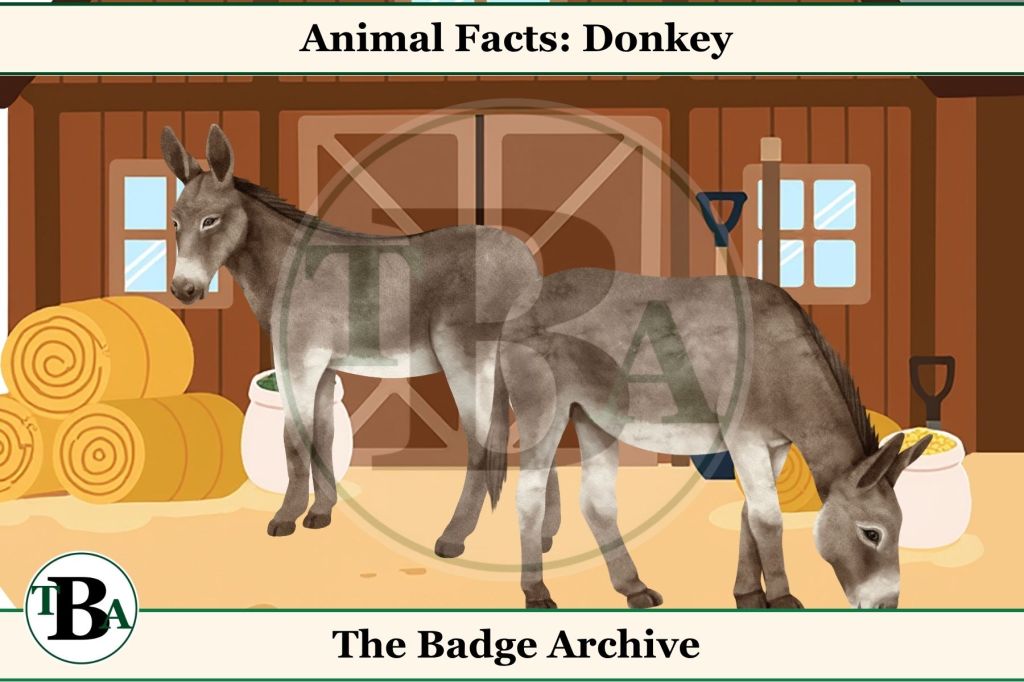
The Donkey (Equus africanus asinus) is a domesticated mammal belonging to the Equidae family. While donkeys are now found worldwide as working animals and companions, their primary geographic distribution originates from the arid desert regions of Africa and the Middle East.
Donkeys possess several key physical adaptations, including large ears that dissipate body heat and allow them to hear vocalizations from other donkeys over long distances. As herbivores, their typical feeding behavior involves grazing on grasses and browsing on various desert plants, supported by a highly efficient digestive system. A unique identifying feature of the donkey is its incredibly loud and distinct vocalization known as a bray, often described as a “hee-haw” sound.
Basic Facts
- Common Name: Donkey
- Scientific Name: Equus africanus asinus
- Type of Animal: Mammal
- Habitat Range: Worldwide (Domesticated); Ancestral range in Africa and Asia
- Lifespan (Wild vs. Captivity): 27 to 40 years
- Wingspan (Height): 31 to 63 inches at the shoulder
- Weight: 180 to 1,000 pounds
Appearance
- Colors (Adult vs. Young): Coat colors vary widely, including shades of gray, brown, black, and white.
- Eyes/Vision: Wide-set eyes provide a broad field of peripheral vision to detect predators.
- Mouth: Strong jaws with flat teeth designed for grinding tough plant material.
- Coat: Coarse hair that lacks the protective, water-resistant undercoat found in horses.
- Skeletal Structure: Sturdy skeletal frame with a strong back capable of carrying heavy loads for long durations.
- Specialized Feet: Small, narrow, and extremely tough hooves designed for traction on rocky and uneven desert terrain.
Diet
- Main Food Source: Grass and hay.
- Secondary Food Source: Straw, grains, and vegetables.
- Digestion Traits: Highly efficient digestive system capable of extracting nutrients from poor-quality, fibrous vegetation.
Habitat
- Proximity to Water/Terrain: Adapted to arid, dry, and mountainous terrain.
- Nesting Locations (Shelter): Requires dry, draft-free shelter, as their coats do not repel water well.
- Environmental Preferences: Prefers hot, dry climates and open spaces.
Life Cycle
- Mating Habits: Highly social animals that form strong, long-lasting pair bonds.
- Gestation: Pregnancy lasts approximately 12 months.
- Birth: Females (jennies) give birth to a single offspring, which is cared for primarily by the mother.
- Milestones for Young: The young, called a “foal,” is able to stand and walk within a few hours of birth.
Fun Facts
- A donkey’s large ears help them stay cool in hot deserts by pumping blood through the ears to release heat.
- Donkeys are often called “stubborn,” but they are actually very intelligent and cautious. They will stop and think about a situation before doing something that might be dangerous.
- A donkey’s bray can be heard for miles in the desert, helping them stay in touch with other donkeys that might be far away.
- Many farmers use donkeys to protect other animals like sheep because donkeys are very brave and will chase away predators like coyotes.
- A group of donkeys is known by several names, including a “drove,” a “pace,” or a “herd”.
- Humans have worked alongside donkeys for thousands of years, using them to carry heavy packs, pull plows, and transport goods.
–
For More Fun Ideas and Plans

Join the Girl Scout Daisy, Brownie, and Junior Leader Help Facebook Group
(Not an official GSUSA Group)

Join the Girl Scout Cadette, Senior, and Ambassador Leader Help Facebook Group
(Not an official GSUSA Group)

See other Recommended Facebook Groups for some Scouting Organizations
(No official Groups)
–
Click Here -> To see information References:
Disclaimer: The information published on The Badge Archive is built from the references listed below. These sources demonstrate that our content is grounded in facts and research, not opinion or speculation. Readers may consult them directly when looking for additional material.
- Doyle, Dan. Donkeys. Danbury, CT, Grolier Educational, 1997.
- Meadows, Graham. All about Donkeys. Hong Kong, Shortland Publications Inc., 1999.
- Noonan, Diana. Donkeys. South Melbourne, Victoria, Thomas Nelson Australia, 1994.
- Potter, Tessa, et al. Donkeys. Austin, TX, Steck-Vaughn Library, 1990.
- Takahama, Valerie, et al. How to Guide Girl Scout Daisies through 5 Flowers, 4 Stories, 3 Cheers for Animals. Girl Scouts of the U.S.A., 2010, p. 69.
- Weaver, Sue Ann. The Donkey Companion. Storey Publishing, LLC, 2008.
–
- Find out how you can support The Badge Archive!
- Return to the Ungulates category.

 The Badge Archive
Leave a comment