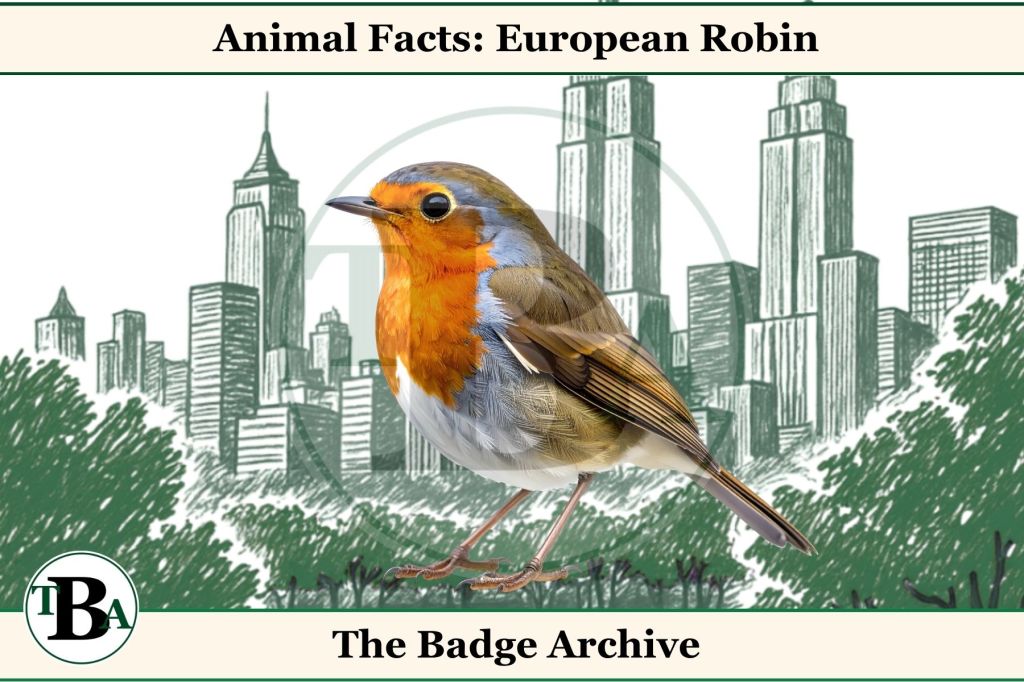
The European Robin (Erithacus rubecula) is a familiar woodland species and a member of the thrushes and chats group of birds. It is widely distributed across Britain and Ireland, with additional populations residing throughout continental Europe.
This species possesses physical adaptations such as a plump body shape and beady black eyes that aid in its role as an active forager. Its typical feeding behavior involves hopping across lawns, rockeries, or undergrowth to search for insects, and it is known for its confiding habit of following gardeners to take advantage of invertebrates turned up by digging. A unique identifying feature of the adult is its prominent orange-red face, throat, and breast.
Basic Facts
- Common Name: Robin
- Scientific Name: Erithacus rubecula
- Type of Animal: Thrushes and Chats
- Habitat Range: Found throughout Britain and Ireland
- Length: 14cm (5.5in)
Appearance
- Colors (Adult vs. Young):
- Adult: Features an orange-red breast and throat, brown upperparts bordered with grey, a brown crown, and a greyish-white belly.
- Young: Lacks the red breast and possesses a different speckled plumage, generally spotted buff, to provide camouflage after leaving the nest.
- Eyes/Vision: Beady black eyes.
- Feathers: Adults have brown feathers on their crown, back, wings, and tail.
Diet
- Main Food Source: Generally insectivorous, focusing on invertebrates such as earthworms.
- Secondary Source: Feeds on seeds and fruit, especially during autumn and winter.
Habitat
- Proximity to Water/Terrain: Prefers woodland but has adapted to gardens, especially those near wooded areas.
- Nesting Locations: Builds cup-shaped nests in shrubs or bushes. They also use unusual sites such as lavatory cisterns and will occupy open-fronted nestboxes.
- Environmental Preferences: Favors lawns, rockeries, and undergrowth for foraging.
Life Cycle
- Mating Habits: Males begin singing to defend territories from January and start building nests in early March.
- Egg Details: Lays four to seven eggs that are bluish-white and may be speckled with red.
- Incubation/Hatching Roles: Eggs are incubated for 12 to 15 days.
- Milestones for Young:
- Hatching: Young are born blind.
- Fledging: Chicks fledge approximately 12 to 15 days after hatching.
- Independence: The species typically raises one to three broods per year.
Fun Facts
- Their association with Christmas cards stems from early Victorian postmen who wore red uniforms and were nicknamed “robins”.
- The Robin often sings at night, which sometimes leads people to confuse it with the Nightingale.
- They frequently follow gardeners as they dig the soil to catch worms turned up by the spade.
- Unlike most British birds, Robins defend their territories throughout the entire year.
- An adult Robin is a little smaller in length than a House Sparrow.
- The Robin has a beautiful, plaintive song and a variety of calls, including a sharp “tic”.
–
For More Fun Ideas and Plans

Join the Girl Scout Daisy, Brownie, and Junior Leader Help Facebook Group
(Not an official GSUSA Group)

Join the Girl Scout Cadette, Senior, and Ambassador Leader Help Facebook Group
(Not an official GSUSA Group)

See other Recommended Facebook Groups for some Scouting Organizations
(No official Groups)
–
Click Here -> To see information References:
Disclaimer: The information published on The Badge Archive is built from the references listed below. These sources demonstrate that our content is grounded in facts and research, not opinion or speculation. Readers may consult them directly when looking for additional material.
- Girl Scouts of the U.S.A. “Meeting : 5 Flowers, 4 Stories, 3 Cheers for Animals! Pt. 2” My.girlscouts.org, Girl Scouts of the U.S.A., https://my.girlscouts.org/content/girlscouts-vtk/en/vtk.html. Accessed 23 Jan. 2026.
- Moss, Stephen. Bird-Friendly Garden. London, Harper Collins Publishers, 2000.
- Moss, Stephen. Garden Birds. London, Harper Collins Publishers Ltd., 2005.
- Takahama, Valerie, et al. How to Guide Girl Scout Daisies through 5 Flowers, 4 Stories, 3 Cheers for Animals. Girl Scouts of the U.S.A., 2010, p. 45.
–
- Find out how you can support The Badge Archive!
- Return to the Songbirds category.


 The Badge Archive
Leave a comment