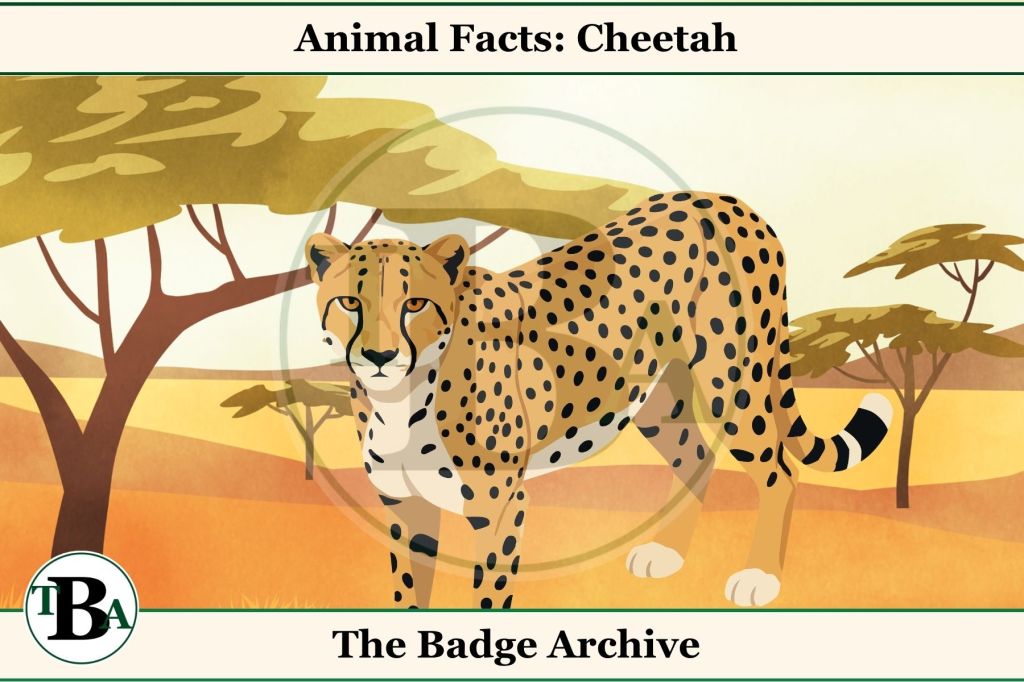
The Cheetah (Acinonyx jubatus) is a big cat and a member of the Carnivora order. These animals are primarily distributed across the grasslands of eastern and southwestern Africa, with the largest population residing in Namibia, and a small remaining group located in Iran.
Cheetahs possess physical adaptations specifically designed for high-speed hunting, including long, slender bones, a flexible spine, and a long tail that acts as a rudder for balance. Unlike most big cats that hunt at night, the cheetah is a diurnal hunter that relies on sharp eyesight to pinpoint prey from nearly three miles away before engaging in a rapid sprint. A unique identifying feature of the cheetah is its tear lines, which are black markings running from the inside corner of each eye to the outside corners of the mouth.
Basic Facts
- Scientific Name: Acinonyx jubatus
- Scientific Name Meaning: “Spotted one,” derived from the Hindu word chia.
- Type of Animal: Big Cat or Carnivore.
- Habitat Range: Mostly eastern and southwestern Africa with a small population in Iran.
- Life Span: About 8 years.
- Body Length: 44 to 53 inches.
- Weight: 80 to 150 pounds.
Appearance
- Colors: Gold fur with dark, polka-dot-like spots. Young cubs have a mantle of fuzzy grayish hair along their heads and backs.
- Eyes/Vision: Excellent forward-facing vision used to judge distances and spot prey up to three miles away.
- Skeletal Structure: Streamlined with long, slender bones and a highly flexible spine to allow for long strides.
- Specialized Feet: Narrow paws with hard, ridged pads and exposed, non-retractable claws that act like running spikes for grip.
Diet
- Main Food: Thomson gazelle.
- Secondary Food: Impalas, young wildebeests, zebras, hares, and various small mammal young.
Habitat
- Specific Terrain: Wide-open plains and grasslands.
- Nesting Locations: Mother cheetahs hide their cubs in tall grass.
- Environmental Preferences: Areas with mounds or fallen tree trunks that can be used as high vantage points to search for prey.
Life Cycle
- Mating Habits: Females are solitary unless raising cubs; males may form small lifelong groups called coalitions.
- Egg Details: Missing Fact.
- Incubation/Hatching: Gestation lasts approximately three months, and cubs are born small, blind, and weighing less than a pound.
- Milestones: Cubs open their eyes at 10 days, begin eating meat at three months, and typically become independent at 16 months of age.
Fun Facts
- The cheetah is the fastest land mammal on Earth, capable of reaching speeds up to 70 miles per hour.
- In a single racing stride, a cheetah can cover 27 feet, which is longer than most school buses.
- Cheetahs are the only big cats that cannot roar.
- Tamed cheetahs were used for hunting by ancient Greeks as early as 2500 B.C. and later by King George III of England.
- The rare “King Cheetah” has large dark blotches and stripes instead of spots due to an unusual gene.
- A cheetah’s paws have hard pads that function like the soles of sneakers to help them grip the ground while running.
–
For More Fun Ideas and Plans

Join the Girl Scout Daisy, Brownie, and Junior Leader Help Facebook Group
(Not an official GSUSA Group)

Join the Girl Scout Cadette, Senior, and Ambassador Leader Help Facebook Group
(Not an official GSUSA Group)

See other Recommended Facebook Groups for some Scouting Organizations
(No official Groups)
–
Click Here -> To see information References:
Disclaimer: The information published on The Badge Archive is built from the references listed below. These sources demonstrate that our content is grounded in facts and research, not opinion or speculation. Readers may consult them directly when looking for additional material.
- Albee, Sarah, and Kate Delaney. All about Animals Cheetahs. Reader’s Digest Young Families, 2007, Pleasantville, NY.
- Girl Scouts of the U.S.A. “Meeting : 5 Flowers, 4 Stories, 3 Cheers for Animals! Pt. 3” My.girlscouts.org, Girl Scouts of the U.S.A., https://my.girlscouts.org/content/girlscouts-vtk/en/vtk.html. Accessed 23 Jan. 2026.
- Spilsbury, Louise, and Richard Spilsbury. Deadly Predators. Minneapolis, MN, Bellwether Media, 2017.
- Takahama, Valerie, et al. How to Guide Girl Scout Daisies through 5 Flowers, 4 Stories, 3 Cheers for Animals. Girl Scouts of the U.S.A., 2010, p. 51.
–
- Find out how you can support The Badge Archive!
- Return to the Feline category.


 The Badge Archive
Leave a comment