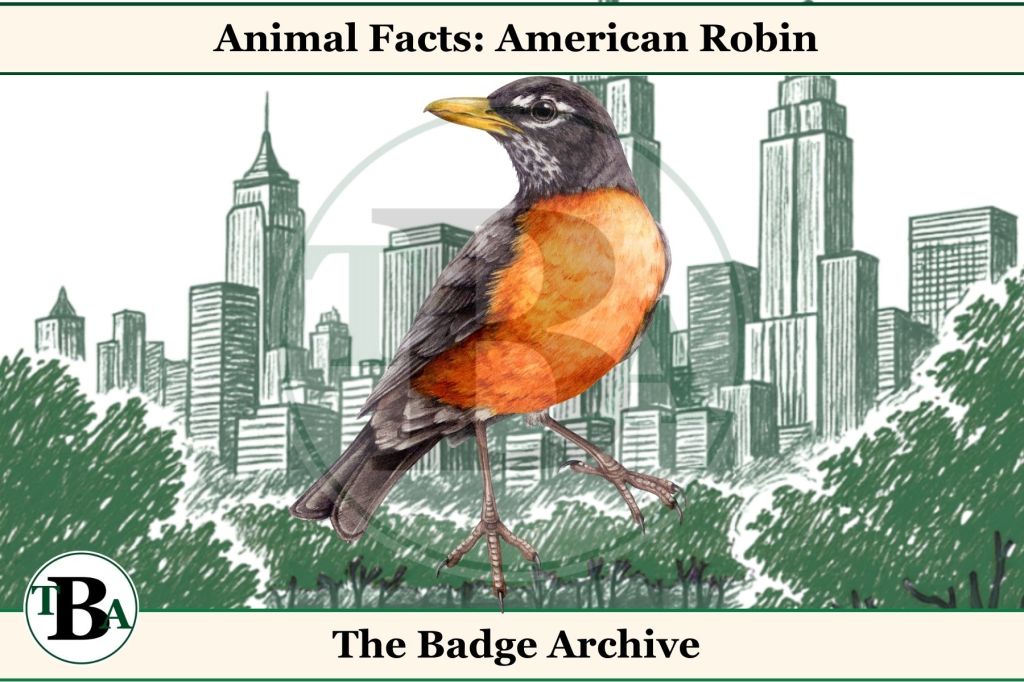
The American Robin (Turdus migratorius) is a common songbird found throughout North America, primarily from Alaska to Mexico. As a member of the thrush family of birds, they are highly adaptable and reside in a variety of environments, including cities, suburbs, and forests.
These birds possess specialized physical adaptations such as thin, hollow bones to reduce weight for flight and perching feet with three toes facing forward and one backward to lock onto branches. Their typical feeding behavior involves running short distances across lawns and cocking their heads to locate prey before using their beaks to pluck earthworms and insects from the ground. A unique identifying feature is their rust or red-orange breast feathers, which earned the species the nickname “robin redbreast”.
Basic Facts
- Common Name: American Robin
- Scientific Name: Turdus migratorius
- Scientific Name Meaning: Missing Fact
- Type of Animal: Songbird (Passerine) and member of the thrush family
- Habitat Range: Found throughout North America, from Alaska to Mexico
- Life Span: Missing Fact
- Wingspan: Missing Fact
- Weight: Newly hatched chicks weigh approximately the same as a nickel; adult weight is a Missing Fact
Appearance
- Colors:
- Adults: Feature rust or red-orange breast feathers. Males have a darker shade of gray on their heads and tails, while females are lighter/grayer.
- Young: Fledglings have speckled breast feathers for camouflage and black spots on their breasts.
- Eyes/Vision: Their eyes are located on the sides of their head.
- Beak Shape: A straight bill used for plucking worms and stabbing prey.
- Feathers: Birds puff up their feathers to stay warm and most shed all feathers once a year in a process called molting.
- Skeletal Structure: The skeleton consists of thin, hollow bones for flight, and the neck contains at least 14 bones.
- Specialized Feet: Perching feet with three toes facing forward and one facing backward that lock into place on branches.
Diet
- Main Food Source: Berries and fruit.
- Secondary Prey: Earthworms and insects such as caterpillars and beetles.
- Scavenging Habits: Missing Fact
- Storage or Digestion:
- Crop: A throat pouch used to store food for later consumption or for feeding young.
- Gizzard: A muscular part of the stomach used to grind food since birds do not have teeth.
- Restriction: Robins cannot easily digest birdseed.
Habitat
- Terrain/Proximity to Water: They live in lawns, gardens, cities, suburbs, and forests. They require water for drinking and bathing.
- Nesting Locations: Nests are built in tree forks (often evergreens), on windowsills, or occasionally in hidden spots on the ground.
- Environmental Preferences: They use mud to hold nests together. If no mud is available, they fill their bills with dust and dip it in water to create their own.
Life Cycle
- Mating Habits: Males sing a cheerful song to attract female partners and claim territory.
- Egg Details: Females usually lay 2 to 5 shiny blue eggs.
- Incubation/Hatching Roles: The female sits on the eggs for 11 to 14 days to keep them warm. Both parents help feed the hatched chicks.
- Milestones:
- Hatching: Chicks use a temporary “egg tooth” on their beak to break out of the shell.
- Growth: Chicks grow to nearly adult size in just 14 days.
- Fledging: Young birds leave the nest at approximately 2 weeks old.
- Independence: The father continues to feed and protect the brood for two more weeks after they leave the nest.
Fun Facts
- The arrival of robins in the north around March is widely considered a signal that spring has begun.
- A single young robin can eat up to 14 feet of earthworms in one day.
- Some robins migrate over 1,000 miles in just two weeks.
- A robin has at least 14 bones in its neck, which is double the number found in a long-necked giraffe.
- If a human grew at the same rate as a nestling robin, they would weigh 90 pounds by the time they were only ten days old.
- Young fledglings have speckled feathers that help them hide among blades of grass and light-dappled shadows.
–
For More Fun Ideas and Plans

Join the Girl Scout Daisy, Brownie, and Junior Leader Help Facebook Group
(Not an official GSUSA Group)

Join the Girl Scout Cadette, Senior, and Ambassador Leader Help Facebook Group
(Not an official GSUSA Group)

See other Recommended Facebook Groups for some Scouting Organizations
(No official Groups)
–
Click Here -> To see information References:
Disclaimer: The information published on The Badge Archive is built from the references listed below. These sources demonstrate that our content is grounded in facts and research, not opinion or speculation. Readers may consult them directly when looking for additional material.
- Fichter, George S. Cardinals, Robins, and Other Birds. New York, Golden Books, 1993.
- Girl Scouts of the U.S.A. “Meeting : 5 Flowers, 4 Stories, 3 Cheers for Animals! Pt. 2” My.girlscouts.org, Girl Scouts of the U.S.A., https://my.girlscouts.org/content/girlscouts-vtk/en/vtk.html. Accessed 23 Jan. 2026.
- Posada, Mia. Robins, Songbirds of Spring. Minneapolis, Carolrhoda Books, 2004.
- Takahama, Valerie, et al. How to Guide Girl Scout Daisies through 5 Flowers, 4 Stories, 3 Cheers for Animals. Girl Scouts of the U.S.A., 2010, p. 45.
- Willis, Nancy Carol. The Robins in Your Backyard. 1996. Montchanin, Delaware, Cucumber Island Storytellers, 1997.
–
- Find out how you can support The Badge Archive!
- Return to the Songbirds category.


 The Badge Archive
Leave a comment