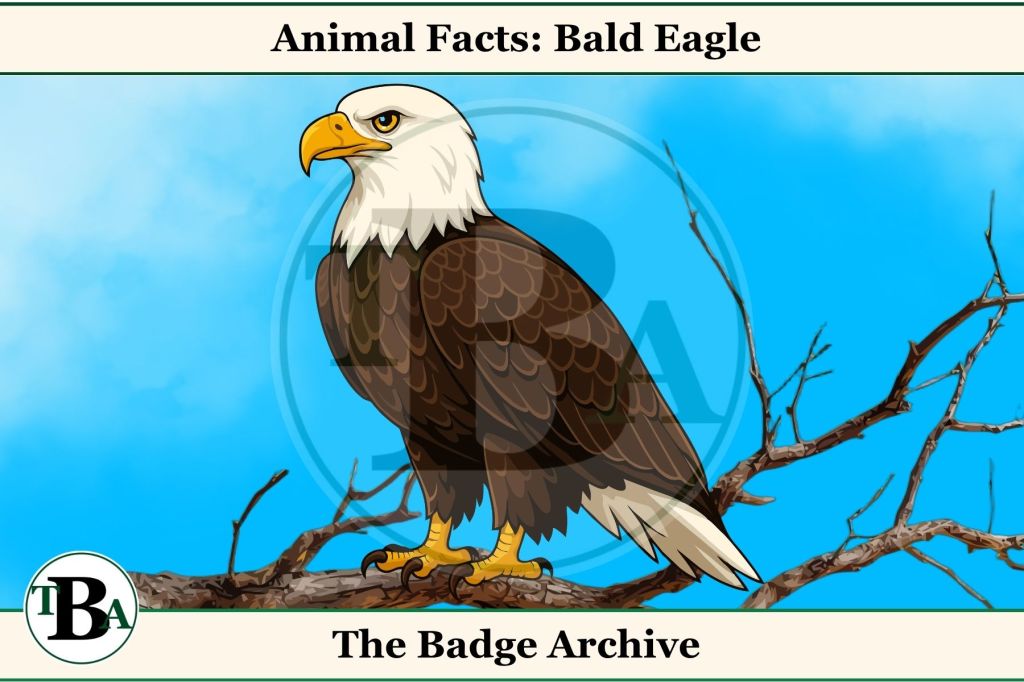
The Bald Eagle (Haliaeetus leucocephalus), is the only eagle found exclusively in North America. Learn of the bird’s distinct physical adaptations, including its seven-foot wingspan, lightweight hollow skeleton, and specialized sandpaper feet used for gripping slippery fish.
The bald eagle’s is a national symbol of the United States that has excellent vision and migrates. Explore the life cycle and behaviors of these raptors, from their birth as fluffy eaglets to their status as powerful hunters that build the largest nests on the continent.
Basic Facts
- Common Name: Bald Eagle
- Scientific Name: Haliaeetus leucocephalus (means “white-headed sea eagle”)
- Type of Animal: Raptor or Bird of Prey
- Where They Live: Only in North America (every state except Hawai’i)
- Life Span: Almost 50 years in captivity, but shorter in the wild
- Wingspan: 6 to 7 feet wide (about as wide as a large couch)
- Weight: About 11 pounds when they are ready to fly
Appearance
- Colors: Adult eagles have a white head and tail with a dark brown body. Young eagles are speckled brown all over.
- Eyes: Yellow eyes that can see three times better than a human’s eyes.
- Beak: A large, hooked yellow beak used to tear food into small pieces.
- Feathers: An adult eagle has more than 7,000 feathers.
- Skeleton: Their bones are thin and hollow to make them light enough to fly.
- Talons: They have four sharp, curved claws called talons on each foot to grab prey.
- Feet: The bottom of their feet are rough like sandpaper to help them hold onto slippery fish.
Diet
- Main Food: They prefer fish that swim near the top of the water.
- Other Food: They also eat waterfowl (like ducks and geese) and small mammals (like mice and squirrels).
- Scavenging: They eat “carrion,” which are animals that are already dead.
- Storage: They have a pouch called a crop to store extra food for later.
- Hunting: They only hunt animals less than 5 pounds.
Habitat
- Near Water: They live near seacoasts, lakes, and rivers so they can find fish.
- Tall Perches: They need tall trees or cliffs to rest on and watch for food.
- Nests: They build their homes, called aeries, high up in the tallest trees.
Life Cycle
- Nests: In North America, Bald eagles build the largest nests.
- Eggs: They usually lay two dull white eggs.
- Hatching: Parents take turns sitting on the eggs for 35 days to keep them warm.
- Eaglets: Babies are born with soft, fluffy feathers called down.
- Learning to Fly: Young eagles (juveniles) start flying when they are about 10 weeks old.
- Growing Up: It takes 4 to 5 years for them to grow their famous white head and tail feathers.
Fun Facts
- The bald eagle became a symbol of the United States in 1782
- They can turn their heads three-quarters of a circle to see in different directions.
- A convocation is what a group of eagles is sometimes called.
- An old nest can weigh as much as 2 tons (about the weight of a small car).
- A migrating eagle can fly up to 270 miles in a single day.
- People with very sharp vision are often called “eagle-eyed”.
–
For More Fun Ideas and Plans

Join the Girl Scout Daisy, Brownie, and Junior Leader Help Facebook Group
(Not an official GSUSA Group)

Join the Girl Scout Cadette, Senior, and Ambassador Leader Help Facebook Group
(Not an official GSUSA Group)

See other Recommended Facebook Groups for some Scouting Organizations
(No official Groups)
–
Click Here -> To see information References:
Disclaimer: The information published on The Badge Archive is built from the references listed below. These sources demonstrate that our content is grounded in facts and research, not opinion or speculation. Readers may consult them directly when looking for additional material.
- Dudley, Karen. Animals on the Brink Bald Eagles. New York, NY, AV2 by Weigi, 2015.
- Girl Scouts of the U.S.A. “Meeting : 5 Flowers, 4 Stories, 3 Cheers for Animals! Pt. 1” My.girlscouts.org, Girl Scouts of the U.S.A., https://my.girlscouts.org/content/girlscouts-vtk/en/vtk.html. Accessed 23 Jan. 2026.
- Takahama, Valerie, et al. How to Guide Girl Scout Daisies through 5 Flowers, 4 Stories, 3 Cheers for Animals. Girl Scouts of the U.S.A., 2010, p. 29.
–
- Find out how you can support The Badge Archive!
- Return to the Birds of Prey category.





 The Badge Archive
Leave a comment