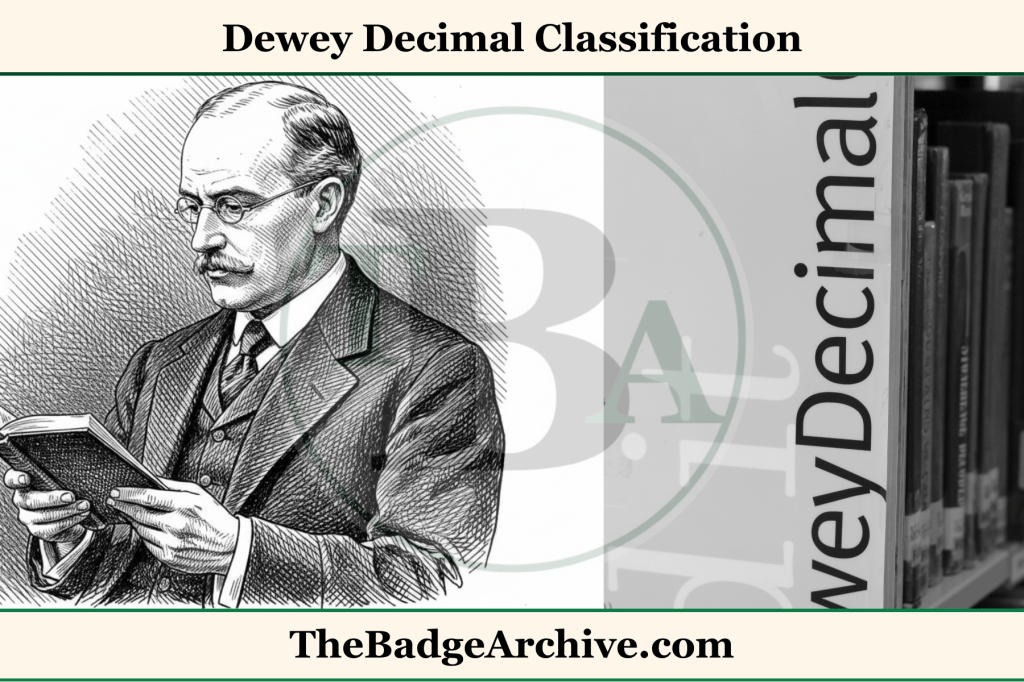
If you’ve ever wandered through the quiet aisles of a library, you’ve likely seen the tiny numbers on the spines of books that tell you exactly where they belong on the shelf. There can be a deep nostalgia for the rhythmic thump-thump of the old-fashioned card catalog (if you know, you know!).
That is a decimal classification system, a clever tool conceived in 1873 to organize the entire world of knowledge into ten main “neighborhoods,” such as Science, Arts, and History. Melvil Dewey (1851–1931) was an American library pioneer who published the first version of the system in 1876 when he was only 24 years old.
Today, this is the most widely used classification system in the world. Libraries around the world use it to organize their collections. Because human knowledge is always growing, the system is continuously revised to keep pace with new discoveries.
While we can all use these numbers to find our favorite books at the local library, the system itself is protected by modern laws. The system is currently owned and managed by OCLC (Online Computer Library Center, Inc.), which owns all copyright rights since 1988. According to their official notices, no part of the system may be reproduced, stored, or transmitted in any form (whether electronic or mechanical) without prior permission from OCLC.
“Dewey,” “DDC,” and “Dewey Decimal Classification” are all registered trademarks, meaning the name and the specific structure are protected legal property. Which is why we haven’t used those terms except here to explicitly state they are trademarks and cannot be used.
OCLC does provide a summary of the classification structure to the public to allow those interested in licensing the system to know what they would be getting access to.
–
For More Fun Ideas and Plans

Join the Girl Scout Daisy, Brownie, and Junior Leader Help Facebook Group
(Not an official GSUSA Group)

Join the Girl Scout Cadette, Senior, and Ambassador Leader Help Facebook Group
(Not an official GSUSA Group)

See other Recommended Facebook Groups for some Scouting Organizations
(No official Groups)
–
Click Here -> To see information References:
Disclaimer: The information published on The Badge Archive is built from the references listed below. These sources demonstrate that our content is grounded in facts and research, not opinion or speculation. Readers may consult them directly when looking for additional material.
- OCLC. “SUMMARIES DDC Dewey Decimal Classification”. Oclc.org, 2003, https://www.oclc.org/content/dam/oclc/dewey/resources/summaries/deweysummaries.pdf. Accessed 8 Feb. 2026.
–
- Find out how you can support The Badge Archive!

 The Badge Archive
Leave a comment