For more than a century, Scouting has helped shape young people who would go on to shape the world, including the world beyond our atmosphere. Across NASA’s history, both Scouting America and Girl Scouts of the USA have left their mark.
NASA and Scouting America
Scouting America’s connection to NASA is also reflected in long‑standing national statistics. A 2005 Boy Scouts of America fact sheet noted that, of the 294 pilots and scientists selected as astronauts since 1959, more than 180 had been involved in Scouting. These included 37 Eagle Scouts, along with dozens of Life, Star, First Class, Second Class, and Tenderfoot Scouts, as well as Cub Scouts, Webelos, and Explorers. The same document highlighted that 11 of the 12 astronauts who walked on the Moon had Scouting backgrounds.
While these numbers reflect data available in 2005 rather than current totals, they underscore a pattern that continues to be visible today: the values and skills emphasized in Scouting (leadership, curiosity, responsibility, and perseverance) have long aligned with the qualities sought in the U.S. astronaut program. The fact sheet also noted that by 2005, more than 289,000 Scouts had earned the Space Exploration merit badge, introduced in 1965 to inspire youth through hands‑on rocketry and space science.
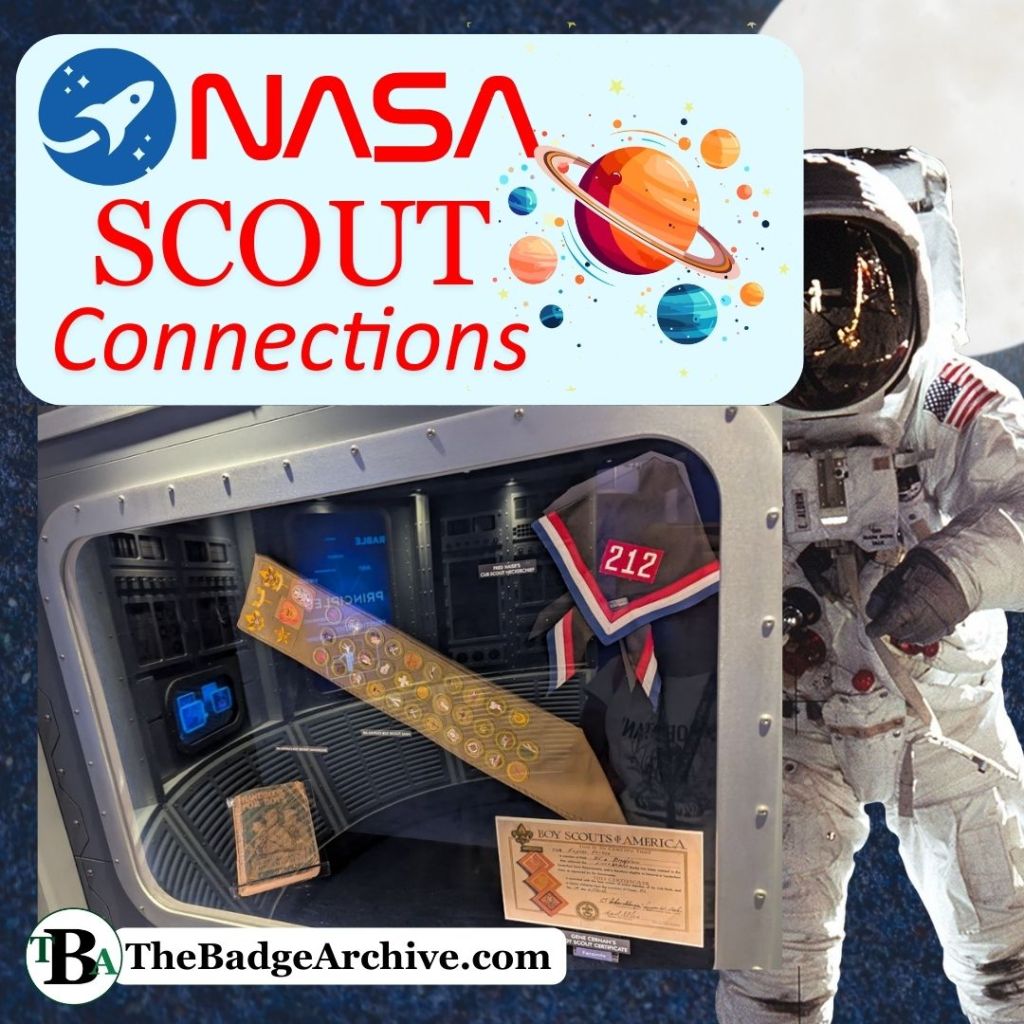
Scouting America (formerly the Boy Scouts of America) does not appear to have any formal partnership with NASA in current publications or agency materials. But when you walk through the Apollo/Saturn V Center at the Kennedy Space Center in Florida, you’ll find a quiet but powerful reminder of how deeply Scouting has shaped the people who shaped space exploration. A display case tucked along the visitor path features three pieces of Scouting memorabilia:
- A Cub Scout neckerchief marked 212
- A Boy Scout sash heavy with merit badges and the classic Handbook for Boys, used by Scouts in the mid-20th century.
- A facsimile of a mid‑century Boy Scout certificate.
These items were spotted by our friends at STEAM MA, who wondered what “Troop 212” might be doing today. As it turns out, the neckerchief belonged not to a troop at all, but to Cub Scout Pack 212.
The original Pack 212 Astronaut Fred Haise (best known as the Lunar Module Pilot of Apollo 13) no longer exists, though the number is still in use by other packs around the country. Haise was born in Biloxi, Mississippi, and his family moved frequently after his father enlisted in the Navy following Pearl Harbor. With time spent in Chicago, Key West, and the Gulf Coast, it’s difficult to pinpoint which council originally chartered his Pack 212. Still, any modern Pack bearing the number can claim a small kinship with the boy who would one day help save a crippled spacecraft on its way to the Moon.
The merit badge sash and vintage Handbook for Boys displayed at the Kennedy Space Center are attributed to astronaut Jim Lovell. Jim Lovell’s Scouting roots run deep. The items on display likely date to his years in the Milwaukee County Council, where he earned the rank of Eagle Scout and served as treasurer of Mikano Lodge in 1946. These roles were documented through Scouting America’s Eagle Scout Astronauts list and the Order of the Arrow’s Mikano Lodge records.
Lovell later became the first Eagle Scout to fly in space and even participated in “the first patrol meeting in space” during the Gemini 7 mission in December 1965. His commitment to Scouting continued well into adulthood: he served as a National Council member‑at‑large, sat on the executive board of the Sam Houston Area Council in the 1970s, received the Distinguished Eagle Scout Award in 1990, and was honored with the Silver Buffalo Award in 1992.
The facsimile Boy Scouts of America certificate attributed to Eugene Cernan offers a quiet glimpse into the early life of the last man to walk on the Moon. Cernan earned the rank of Second Class Scout as a youth, long before he became a naval aviator, Gemini astronaut, and Apollo commander. It highlights the role Scouting played in shaping Cernan. Traits like curiosity, discipline, and sense of responsibility carried him through three historic spaceflights. In honoring his Scouting beginnings alongside his NASA achievements, the exhibit reminds visitors that even the most accomplished explorers often start as young people learning skills, setting goals, and imagining what might be possible.
NASA and Girl Scouts of U.S.A. (GSUSA)
For more than a century, Girl Scouts have been encouraged to look up at the night sky and imagine their place among the stars. As early as 1920, the organization introduced the Star Gazer badge, beginning a long tradition of astronomy and space science awards that helped spark curiosity in generations of girls. Many future scientists and astronauts trace their earliest interest in space back to their troop years. Sylvia Acevedo, former GSUSA CEO and NASA engineer, credits her Brownie leader with igniting the passion she later describes in Path to the Stars.
That tradition grew into a formal partnership with NASA focused on inspiring girls to pursue STEM. Through Artemis‑related activities, Girl Scouts were connected directly to lunar science and exploration. NASA flew Girl Scout space science badges on Artemis I, while GSUSA’s national “To the Moon and Back” essay contest gave winners the chance to receive badges that had traveled thousands of miles beyond the Moon. NASA personnel have also supported Girl Scout STEM festivals, virtual events, and conversations between troop members and Artemis mission staff.
In 2021, the collaboration reached orbit. NASA astronauts installed the Faraday‑2 Research Facility on the International Space Station, a small autonomous platform capable of running multiple “microlab” experiments. Three Girl Scout designed experiments (created by winners of the Making Space for Girls challenge) were selected to fly. Their projects explored plant growth in microgravity, ant tunneling behavior, and brine shrimp life cycles. While local news confirmed the experiments ran for 30 days, no formal results were published, consistent with how ISS National Lab typically handles student research.
Girl Scouts have also left their mark through the women who carried their skills into space. Former Girl Scouts flew on more than one‑third of all space shuttle missions, and many of NASA’s most significant “firsts” were achieved by alumnae:
- Jan Davis brought Girl Scout Cookies aboard STS‑47 int the the 1992 Spacelab‑J mission, the first documented Girl Scout Cookies in space
- Susan Helms became the first female crew member of the International Space Station
- Eileen Collins became the first woman to pilot and command a space shuttle
- Dr. Kathy Sullivan became the first American woman to perform a spacewalk
- Christina Koch and Jessica Meir conducted the first all‑woman spacewalk in 2019
- Koch later set a new record for the longest single spaceflight by a woman, providing crucial data on how long‑duration missions affect the human body
Today, the Girl Scout legacy continues through Artemis‑generation astronauts such as Kayla Barron, Jessica Watkins, and Loral O’Hara. These women credit their early troop experiences with building the confidence, curiosity, and teamwork that guide them in space.
Conclusion
The quiet presence of Scouting memorabilia at the Kennedy Space Center and the Girl Scout experiments flown aboard the International Space Station show the influence of Scouting on America’s space program is woven into both its past and its future.
–
For More Fun Ideas and Plans

Join the Girl Scout Daisy, Brownie, and Junior Leader Help Facebook Group
(Not an official GSUSA Group)

Join the Girl Scout Cadette, Senior, and Ambassador Leader Help Facebook Group
(Not an official GSUSA Group)

See other Recommended Facebook Groups for some Scouting Organizations
(No official Groups)
–
Click Here -> To see information References:
Disclaimer: The information published on The Badge Archive is built from the references listed below. These sources demonstrate that our content is grounded in facts and research, not opinion or speculation. Readers may consult them directly when looking for additional material.
- Brady, Sara. “SpaceKids Global and Girl Scouts Announce “Making Space for Girls” Winners.” Tampa Free Press, 10 Mar. 2021, http://www.tampafp.com/spacekids-global-and-girl-scouts-announce-making-space-for-girls-winners/. Accessed 30 Dec. 2025.
- “Fred Haise | Biography, Apollo 13, & Facts.” Encyclopedia Britannica, http://www.britannica.com/biography/Fred-Haise. Accessed 30 Dec. 2025.
- Lovell, James A. “Shape up and Live.” Scouting Magazine, Nov–Dec 1970, pp. 10–11, worldscoutingmuseum.org/jimlovell/.
- Matzinger, Mike. “Lovell, James – Scouting Alumni.” Scouting Alumni, 28 Aug. 2025, scoutingalumni.org/about/notable-scouting-alumni/lovell-james/. Accessed 30 Dec. 2025.
- “NASA and Girl Scouts Collaboration Moves Further beyond Gravity.” Nasa.gov, NASA, 14 July 2022, http://www.nasa.gov/missions/artemis/artemis-1/nasa-and-girl-scouts-collaboration-moves-further-beyond-gravity/. Accessed 30 Dec. 2025.
- “Path to the Stars | Sylvia Acevedo.” Sylviaacevedo.org, 2018, sylviaacevedo.org/book/. Accessed 31 Dec. 2025.
- Robertson, Ann. “To the Moon, Girl Scout!” Girl Scout History Project, 19 July 2019, gshistory.com/2019/07/19/to-the-moon-girl-scout/. Accessed 31 Dec. 2025.
- Robinson-Smith, Will. “Girl Scouts Sent Science to ISS.” Mynews13.com, 2021, mynews13.com/fl/orlando/news/2021/08/27/girl-scouts-sent-science-to-iss. Accessed 30 Dec. 2025.
- NASA. “The Path to High Adventure Begins With Girl Scouting!” Tumblr, 12 Mar. 2020, http://www.tumblr.com/nasa/612406061424574464/the-path-to-high-adventure-begins-with-girl. Accessed 31 Dec. 2025.
–
- Find out how you can support The Badge Archive!



 The Badge Archive
Leave a comment