Camp names are more than just fun nicknames, they’re a tradition rooted in both practicality and personality. In a setting where leaders are guides, mentors, and fellow adventurers, the formal “Mrs.” feels too rigid, while first names can feel overly familiar. Camp names strike the perfect balance: they honor the role adults and older scouts play at camp while creating an approachable, imaginative atmosphere that sparks connection and community.
Across different councils and troops, scouts and leaders receive camp names in a variety of ways. Some are self-chosen, inspired by favorite animals or personal quirks. Others emerge from memorable camp moments or inside jokes shared around the fire. In some areas, camp names are earned through leadership roles or multiple summers of experience; in others, they’re embraced early and often for everyone who sets foot at camp.
This article brings together the wisdom of dozens of troop leaders, showcasing the many ways camp names are given, chosen, and celebrated. Your scouts may be dreaming up names for their first campout or stepping into counselor-in-training roles. This overview encourages a scout-led approach and emphasizes that no matter the method, the name should always be meaningful to the scout who wears it.
Who Gets a Camp Name?
- Most commonly given to Counselors, CITs (Counselors in Training), and Program Aides after training or leadership roles.
- In some councils, everyone gets a camp name, including campers, volunteers, and adults.
- Others reserve official names only for older scouts or staff, often around high school age.
- Some troops and day camps use temporary or fun nicknames on trips just for bonding.
How Are They Chosen?
- Self-chosen based on personal interests, traits, or fun quirks (e.g. “T-Rex,” “Monkey,” “Astoria”).
- Given by others—sometimes after memorable experiences like getting lost (“Lost”) or tending campfires (“Ember”).
- Often sparked by shared moments, games (like Mad Libs), or inside jokes, and approved by the girl herself.
- Some councils use name suggestion lists with guidelines to ensure appropriateness and originality.
When Do You Get One?
- Traditions vary:
- After 4 summers at overnight camp
- During CIT/LIT training
- When becoming a counselor or volunteer
- Or simply whenever it “feels right” during camp experiences
- Many say something along the lines of: “Sometimes you choose your camp name, sometimes it chooses you.”
Scout-Led Choices Matter
The strongest message across comments by leaders? Let the scouts lead. If a scout wants a camp name, they can choose it. If not, that’s okay too. Camp names should bring joy and pride, not embarrassment or discomfort.
Whether silly, symbolic, or spontaneous, camp names are part of the magic that helps Girl Scouts step outside the everyday and into something adventurous, connected, and memorable.
How many do the tradition in the different ways?
Here’s a breakdown of the camp name traditions shared by the 34 leaders, organized into statistical categories based on who receives camp names, how they’re chosen, and when they’re assigned. Since some responses include more than one method or belief, totals may exceed 34 due to overlapping practices.
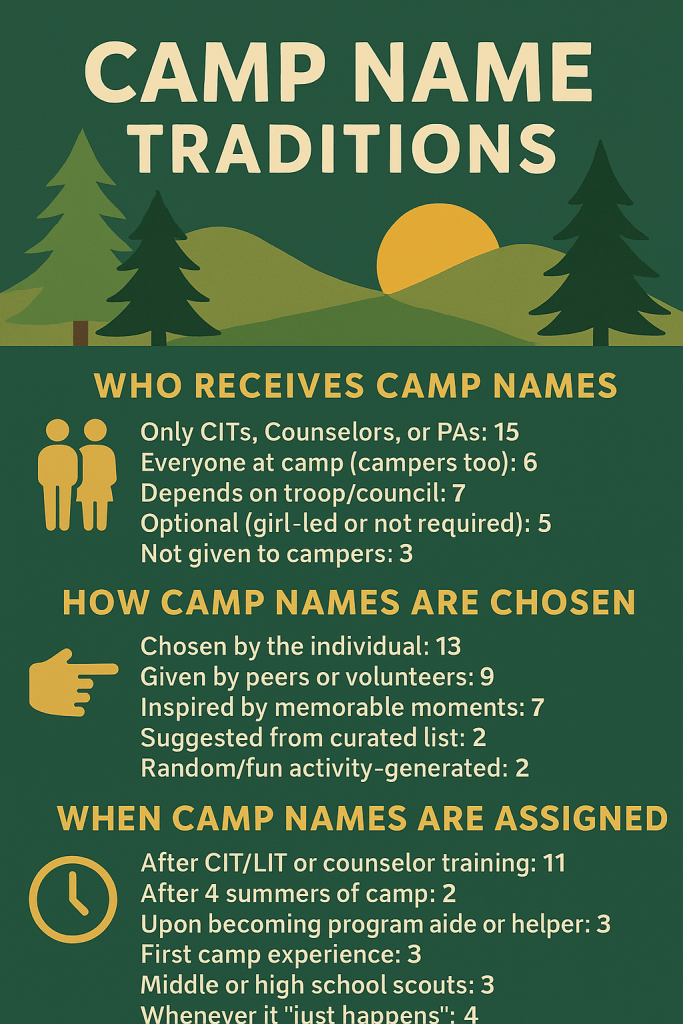
Who Receives Camp Names
| Category | Number of Mentions |
|---|---|
| Only CITs, Counselors, or PAs | 15 |
| Everyone at camp (campers too) | 6 |
| Depends on troop/council | 7 |
| Optional (girl-led or not required) | 5 |
| Not given to campers | 3 |
How Camp Names Are Chosen
| Method | Number of Mentions |
|---|---|
| Chosen by the individual | 13 |
| Given by peers or volunteers | 9 |
| Inspired by memorable moments | 7 |
| Suggested from curated list | 2 |
| Random/fun activity-generated | 2 |
| Temporary names for fun (not official) | 2 |
When Camp Names Are Assigned
| Timing or Trigger | Number of Mentions |
|---|---|
| After CIT/LIT or counselor training | 11 |
| After 4 summers of camp | 2 |
| Upon becoming Program Aide or helper | 3 |
| First camp experience | 3 |
| Middle or High School scouts | 3 |
| Whenever it “just happens” | 4 |
–
–
For More Fun Ideas and Plans

Join the Girl Scout Daisy, Brownie, and Junior Leader Help Facebook Group
(Not an official GSUSA Group)

Join the Girl Scout Cadette, Senior, and Ambassador Leader Help Facebook Group
(Not an official GSUSA Group)

See other Recommended Facebook Groups for some Scouting Organizations
(No official Groups)
–
Click Here -> To see information References:
Disclaimer: The information published on The Badge Archive is built from the references listed below. These sources demonstrate that our content is grounded in facts and research, not opinion or speculation. Readers may consult them directly when looking for additional material.
- This article draws solely on the author’s firsthand experience and responses from a Facebook Group Post in July 2025. It does not incorporate outside sources.
–
- Find out how you can support The Badge Archive!
- Return to the Daisy Badge List.
- Return to the Brownie Badge List.
- Return to the Junior Badge List.
- Return to the Cadette Badge List.
- Return to the Senior Badge List.
- Return to the Ambassador Badge List.
–


 The Badge Archive