Updated March 2025
Yes – the scouts are supposed to come up with the ideas based on the local community needs. GSUSA recommends you find a need in the community and let them figure out what they could do to help on their own.
In reality – we try that but sometimes they (and us leaders!) need help knowing what could be possible to do. Especially for the younger scouts who can’t build butterfly gardens or buddy benches without a lot of adult help.
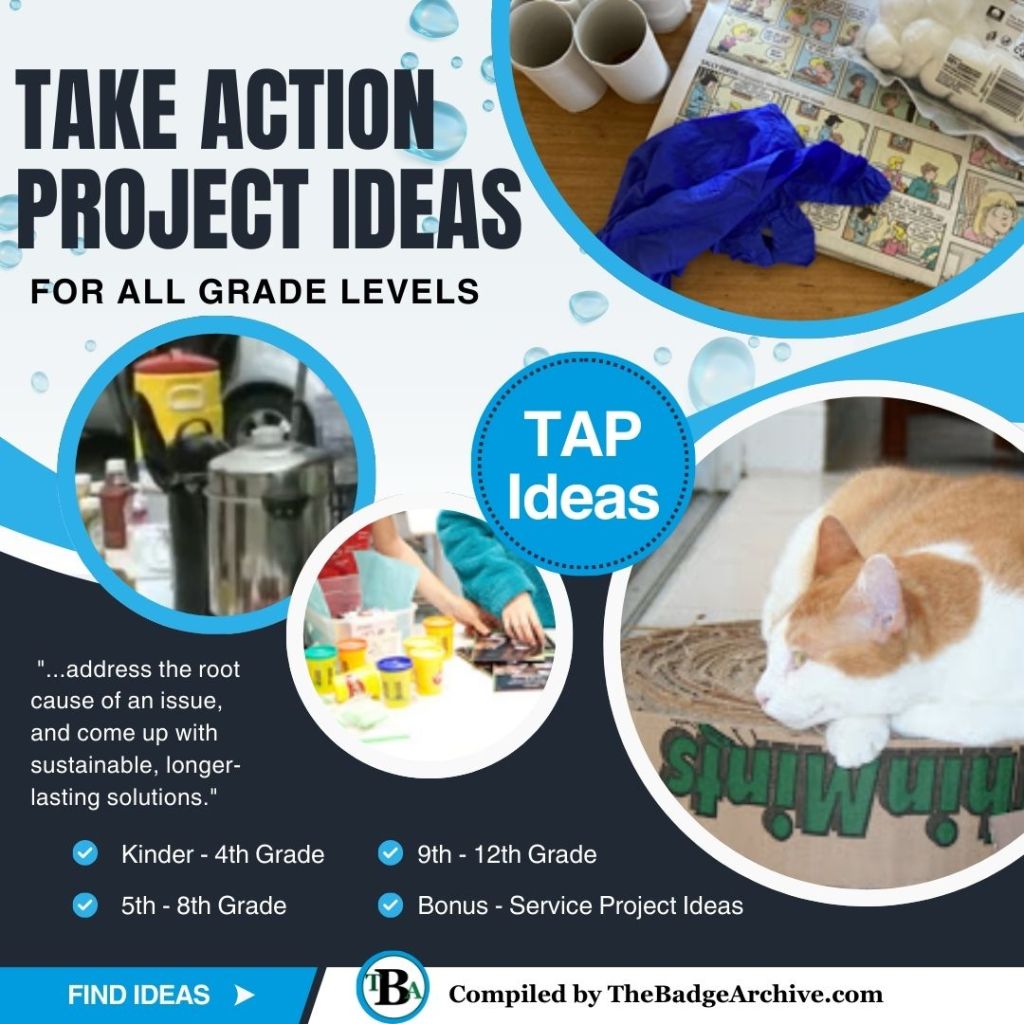
While GSUSA recommends the TAPs be themed for the journey AND that scouts use what they learned in the journey to help them plan – GSUSA only requires that a TAP (any TAP) be done. And a TAP is defined as projects that “address the root cause of an issue, and come up with sustainable, longer-lasting solutions.” Usually this is done with making something permanent or education. If you can manage to change a rule or regulation – that is very much a TAP.
We’ve left all themes together and broken them into more easily seen age appropriate areas. Some are only appropriate if you are doing them as a group with adult help – but it can be done. Some troops will find projects in the higher recommended levels they could easily do – it’s all about your own skill levels and resources. Some might find a project that is ideal for them in the lower level recommended list. No worries – do it. Any TAP Idea listed will work if you can do it.
Kinder – 4th grade
- Create a pamphlet of peanut butter recipes that the food bank could place in each bag of food, then collect peanut butter and jelly as a food drive.
- Write a Public Service Announcement about hunger to be read over the local radio station.
- Create poster on the ways people love and care for their pets.
- Animal Helper Postcards
- Make pages for a Pet Care/Safety Book
- Create and perform a skit about caring for animals
- Make things for the local human society or animal shelter
- Make pet toys and/or collect items for a local animal shelter. One troop made braided pull toys for dogs from strips of old fabric or taken old socks, stuffed them with polyfil and catnip or old tennis balls, and tied them up for toys.
- Make blankets for an animal shelter
- Cards for the caregivers of the local humane society or animal shelter
- Make bird nesting material hangers
- Design and build birdhouses
- Make bat boxes
- Make Duck houses
- Make Seed bombs with native seeds. There are many different ways to make these with kids.
- One troop created wildflower seed bombs using the recipe from “DIY | Seed Bomb Wedding Favors” by Something Turquoise blog.
- Install garbage can outdoors where there is none and find an organization that will maintain it
- Fire circle maintenance (clean out circle but also around and new water buckets)
- Trail maintenance or restoring a trail
- Create trail signage – map, details on distance, etc.
- LNT signs for a state park (bathrooms, notice boards, and trail head areas)
- Call several parks and ask them what they need – there are often projects needed we won’t see until we ask
- Create fire starters with wax paper, stock camp with tinder, leave fire starters and instructions on how to use for future troops that come to camp
- Clean out invasive plants at meeting place or pulling invasive weeds in a park AND make a little video to share with family on the type of invasive plant and how to remove it from your yard
- Plant a country roadside iris bulb garden
- Plant flowers to help someone within the local community
- Plant something (butterfly garden, tree, wind chime garden, etc.)
- Volunteer at a local community garden
- Create notes, supplies and words of encouragement for a future daisy troop.
- Create Daisy Days events if none exist in your community/council events
- Write a letter to future daisies, to give ideas and encouragement
- Do a presentation at your school’s parents’ night about why citizen science is important. Showcase a few citizen science projects that are particularly fun and easy for families to do together.
- Presentation to create awareness on a topic
- Create a video, presentation, skit, event, poster campaign, movie, etc. to tell people about the problem — and give them several ways they can take action to address it.
- Show-and-tell, explain what you’ve learned about how engineers help others, then lead a design challenge activity with your class.
- Create a list of great books, movies and documentaries that focus on STEM. Make copies for teachers to hand out or make posters for the school library.
- One troop read “engineering” library books and had the scouts make a little “recommendation” poster for the book they read. The library displayed the posters for a few weeks.
- One scout found books in her school library about women in science and asked the Librarian to host a display of these books. She made a poster with her top five to go with the display.
- One troop made posters showing what different engineers they learned about do. Then displayed them at the library.
- Make engineering themed bookmarks for the library to hand out.
- Create a short play based on one of the books and perform it for your class or school.
- Record doing an activity for a project with instructions to share on a Facebook Group Leader page.
- Make rain collection devices for family or friends that can be installed in their yards. Give them a list of different ways to use rain water and how they’re helping the Earth.
- Create a handout, video tutorial, or show-and tell presentation about how to make a rain collection device, how to use rain water and how that helps the Earth.
- Create pet portraits for the animal shelter’s web site. Use your writing skills to craft heart-warming bios for each portrait.
- Make something inside (Maker Space, reading room, etc.)
- Create a collection (children’s books children’s hospital or family shelter, oral histories for town museum, etc.)
- Do a show-and-tell
- Create a poster campaign
- Perform a skit
- Make a “how to” handout
- Create an engineering challenge to post online and/or send to other troops to raise awareness about trash in the oceans.
- Spread the word about how bad the reusable plastic straws are for the earth (ocean life suffers, 30 years to biodegrade) by using 4-5 plastic straws and ironing them together in a row (using parchment paper) and creating bracelets (hole punched and tied with yarn) to distribute and wear to strike up the conversation.
- Make bags with instructions and materials for one of the Daisy Think Like an Engineer projects. The local recruitment chair could give them as a take home at the next event.
- Make kits to make popsicle stick catapults and teach a homeschool group how to make them.
- Make lunchbox notecards with space facts and facts about female astronauts. Print on thick paper, cut and bag them to hand out to teachers and parents. You can also share the pdf with other troops.
- Make a commercial about something kids their age should focus on to make the community better. (Make sure face and identifying marks don’t show). Share it on social media and ask friends to share too. Hang a poster at a library, school or even your home with a QR link to the video.
- Teach others about the design process- short video, activity sheets, etc.
5th – 8th grade
- Create a mural out of bottle caps and made a presentation to younger children about recycling
- Provide maintenance, such as painting and decorating rooms, at a shelter or center.
- Provide activities for children or seniors at a shelter or center and find an organization that will continue doing what you set up for a few years.
- Organize a local food drive and find an organization (school PTO, church, etc.) that will continue what you did annually for a few years.
- Create a comic book based on the project experience.
- Create posters for your school or a local faith community that educate people about not dumping chemicals or other materials into storm drains.
- Build a pollinator garden for a local library and work with them to develop a curriculum to educate children.
- Install Rain barrels.
- Build Goose deterrents around the beaches (decoy animals, pinwheels, flashy streamers that blow in wind etc).
- Make recycled wind chimes
- Trail erosion maintenance instead of the typical cut back of branch type of maintenance
- Map out the trails at a local camp for a hiking map/guide.
- Butterfly gardens
- Make a Butterfly House
- Create a pollinator garden
- Have a Mason Bee campaign
- Make Tic Tubes for a Park Ranger to have on hand.
- Create large cards, books, binder, posters – showing the leave no trace principles for service unit director/camp ranger to share with other troops
- Promote native plants in your area. Look to see what a local gardening club can do to assist you with this project.
- Community Clean-Up Scavenger Hunt
- Improve upon a landscaped area
- Organize a Citizen Science Day at your school or in your town. Set up Citizen Science Stations with handouts explaining different projects (and materials, if needed). Invite everyone to choose a project, collect data and upload it.
- Make a presentation to your school principal, school board, city council
- Create a girls’ coding club that meets at lunchtime or recess. Teach other girls how to play with tangrams or learn algorithms by making functional suncatchers.
- Make a presentation to the school board or administrators about why this is a problem and suggest a new rule that makes the pick-up/ drop-off area a “no idling” zone.
- Research about people who used code to help others, and then create a video or slideshow to show at your school.
- Make a video to explain algorithms, using fun examples like baking a cake, planting a flower or giving directions. Show it to your class at school or to a group of friends.
- Research the “hidden figures” in your community (unsung women who’ve done great things). Create a display about their accomplishments for a library or community center.
- Design and build “buddy benches.” Partner with the school to have the benches installed on the playground so kids who want to make new friends can find each other.
- Make and install something outside (benches, bird houses, dog run, ropes course, sensory trail for children with disabilities, Little Library, etc.)
- Draw a comic
- Give a speech
- Write and perform a song
- Make an animated or a live-action movie
- Make a “playbook” to help others follow your lead (how to mentor robotics teams, organize a workshop or event, advocate to city council, create an online petition, change a law, etc.)
- Write an op-ed or letter to the editor of a newspaper or magazine
- Make cat scratching pad using leftover boxes from cookie cases.
- Promote a Pillow Drive. Collect pillows and make or tie-dye pillow cases for kids in foster care.
- One troop did so in 2014 with Pillows for Kids in Foster Care.
- Jared Box. A Jared Box is a shoebox size plastic storage box filled with small gifts, toys, cards, and games. Each box contains items selected for a specific age and gender. The boxes are delivered to hospitals and are given to chronically ill children. The Jared Boxes provide a special diversion for young patients as they receive chemotherapy and other medical treatments.
- Make a Little Free Library in your neighborhood
- One scout did so in 2014 in Morely, NY
- Create a bike route to school.
- Set up a neighborhood ‘bike train’ on a specific day. Kids in the neighborhood with a few adult volunteers would meet up at the neighborhood part with their bikes and ride together to school.
- Hold a Zombie run (or other holiday-themed runs).
- The Girl Scouts of Southern Illinois held a Zombie Run in 2013.
9th – 12th grade
- Tutor children at a shelter or center.
- Work with other troops to organize an after-school tutoring center at a homeless shelter.
- Create a workshop (perhaps in partnership with a local business or organization) to teach a skill such as coding, camping, canoeing, robotics, sewing, car care, healthy eating, gardening, home repair, budgeting, etc.
- Create a workshop to teach others about healthy living (exercise, nutrition, mental health, etc.)
- Contact your school, grocery stores, restaurants, bakeries, hospitals, etc. in the community to find out if they are, or would like to be part of, a food rescue program or food donation program.
- Coordinate a local food rescue program.
- Contact your school, grocery stores, restaurants, bakeries, hospitals, etc. in the community to find out if they are, or would like to be part of, a food rescue program or food donation program.
- Work with your local community to develop a process for pedestrians to cross the street safely and educate the public.
- Advocate for a law with your state government
- Advocate for building a permanent community improvement (sidewalk, bridge, park, streetlights, stoplight, etc.)
- Speak on behalf of a food resource group at a town meeting or other community forum.
- Speak up at your representative’s town hall meeting
- Do some research and find out that changing a local law or regulation could address the problem. Make a presentation to your city council, start a petition drive, or advocate at the state level for a change in laws or regulations to address the problem.
- Make a presentation to the city council about the problem and suggest that they build a sidewalk – TAP is still earned no matter what choice the city council makes.
- Research the number of accidents and make a presentation to the city council, asking that they have a stoplight installed.
- Make a presentation to the city council explaining the problem and offering to use troop money from the cookie sale to help pay for the swing.
- Lobby to have your school cafeteria serve more healthy snacks and drinks.
- Create a website
- Work with the school to help make a mental health resources webpage.
- Create a social media campaign
- Make an app that helps people take action on an issue
- Create a web site
- Create an online petition
- Make video tutorials to teach a skill
- Organize an email campaign
- Organize a petition
- Organize an event (concert, play, poetry slam, art exhibit, sporting event, field day) to raise awareness about an issue
- Start a blog
- Wake-up stands at rest areas on busy traffic holiday weekends. Free coffee to keep folks stay awake on long drives. You may need to get approval from local police/state highway patrols.
- Here’s one troop that did it in 2012: Girl Scouts Helping Drivers.
Service Projects!
These are great to do, but don’t technically qualify for a TAP. Some troops enjoy using a patch program to encourage doing good in the world – like the Center Service Patch and picking Segments you can place around them from Advantage Emblem.
- Make placemats for Meals on Wheels. This would be a good project for Daisies to do. Could also be for an adult daycare or rest home.
- Red Cross Comfort Kits. Collect personal hygiene items for Red Cross comfort kits.
- Cook or serve food at a shelter or drop-in center.
- Coordinate a supplies drive for a shelter or center such as blankets, towels, books, etc. (speak with a shelter or center first to receive permission and find out the needs)
- Help someone in the community with picking up leaves
- Collect Comfort Cases for kids in foster care. Collect small suitcases, duffel Bags or backpacks with PJs, stuffed animals, coloring books and crayons, personal hygiene, and other items.
- Socks of Love. Fill warm socks for the homeless with toiletry necessities.
- Birthday packets for nursing homes. Fill a bag with birthday hat, party blower, tissue packet and hand-made card. Have nursing home staff give to residents on their birthdays.
- Birthday-in-a-Bag. Talk to a local homeless shelter or food bank about donating Birthday-in-a-Bag collections for young children. Fill a large gift bag with: cake mix, frosting, foil cake pan, cake decorations, candles, balloons, plates, napkins, small unisex toy or present (unwrapped), and wrapping paper and ribbon. Some scouts have done this as a way to celebrate Juliette Low’s birthday.
- Bedtime Bags for children at shelters, or going into foster care: Each bag has a stuffed animal, a blanket, a book, and a toothbrush.
- Serve at a soup line or shelter and have lunch with someone who is homeless
- Collect grocery store coupons to donate to food service programs
- Organize a food drive before Thanksgiving
- Donate toiletries to a homeless shelter
- Sing songs at an assisted living home
- Volunteer to serve food at a homeless shelter
- Sort and pack food at a food shelf or food bank.
- Help out with special events such as large food drives
- Put together “I Care” kits that include toothpaste, brush, shampoo, etc. for shelter clients (speak with a shelter or center first to receive permission and find out the needs).
- Help with administrative duties such as mailings, promotions, etc.
- Park or creek clean ups. Check around your neighborhood or local parks. Many of these may have annual or semi-annual clean up events organized by local environmental or community groups, particularly around Earth Day (April 20th).
- Food or clothing drive. Hold a drive to collect food or clothing items for a local food bank or homeless shelter. We’ve had Daisies do this very enthusiastically. They first visited a local food bank to see what it was all about and what they needed. The food bank had a large scale, which the girls all hopped on to weigh themselves. We used their total weight as our goal (~800 lbs) for how much we want to collect that year. The girls collected during school events, asking everyone who attended to bring in canned good and other non-perishable food items and personal hygiene supplies).
- Book drive. Collect books, particularly children’s books to give to local children that may not have books to read over the summer.
- Donate toys to a children’s hospital
If you have an idea that isn’t on the list of things below – drop them in the comment section! This list could be endless and we’d love to add to it.
–
For More Fun Ideas and Plans
for Daisy, Brownie, and Junior Scouts
Join the Girl Scout Daisy, Brownie, and Junior Leader Help Facebook Group
(Not an official GSUSA Group)

This is a supportive community for Cadette, Senior, and Ambassador Girl Scout leaders. This group offers solutions to keep older scouts engaged in scouting amidst their busy lives. Share strategies, tackle challenges, and exchange ideas for fun, meaningful activities that resonate with teens and build lasting connections.
for Cadette, Senior, and Ambassador Scouts
Join the Girl Scout Cadette, Senior, and Ambassador Leader Help Facebook Group
(Not an official GSUSA Group)
This is a supportive community for Cadette, Senior, and Ambassador Girl Scout leaders. This group offers solutions to keep older scouts engaged in scouting amidst their busy lives. Share strategies, tackle challenges, and exchange ideas for fun, meaningful activities that resonate with teens and build lasting connections.
Find out how you can support The Badge Archive!
–



 The Badge Archive