WARNING
Remember – this is a GSUSA centered challenge. That means we follow the Girl Scout Promise and Law as well as the Internet Safety Pledge. All story plots need to be family friendly. Could you share it with your elderly grandmother? School principal? A church congregation? An elementary school class?
November 3rd
Story idea? Check. Character(s)? Check.
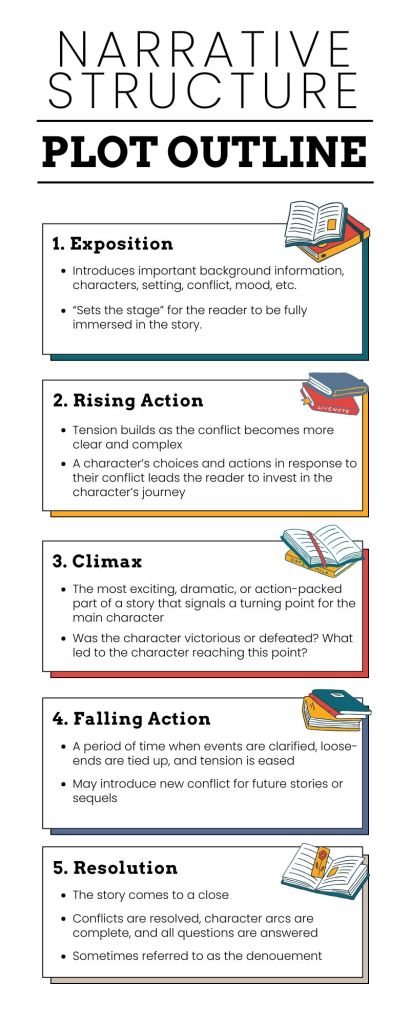
Here’s the big one – Plot Outline.
You don’t have to outline all the details. If you have details – great! But don’t get hung up on them. What you need is the 5 major plot points.
- Beginning (Exposition) – Where does the story start?
- Problem (Rising Action) – What is this novel is facing? A villain? A natural disaster? Character conflict? War?
- Solution (Climax) – What will be the exciting way the problem is solved?
- Wrap Up (Falling Action) – As it’s solved, does it cause anything to happen or a hint at a new problem the characters might face in a 2nd novel?
- Ending (Resolution) – Where will this story end? The Wrap Up might be the ending to most, but many authors have a clear thought of how they want to end. Most think of a “happily ever after” moment. Some do a “this might be a problem” scenario that sets it up for the next novel. Think of your novel like a movie – when would you have the ending credits roll?
Non-Fiction Plots
Do Non-Fiction books have a Plot Outline? You betcha.
Your task will be a little different.
- Think of your school textbooks. Many have different sections or categories. Some have an Index with topics. Write your own index or table of contents – stick to the main headings, not sub-categories unless you have a clear idea.
- Think of a non-fiction historical novel. They’re usually based on a timeline, but have a clear start and stop point the novel covers. Find your own start and stop, then put in the highlights of what you are covering in that time period.
- Think of an auto-biography. These are often broken up into parts of the person’s life. It could be as simple as: Birth, Early Childhood, Adulthood, The Last Years. What will your book cover?
- Recipe Collections, Pattern Books, Collection Compilations – They all have an index or table of contents. Some just list each item, but they do it in an alphabetical or categorial manner. What items are you including and how will you organize them?
- How-To books also have Table of Contents. Some are just looking for advice on a specific portion of what the How-To covers. What are the steps in your How-To? How do you label them in a Table of Contents?
Finish!
Got everything organize? Have a clear start and stop point? You’re done!
Go on to Day 4 (It will be world building. Non-Fiction writers, this still means you – how are you going to be formatting (laying it out in print)? Fiction writers, you need to clarify exactly what kind of world you’re putting this plot in.)
Want an Example?
Beginning – Clara gets stuck with the job of finding the child of the retiring god.
Problem – No one knows who the child is except for the hint the Mirror of Truth gave.
Climax – Mirror of Truth reveals the child is actually someone in Clara’s group that went on the quest with her… or Clara herself. Still not sure yet.
Wrap Up – The child is not sure how they feel about taking over as a god and has to get support from their friends in the group.
Ending – Child gets their power only to learn that just as the retiring god left, one of the outer villages of the territory got attacked.
(Go back to Day 2?)
 The Badge Archive