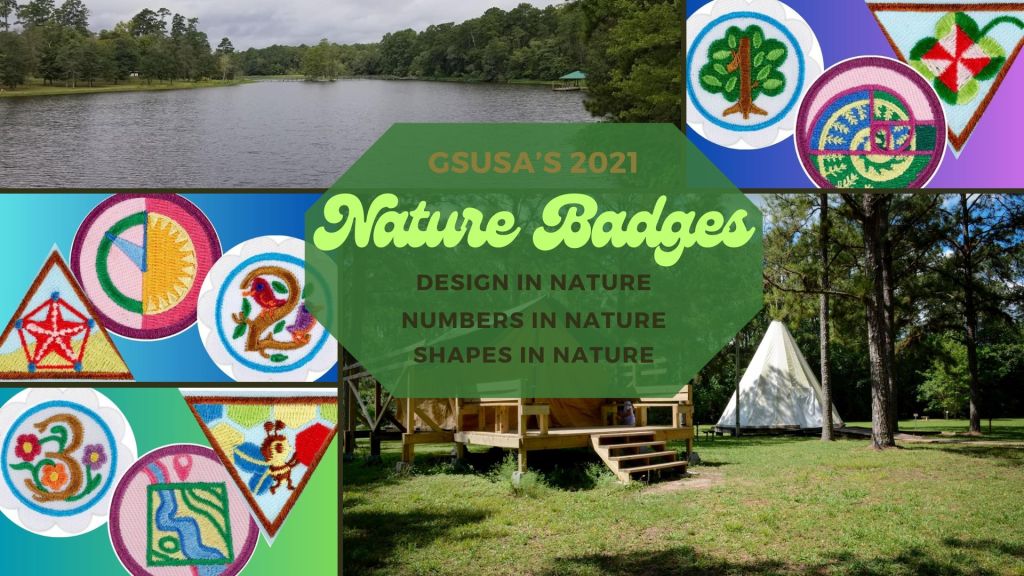
2021 Nature Badges
Which level are you interested in?
Daisy
Brownie
Junior
GSUSA released a trio of Nature Badges for Daisy, Brownie, and Junior levels. These look like they are progressive badges (Daisy even has a 1, 2, 3 on their badge images), but they are not. These three are independent and can be earned separately in any order, or earn only one or two of the three. They are simply themed the same way.
Multi Level Meeting Suggestions
When doing them multi level, Numbers and Shapes work well with all three. Design is great with Daisy and Brownie levels but Junior level requirements are pretty different. Here are some outlines for what you can do in a meeting to cover multiple levels:
Numbers in Nature
Brownie/Daisy goes well together. Junior only adds a few more activities.
Brownies do not need to measure shadows, but Daisies don’t need to do a temp experiment, plan a garden, or make a line plot.
Start the meeting by tracing a partner’s shadow with chalk or string. Leave until end of meeting activity. (Part of Daisy R1)
Use leaves to measure with a ruler and with a finger/thumb. Remember to guess what it might be before measuring. (Daisy R2&R3/Brownie R2)
Take the data from leaf measuring to make a Line Plot. (Brownie R3)
Show them how much room seeds need to grow, and have them plan a garden with a specific space. (Brownie R4&R5)
Make a calendar that shows how to tell when the seasons change. (Brownie R1)
End the meeting by tracing a partner’s shadow with chalk or string from the same spot as earlier. Compare the two shadows. (End of Daisy R1)
Daisy and Brownie levels earned!
Juniors do not need most of the Brownies but plotting the garden goes along with their requirement to find perimeter and area of a space. Junior’s human sundial works perfectly with Daisy’s shadow requirement.
Start the meeting by tracing a partner’s shadow with chalk or string. Mark the time of when you traced. Compare the height of everyone’s shadow compared to their own height to learn that shadows are proportional to what makes the shadow. Leave until end of meeting activity. (Junior R4 and Part of Daisy R1 & Junior R1)
Use leaves to measure with a ruler and with a finger/thumb. Remember to guess what it might be before measuring. (Daisy R2&R3/Brownie R2)
Take the data from leaf measuring to make a Line Plot. (Brownie R3)
Show them how much room seeds need to grow, and have them plan a garden with a specific space. Make sure you calculate the perimeter and area. (Brownie R4&R5 and Junior R5)
Make a calendar that shows how to tell when the seasons change. (Brownie R1)
Measure the circumference of a tree to figure out it’s age. (Junior R3)
Make a weather tracking device – a DIY weather station, barometer, or tracking nature clues over time. (Junior R2)
End the meeting by tracing a partner’s shadow with chalk or string from the same spot as earlier. Compare the two shadows. (End of Daisy R1 and Junior R1)
NOTE: It may take two meetings to do both Brownie and Junior. In one meeting, your main activity can be planning the garden and making the weather station. The other can be outdoors tracing shows, measuring leaves, and measuring the circumference of a tree.
Daisy, Brownie, and Junior levels earned!
Shapes in Nature
Brownie/Daisy goes well together. Junior only adds a few more activities.
Brownies draw tessellations which covers a Daisy level requirement. The Brownie category tally covers the other 2 Daisy level requirements.
Make a foldable with 4 categories (like animals, plants, bugs, and rocks) to tally the things you see. (Daisy R1&R3 and Brownie R1)
Use the data from the 4 categories to make a graph (bar graph, pie chart, or word cloud). (Brownie R2)
Make a spiderweb craft of some kind. (Brownie R3)
Draw tessellations (patterns without space) from objects (leaves or kitchen items) or make them with different colors of paper/fabric. (Daisy R2 and Brownie R4)
Track and tally how many birds of each type you see and then make something (a data table, a play, or a citizen science project submission). (Brownie R5)
Daisy and Brownie levels earned!
Juniors do not need to bird watch or measure like Brownies, and Brownies do not need to learn the Fibonacci sequence. Juniors do need to learn symmetry and symmetrical art, and Brownies learn patterns and make tessellation art.
Make a foldable with 4 categories (like animals, plants, bugs, and rocks) to tally the things you see. (Daisy R1&R3 and Brownie R1)
Use the data from the 4 categories to make a graph (bar graph, pie chart, or word cloud). (Brownie R2)
Track and tally how many birds of each type you see and then make something (a data table, a play, or a citizen science project submission). (Brownie R5)
Make a spiderweb craft of some kind, explaining about radial patterns. (Brownie R3 and Junior R3)
Learn the Fibonacci sequence and understand it makes a spiral and then find spirals in nature and draw, act, or chart your findings. (Junior R5)
Look for fractals in nature and either track them or recreate them (draw, press into clay, make 3D art with pie cleaners and beads, etc.) (Junior R4)
Learn about symmetry and draw something like butterfly wings that have natural symmetry. (Junior R1)
Draw tessellations (patterns without space) from objects (leaves or kitchen items) that have symmetry. (Daisy R2, Brownie R4, and Junior R2)
NOTE: It may take two meetings to do both Brownie and Junior. In one meeting, you can go outside to do the 4 categories and bird watching and the fractals craft. The second meeting can be doing the spiderweb craft and learning the Fibonacci sequence, and then the symmetry and tessellation craft.
Daisy, Brownie, and Junior levels earned!
Design in Nature
Brownie/Daisy goes well together. Junior is a completely different badge.
Brownies don’t need the map Daisies make, but Daisies don’t need to build a bird feeder or explore beehives.
Pick something (trees, pets, snakes) and calculate the age (tree rings, dog years, length of snake) of several subjects. Use tally marks to hit the Daisy level requirement too. (Daisy R2 and Brownie R1)
Draw a diagram (a hexagon, bee hotel, or hive) and scale it (hexagon becomes a stick hexagon you can stand in, bee hotel can be built from the diagram, and hive should have 3 honey boxes, 10 frames each and each frame holds 5 pounds of honey… and they figure out how many pounds that is and how many could fit in a jar you have). (Brownie R2)
Pick a type of bird feed (seeds, nectar, or something else) and make a feeder (seed feeder, nectar feeder, or unique design). (Brownie R3)
Make bird feed (nectar ingredients, different seeds to make a mix, or a standard feed you need to fill multiple feeders with) and calculate the ratios (sugar to water, how many of each seed, or how much feed for each feeder). (Daisy R1 and Brownie R4)
Make a bar graph from data you get from birds (how much food they eat each day, how many birds you see, or how much food eaten at different locations) (Brownie R5)
Draw a map (place, neighborhood, place with sounds) and include landmarks and a legend (for sounds or objects) then choose a start and end point, draw lines from start to finish including all the stops. (Daisy R3)
Daisy and Brownie levels earned!
Junior level has almost completely different requirements from Daisy & Brownie. Only using the Daisy made map to find a trail you can hike 3 hours on would possibly be a match up.
Do all the Daisy Brownie steps and then all the following to earn the Junior level in addition to Daisy/Brownie.
Walk a quarter mile while timing yourself and either calculate how much time it would be for a mile, 60 minutes, or 3 hours OR time it again doing a different pace (skipping, walking backward, etc) and then calculate a mile for both paces. Alternatively you can compare different speeds of animals and how some are fast for short distance and others long distances and which animal would win different kinds of races.
Knowing how fast you can go in 3 hours in Step 1, find a trail that would fit on a map from the GSUSA booklet, a local map, or a map from far away.
Choose three points on a map (one from the GSUSA booklet, a topographic map of your area, or one from anywhere in the world) and find their elevations, graph them, and find the elevation change between each point.
When planning an outing take the snack/treat or lunch and calculate how much of it you need for everyone attending, the amount of ingredients you need to feed everyone going, or how many batches of a recipe would be needed for one portion for everyone.
Calculate the volume by measuring something (backpack, vehicle, or tent) and an object to go inside it (supplies, people and gear, or sleeping area) and then see if everything needed will fit as calculated.
Junior level earned!
–
For More Fun Ideas and Plans
for Daisy, Brownie, and Junior Scouts
Join the Girl Scout Daisy, Brownie, and Junior Leader Help Facebook Group
(Not an official GSUSA Group)

This is a supportive community for Cadette, Senior, and Ambassador Girl Scout leaders. This group offers solutions to keep older scouts engaged in scouting amidst their busy lives. Share strategies, tackle challenges, and exchange ideas for fun, meaningful activities that resonate with teens and build lasting connections.
Find out how you can support The Badge Archive!
–
- Return to the Daisy Badge List.
- Return to the Brownie Badge List.
- Return to the Junior Badge List.
–


 The Badge Archive