When the Girl Scout program underwent its massive “Four Program Levels” overhaul in 1963, the Senior level (ages 14–17) received a unique structural change. While Juniors and Cadettes focused heavily on earning new proficiency badges, the Senior program was designed to be more flexible and adult-like.
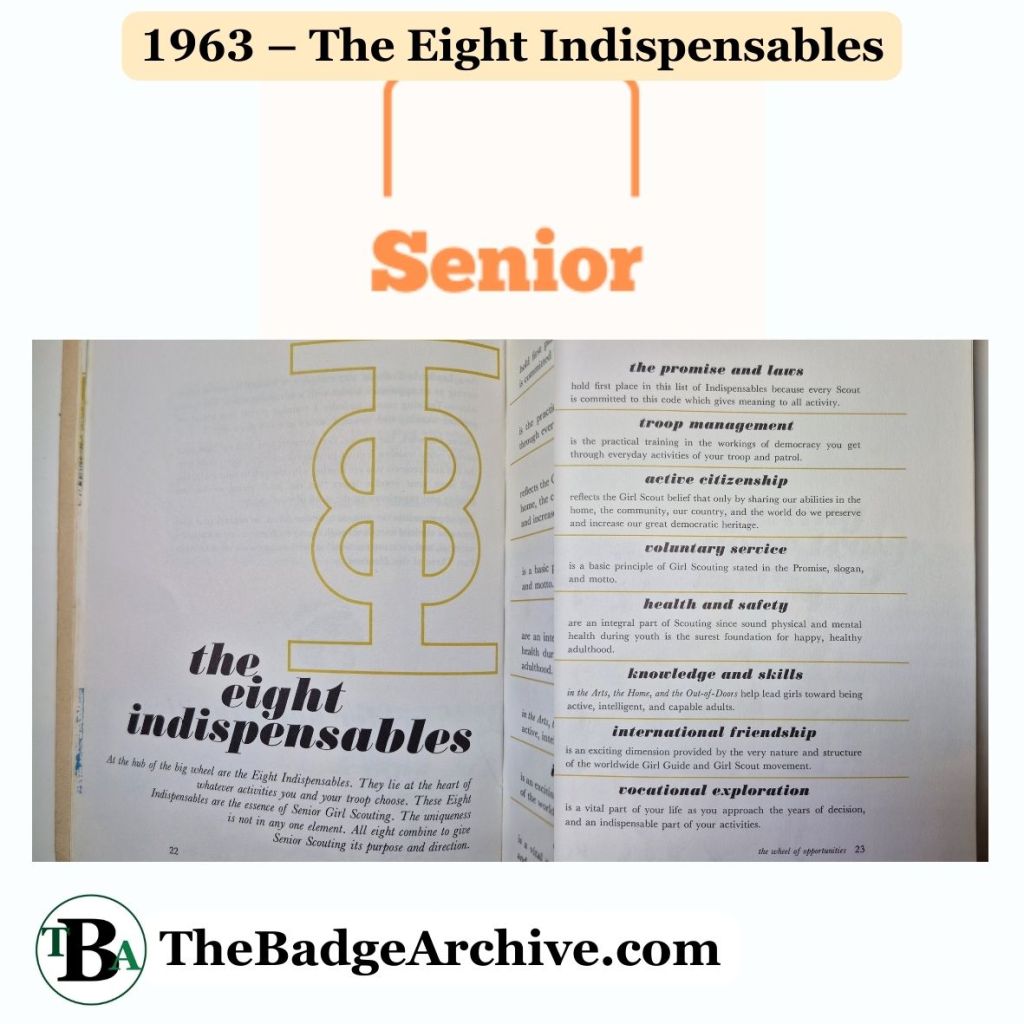
The 1963 Handbook introduced the Eight Indispensables. These eight elements were the “essence of Senior Girl Scouting.” They were:
- The Promise and Laws
- Troop Management
- Active Citizenship
- Voluntary Service
- Health and Safety
- Knowledge and Skills (specifically in the Arts, the Home, and the Out-of-Doors)
- International Friendship
- Vocational Exploration
Why They Used These
The 1963 Senior Girl Scout Handbook (pages 22–23) explicitly used the metaphor of a “Big Wheel” to explain this concept. The Eight Indispensables formed the “hub” of the wheel. They were the central, non-negotiable core of the program. The Senior Interest Patches (like Mariner, Trailblazer, or International Friendship) were the “spokes” radiating out from the hub.
The logic was that a Senior troop could specialize in any interest (e.g., becoming a Mounted troop), but they still had to maintain the “hub.” A troop of horse riders (Mounted interest) still had to practice Active Citizenship, ensure Health and Safety, and explore Vocational opportunities within that field. The Indispensables ensured that no matter how specialized a troop became, they remained grounded in the broader Girl Scout mission.
How They Used These
Unlike the specific “do X to get Y” requirements of Junior badges, the Eight Indispensables were used as a planning and evaluation tool. There was a specific patch for this, featuring a stylized letter “I” superimposed over the number “8.”
The patch was not earned by an individual checking off a list alone. Instead, it was often awarded annually by a vote of the troop. The girls would evaluate their year’s work to see if their activities had adequately covered all eight areas. If the troop agreed they had met the “Indispensable” standards, the members received the patch.
A troop focusing on the Arts Interest Patch might fulfill the “Vocational Exploration” Indispensable by visiting a graphic design firm, or fulfill “Service” by teaching art to younger children.
Why They Stopped Using Them
The Eight Indispensables remained the core of the Senior program from 1963 until 1974.
In 1974, GSUSA released a new publication called Senior Girl Scout Options. The new program focused on “Process” and individual paths (Campus Girl Scouts, Leader-in-Training) rather than a unified troop “hub.” This was intended to transition the program away from the rigid structure of the 1960s, but it is widely regarded as a misstep. Attempting to appeal to the “mod” culture of the 1970s, the book featured activities (such as “Mysterious Musical Mood”) that many high schoolers found childish and condescending.
Because the new Options book lacked the maturity and clear direction of the previous program, many troops simply ignored it, continuing to rely on the trusted 1963 Senior Girl Scout Handbook and the “Eight Indispensables” well into the late 1970s.
It wasn’t until the “Worlds to Explore” era fully arrived around 1980 that a successful replacement was established. This new framework introduced the Interest Projects (IPs) that many grew up with in the 80s and 90s, finally retiring the Indispensables for good.
–
For More Fun Ideas and Plans

Join the Girl Scout Daisy, Brownie, and Junior Leader Help Facebook Group
(Not an official GSUSA Group)

Join the Girl Scout Cadette, Senior, and Ambassador Leader Help Facebook Group
(Not an official GSUSA Group)

See other Recommended Facebook Groups for some Scouting Organizations
(No official Groups)
–
Click Here -> To see information References:
Disclaimer: The information published on The Badge Archive is built from the references listed below. These sources demonstrate that our content is grounded in facts and research, not opinion or speculation. Readers may consult them directly when looking for additional material.
- Degenhardt, Mary, and Judith Kirsch. Girl Scout Collector’s Guide. Lombard, IL, Wallace-Homestead Book Company, 1987, pp. 106–107, 120–136.
- Johnston, Johanna. Senior Girl Scout Handbook. 1963. Second Impression ed., New York, NY, Girl Scouts of the U.S.A., pp. 22–23, 76–77.
- Robertson, Ann. “Cadette Girl Scouts Turn 60.” Girl Scout History Project, 26 Oct. 2023, gshistory.com/2023/10/26/cadette-girl-scouts-turn-60/. Accessed 17 Jan. 2026.
- Robertson, Ann. “New Exhibit: 50 Years, 4 Levels, 1 Program.” Girl Scout History Project, 8 Oct. 2013, gshistory.com/2013/10/08/new-exhibit-50-years-4-levels-1-program/. Accessed 19 Jan. 2026.
- Robertson, Ann. “Senior Interests, Then and Now.” Girl Scout History Project, 26 Oct. 2023, https://gshistory.com/2020/01/17/girl-scout-senior-interest-troops/. Accessed 19 Jan. 2026.
- Women’s History and Cultural Center. “Girl Scouts Through the Years: 1960-1971.” WHCC, 13 Aug. 2025, womenshistoryandculturalcenter.org/girl-scouts-through-the-years/. Accessed 19 Jan. 2026.
–
- Find out how you can support The Badge Archive!
Short Link: https://tinyurl.com/eh4ra4c5



 The Badge Archive