While the 1963 program overhaul is often the most talked-about shift in Girl Scout history, a significant and often overlooked update occurred just three years prior. In 1955, the Senior Girl Scout program (for girls ages 14–17) received Senior Interest Patches.
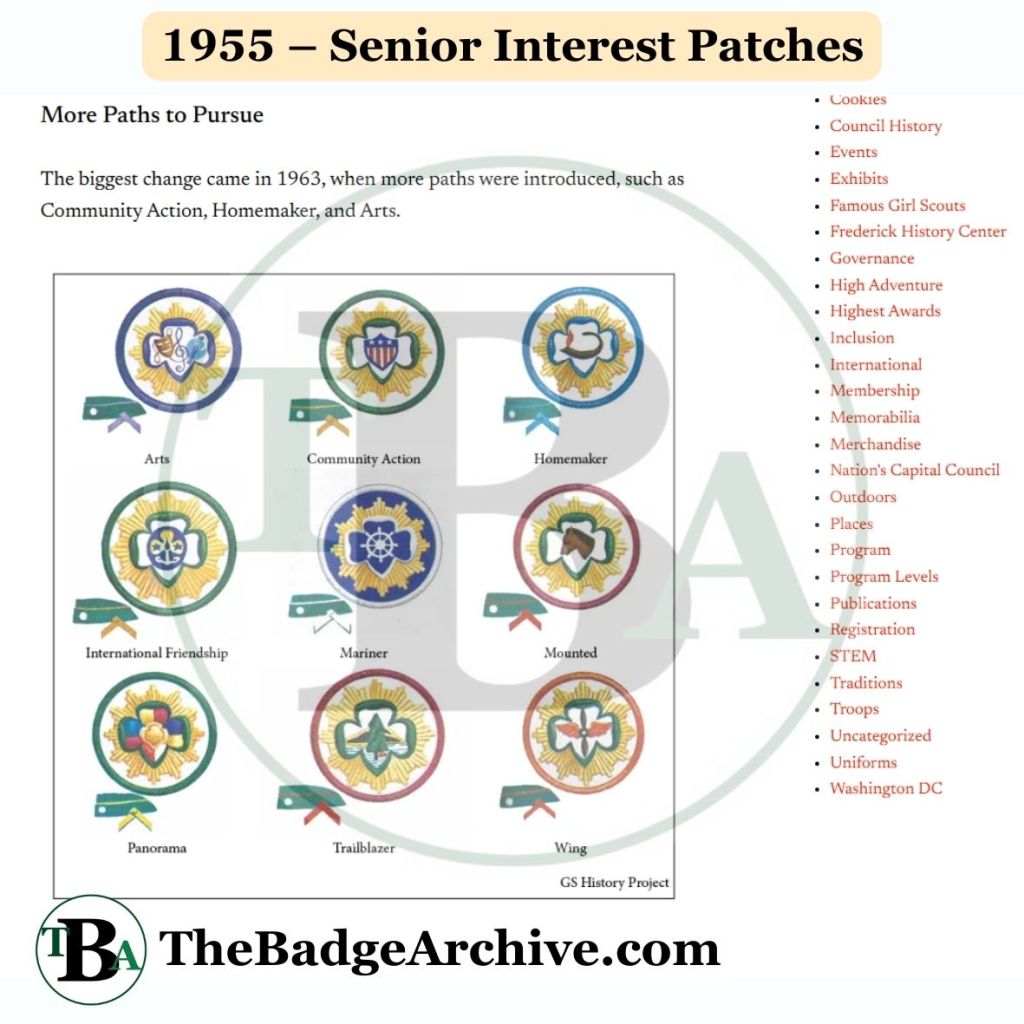
Originally introduced in 1955 as large 3-inch emblems, the 1960 update shrank these patches to a more streamlined 2 1/4-inch size to fit better on the new, sharper two-piece Senior uniform introduced the same year.
1955–1963: Seniors selected an interest patch as their primary focus (e.g., Trailblazer). Sometimes called The “Lost” Era, as it bridged the gap between the specialized “Service Aide” programs of the 1950s and the “Four-Level” expansion that would arrive in 1963.
1963–1974: The program was restructured around a new core called the “Eight Indispensables” (Promise & Laws, Service, Troop Management, etc.). However, girls still wore the Senior Interest Patches to show their specific area of concentration.
Patch Collection
Unlike the proficiency badges earned by Intermediates (later Juniors and Cadettes), Senior Interest Patches were not earned individually by a single girl. Instead, a Senior troop selected an area of interest to focus on for the year. Every member of the troop wore the patch corresponding to that chosen interest, similar to a Troop Crest.
The available Interest Patches included the following specific areas. Not all were available as they tried out different ones.
- Arts – (1963–1974) Represented by a palette and brush symbol (Lavender border/tie).
- Community Action – (1963–1974) Focused on civic engagement and local service (Gold border/tie).
- Homemaker – (1963–1974) Focused on domestic skills and hospitality (Turquoise border/tie).
- International Friendship – (1963–1974) Focused on global awareness and WAGGGS relationships (Gold border/tie).
- Mariner – (1960–1974) For troops specializing in water activities and sailing (Blue border/White tie).
- Mountaineer – (1955–1960) For troops specializing in mountain climbing, high-altitude hiking, and survival skills in mountainous terrain (Green border/Red tie). Note: While “Trail Blazer” focused on general camping and woodcraft, “Mountaineer” was for more rugged, high-adventure terrain.
- Mounted – (1955–1974) For troops specializing in horsemanship (Green border/Red tie).
- Panorama – (1963–1974) For troops who wanted to explore a variety of interests rather than specializing in just one (often called the “Rainbow Trefoil”) and replaced the General Interest / Multi-Interest name. (Green border/Yellow tie).
- Trailblazer – (1955–1974) For troops specializing in camping and outdoor survival (Green border/Red tie).
- Wing – (1955–1974) For troops specializing in aviation and flight (Orange border/tie).
- General Interest / Multi-Interest – (1958–1963) A patch featuring the standard trefoil, introduced specifically for troops who wanted to explore a variety of topics rather than specializing in just one (Green border/tie).
All were embroidered on white twill, until the Mariner patch was changed to blue twill in 1960. The original 3-inch patches were all green bordered. The 1960 smaller patches had different borders: General (green), Explorer (green), International Friendship (green), Mariner (yellow), Mounted (light green), Trail Blazer/Mountaineer (red), and Wing (orange). The different colored borders and ties continued in the 1963 handbook.
How They Were Worn
These patches were worn on the Senior Girl Scout uniform, which in 1960 transitioned to a two-piece distinct green suit.
- Hat Cords: The program used color-coded hat cords (ties) to match the interest patch. For example, a girl in a “Wing” troop wore an orange tie, while a girl in a “Mariner” troop wore a white tie.
- Aide Bars: In addition to these interest patches, Senior Scouts could earn “Aide” bars (Library Aide, Child Care Aide, Hospital Aide, etc.) for individual service, which were worn on the pocket.
The 1963 Transition
This specific set of 2 1/4-inch patches was short-lived. In 1963, the entire Girl Scout program was reorganized into four age levels (Brownie, Junior, Cadette, Senior). While the Senior level kept the “Interest Patch” concept, the designs were updated again, and the “Eight Indispensables” (a patch featuring an “I” over an “8”) became the core foundation of the Senior program, replacing the 1960 system.
–
For More Fun Ideas and Plans

Join the Girl Scout Daisy, Brownie, and Junior Leader Help Facebook Group
(Not an official GSUSA Group)

Join the Girl Scout Cadette, Senior, and Ambassador Leader Help Facebook Group
(Not an official GSUSA Group)

See other Recommended Facebook Groups for some Scouting Organizations
(No official Groups)
–
Click Here -> To see information References:
Disclaimer: The information published on The Badge Archive is built from the references listed below. These sources demonstrate that our content is grounded in facts and research, not opinion or speculation. Readers may consult them directly when looking for additional material.
- Degenhardt, Mary, and Judith Kirsch. Girl Scout Collectors’ Guide. Lombard, IL, Wallace-Homestead Book Company, 1987, pp. 106–107.
- Girl Scouts of the Nation’s Capital. “Spotlight on Senior Girl Scouts.” Girl Scout History Project, 19 Apr. 2023, gshistory.com/2023/04/19/spotlight-on-senior-girl-scouts/. Accessed 17 Jan. 2026.
- Johnston, Johanna. Senior Girl Scout Handbook. 1963. Second Impression ed., New York, NY, Girl Scouts of the U.S.A., pp. 76–77.
- Robertson, Ann. “Senior Interests, Then and Now.” Girl Scout History Project, 17 Jan. 2020, gshistory.com/2020/01/17/girl-scout-senior-interest-troops/. Accessed 17 Jan. 2026.
- Women’s History and Cultural Center. “Girl Scouts Through the Years: 1960-1971.” WHCC, 13 Aug. 2025, womenshistoryandculturalcenter.org/girl-scouts-through-the-years/. Accessed 19 Jan. 2026.
- Girl Scout Museum. “Senior Girl Scout Uniforms and Insignia 1960-1971.” Vintage Girl Scout Online Museum, http://www.vintagegirlscout.com. Accessed 24 Mar. 2023.
–
- Find out how you can support The Badge Archive!



 The Badge Archive